

Let’s be honest, finding the best ebike for city commuting is about more than just having fun. It's a smart play for a faster, cheaper, and way more enjoyable trip to work. The right e-bike is your personal, on-demand express lane, letting you glide past traffic and turn frustrating gridlock into time you actually get back in your day. Think of this guide as your practical roadmap—it’s here to help you make a choice that will genuinely make your daily life better.
Why an E-Bike Is Your Best Commuting Upgrade
Are you tired of staring at the bumper in front of you? Fed up with packed subways and the endless hunt for a parking spot? You're definitely not alone. The daily commute is often the most stressful part of the day, a constant fight against delays and crowds. But what if you could just… opt-out? An electric bike is a powerful way to do just that, turning your journey from a headache into a highlight.
Picture this: you're breezing past rows of stopped cars, feeling the fresh air, and showing up to work energized instead of drained. That's the real magic of an e-bike. It’s not about replacing your workout; it's about upgrading your transportation entirely. The electric assist makes hills feel flat and headwinds vanish, so you can get where you're going on time without needing a second shirt.
The Shift From Niche Hobby to Mainstream Transport
What used to be a niche gadget has quickly become a go-to commuting tool, and it's completely changing how people get around their cities. This isn't just some passing trend; it's a real shift driven by benefits that save you both time and money. The proof is in the numbers.
This surge in popularity has kicked the e-bike market into high gear. In the United States alone, the market was valued at $2.2 billion and is expected to grow by about 7.9% annually, largely thanks to everyday riders ditching their cars for short trips. Globally, the market is already a massive $32 billion industry and is on track to hit $51 billion by 2029. That's a clear signal that commuters want practical, reliable e-bikes, not just weekend toys. You can find more data on this market explosion over at GM Insights.
An e-bike gives you the best of both worlds: the exercise and fresh air of a traditional bike, plus the speed and efficiency of a motorized vehicle. It neatly solves the biggest problems with bike commuting—hills, long distances, and the fear of showing up to a meeting drenched in sweat.
Your Ideal Commuter E-Bike Profile at a Glance
Before we dive deeper, here’s a quick snapshot of what you should be looking for. This table breaks down the essentials for a great city commuter e-bike, helping you focus on what really counts.
| Feature | Why It Matters for Urban Riding | Key Spec to Look For |
|---|---|---|
| Range | Enough juice to get you to work and back without anxiety. | At least 20-40 miles on a single charge. |
| Motor & Speed | Power to flatten hills and keep pace with city traffic. | Class 1, 2, or 3 (up to 28 mph); 500W-750W motor. |
| Weight & Frame | Easy to carry up stairs and maneuver in tight spaces. | Under 65 lbs; step-through or step-over frame. |
| Brakes & Tires | Crucial for safe stopping in unpredictable traffic. | Hydraulic disc brakes; puncture-resistant tires. |
| Cargo & Comfort | Ability to carry your gear without a sweaty backpack. | Integrated racks, fenders, and an upright riding position. |
| Security | Peace of mind when you have to park it on the street. | Removable battery; built-in locking features. |
Getting these features right means your e-bike won't just be a purchase; it'll be a seamless part of your daily routine.
Reclaiming Your Commute and Your Wallet
Opting for the best e-bike for city commuting is an investment in your sanity and your bank account. Take a second to add up what your current commute costs: gas, public transit passes, parking fees, and car maintenance. It adds up fast. An e-bike can slash—or even get rid of—those expenses entirely.
Here’s a quick look at the advantages you’ll gain:
- Predictable Arrival Times: No more being late because of a sudden traffic jam or a delayed train. Your travel time becomes reliable, day in and day out.
- Reduced Stress: Swapping a cramped, noisy bus for a ride in the open air makes a huge difference in your mental well-being. You’ll start and end your workday on a much better note.
- Integrated Exercise: You’re still pedaling, so you’re getting low-impact physical activity. The best part? You decide how much effort to put in.
Getting to Know Your E-Bike's Engine and Fuel Tank
Choosing the right e-bike for your city commute is a lot like buying a car. You wouldn't just grab the first one you see without peeking under the hood, right? You’d want to know about its engine and how far it can get you on a full tank.
For an e-bike, the motor is your engine, and the battery is your fuel tank. Nail this combination, and you’ll have a reliable ride that never leaves you stranded.
The Two Flavors of E-Bike Motors
Let's start with the "engine." E-bike motors generally come in two main types, and each offers a totally different feel, especially when you're navigating the stop-and-go rhythm of city traffic.
The most common you'll find is the hub-drive motor, which sits right in the hub of the front or rear wheel. Think of it as a direct push from behind. When you hit the throttle or start pedaling, the motor spins the wheel for you, delivering an immediate surge of power. It's fantastic for getting a quick jump when the traffic light turns green.
Your other option is a mid-drive motor. This one is located right in the middle of the frame where your pedals are. Instead of spinning the wheel directly, it adds power to the chain and gears—the same drivetrain you power with your legs. The feeling is incredibly natural, almost like you've suddenly developed superhuman strength. It’s also super efficient on hills because it can use the bike’s gears to its advantage, just like you do.
- Hub-Drive Feel: A powerful, instant kick. Great for quick acceleration.
- Mid-Drive Feel: A smooth, amplified version of your own pedaling. Perfect for climbing and efficiency.
For most city riders, a strong hub-drive motor is the perfect sweet spot. It gives you that on-demand power and simplicity you need to confidently weave through busy streets.
What Battery Specs Actually Mean for Your Commute
Now, let's talk about the "fuel tank"—the battery. You'll see specs thrown around like Volts (V) and Amp-hours (Ah), but the number you really want to focus on is Watt-hours (Wh). This is the true measure of your battery's total capacity. More Watt-hours simply means you have more fuel in the tank.
Think of it this way: Volts are like the water pressure in a hose, and Amp-hours are like the size of the water tank. Watt-hours (Volts x Amp-hours) tells you the total amount of water you can actually spray.
So what does a number like 672Wh mean in the real world? It’s all about range and convenience. A bigger battery doesn't just let you ride farther; it means you can go all week on your 5-mile round-trip commute without plugging in every single night. The infographic below highlights a few of the other perks that make e-bikes such a smart investment for city life.
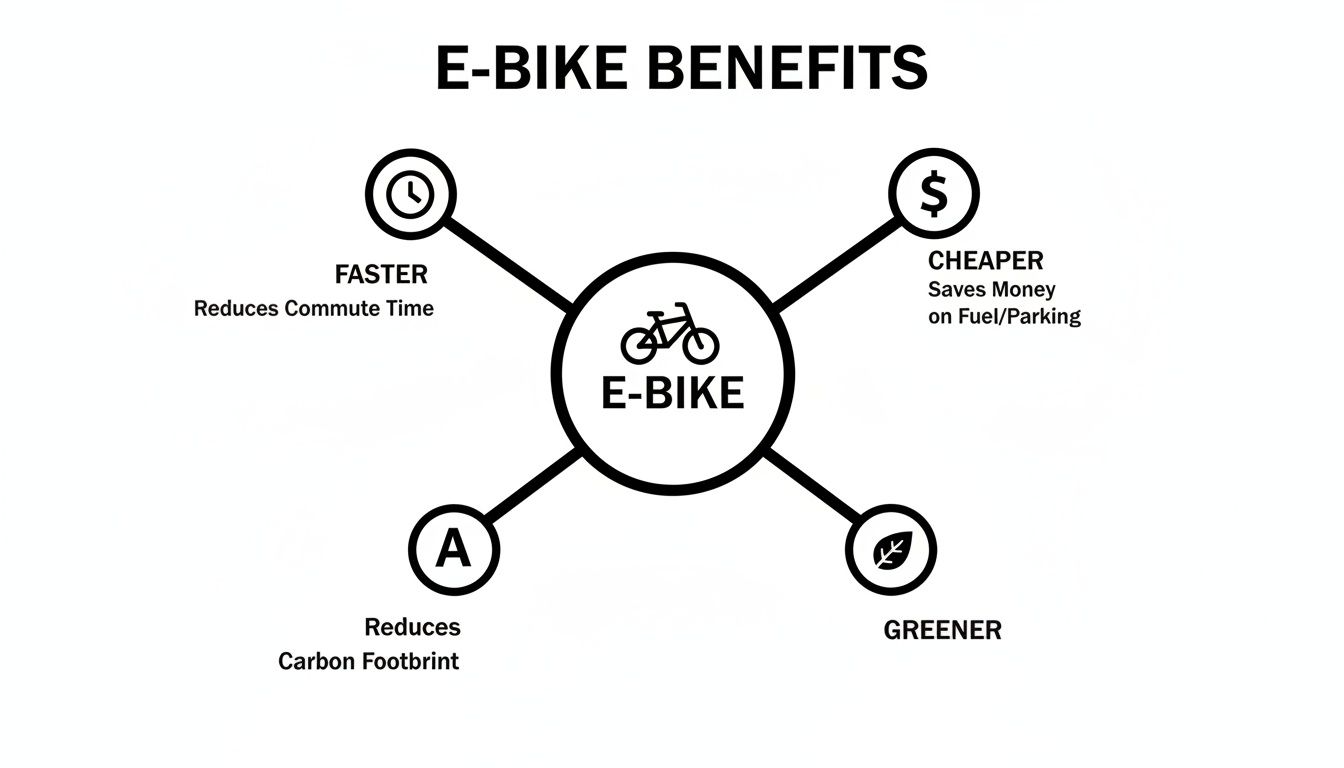
As you can see, getting from point A to B becomes faster, cheaper, and a whole lot greener. That’s why matching the right motor and battery to your daily ride is so crucial.
Why Your Actual Mileage Will Vary
The advertised range on an e-bike is a best-case scenario, kind of like the MPG sticker on a new car. Your real-world mileage will always depend on a few key things:
- Your Weight and Cargo: The more weight the motor has to move, the more energy it uses.
- Terrain: Hills are the real battery-killers. Cruising on a flat bike path uses way less juice than grinding up a steep incline.
- Pedal Assist Level: Riding on the highest power setting feels amazing, but it will drain your battery much faster.
- Stopping and Starting: City traffic is tough on batteries. Just like a car, constant acceleration from a dead stop eats up more energy than holding a steady speed.
Keeping these factors in mind helps you avoid "range anxiety." If your commute ends with a massive hill, you’ll want to make sure your bike has enough battery to power through without you worrying.
To dig deeper into this, our detailed electric bike buying guide has even more tips. Getting the motor and battery right from the start is what makes an e-bike a joy to ride, not a source of stress.
The Essential Features for a City-Ready E-Bike
While the motor and battery get all the glory, a handful of other features truly make or break an e-bike in an urban jungle. These are the components that handle safety, comfort, and real-world practicality. Think of them as the non-negotiables that separate a good bike from the best ebike for city commuting—the ones that ensure your ride is ready for whatever the city throws at you.
Nailing these details means your bike will feel less like a machine you're operating and more like a natural part of your commute. From slamming on the brakes in traffic to navigating slick streets after a downpour, these are the features that give you real confidence and control.
Stopping Power Is Your Top Priority
City riding is unpredictable. A car door swings open, a pedestrian darts into the street, a light changes without warning. In those split-second moments, your ability to stop on a dime is everything. This is why your brakes are arguably the single most important safety feature on your e-bike.
For this reason, hydraulic disc brakes are the undisputed champion for any serious city commuter. Unlike older mechanical or rim brakes, they deliver consistent, powerful stopping performance in all conditions, rain or shine. They also require a much lighter touch, giving you finer control when you need it most.
When you're cruising at 20 mph next to city traffic, having brakes that bite instantly isn't a luxury—it's a necessity. Hydraulic disc brakes give you the peace of mind to ride defensively and react to hazards with total control.
Tires and Frame Geometry Matter More Than You Think
Your tires are your only connection to the road, and let's be honest, city streets can be a minefield. Potholes, broken glass, and random debris are just part of the landscape. That's why puncture-resistant tires are a must. They save you the headache and hassle of fixing a flat on your way to a meeting.
Just as critical is the bike's frame and your riding posture. A proper city e-bike should put you in a comfortable, upright riding position. This isn't just about avoiding back pain; it's about visibility. Sitting upright gives you a commanding view over cars, helping you see and anticipate what's happening far ahead. It makes you a more aware and safer rider. Step-through frames are also a fantastic choice, making it a breeze to hop on and off in stop-and-go traffic.
Must-Have Accessories for Daily Use
The best urban e-bikes come ready for the daily grind right out of the box. You shouldn’t have to spend a ton of extra cash on add-ons just to make your bike functional. These built-in accessories are what truly equip a bike for city life.
Here's what to look for:
- Integrated Lights: Front and rear lights wired directly into the bike’s main battery are a game-changer. You never have to worry about them dying or getting stolen. They’re crucial for being seen at dawn, dusk, and at night.
- Full-Coverage Fenders: Hitting one puddle without fenders is enough to teach you this lesson for life. That muddy stripe up your back is not a good look. Fenders keep you and your clothes clean and dry, making it practical to ride in less-than-perfect weather.
- A Sturdy Rear Rack: A rack is your best friend for hauling a laptop bag, groceries, or a change of clothes without turning your back into a sweaty mess. It makes your ride more comfortable and keeps the bike's center of gravity low and stable.
These elements all work together to create a machine that just works for commuting. The pedal assist system does the heavy lifting, while these features handle the day-to-day realities of urban travel. To get a better sense of how the motor helps you out, it's worth learning what pedal assist on an e-bike is and how it transforms your ride. A great city e-bike integrates all of this into one reliable, cohesive package.
Putting It All Together with the UGBEST MB750
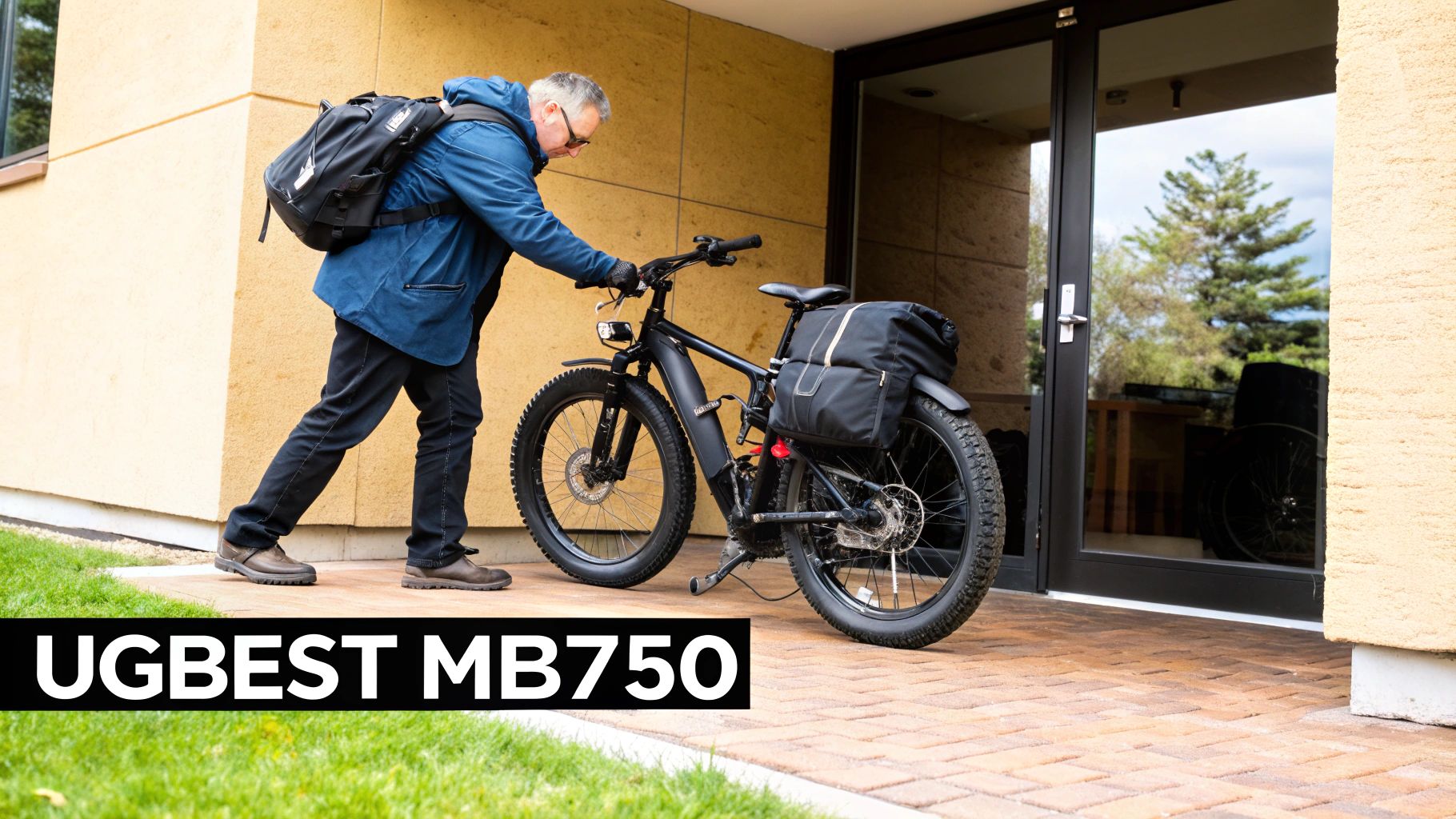
Theory and checklists are great, but everything clicks when you see how those key features come together in a real-world bike. The UGBEST MB750 is a perfect example of this, showing how the right components can create one of the best e-bikes for city commuting you can get. It’s not about ticking off boxes on a spec sheet; it's about how all those parts work together to solve the real problems you'll face on city streets.
Let's start with the heart of the bike—its powerful 750W motor. In the city, this isn't about hitting top speed. It's about quick, confident acceleration. When a light turns green, you need to get ahead of traffic, not get stuck in it. This motor gives you that instant torque, which is a huge safety advantage at intersections. It also flattens out those steep overpasses and the last killer hill before you get home, making sure your ride is always low-stress.
Power and Practicality for the Daily Grind
A strong motor is nothing without a solid "fuel tank." The MB750's high-capacity battery is all about convenience. Instead of getting range anxiety on a single trip, you can start thinking in terms of how many round-trip commutes you can knock out. For someone with a five-mile ride to work, this bike has enough juice for several days of travel on just one charge.
That kind of battery life means you aren't chained to an outlet every single night. You just get on and ride. This combo of on-demand power and multi-day range is what turns an e-bike from a cool gadget into a truly dependable vehicle.
The real value of a commuter e-bike emerges when it seamlessly replaces car trips without adding complexity to your routine. A bike that can handle a full work week's worth of short commutes on one charge isn't just convenient—it's a fundamental shift in how you manage your daily travel.
Of course, city riding is about more than just a good powertrain. Urban streets are notoriously rough, full of potholes, slick manhole covers, and cracked pavement. The UGBEST MB750 tackles this with a tough frame and all-terrain fat tires. Those wide tires are like a built-in suspension system, soaking up bumps and giving you a stable, confident grip when the surface gets unpredictable.
Throw in a set of responsive hydraulic disc brakes, and you have total control. You can stop on a dime in dry weather or slow down safely on a rain-slicked road. These are the features that give you genuine peace of mind during a chaotic rush hour.
A Complete and Reliable Commuting Package
Thinking about long-term ownership, a city e-bike needs to be a smart investment. The best ones strike a balance between performance and value, easily beating the cost of owning a car. Good, reliable models usually fall in the $1,200–$1,800 range. Plus, studies suggest that swapping a car for an e-bike can save you $2,000–$3,000 per year on gas, insurance, and parking. You can dig into the numbers and see for yourself if e-bikes are worth it for your budget.
This is where a bike like the UGBEST MB750 really proves its worth. It arrives 85-90% assembled, so you don't need to be a mechanic to get it on the road. Better yet, it's backed by a 12-month limited warranty and comes with free U.S. shipping, which gets rid of some of the biggest hurdles to buying online.
To see exactly how these features translate to your daily ride, check out the table below. It breaks down common commuting headaches and shows how the MB750 is built to solve them.
How the UGBEST MB750 Solves Common Commuting Challenges
| Urban Commuter Problem | The UGBEST MB750 Solution | Benefit for Your Ride |
|---|---|---|
| Getting stuck behind cars at traffic lights | 750W motor with instant torque | Quick, safe acceleration to get ahead of traffic and feel more confident. |
| Steep hills or overpasses on the route | High-torque motor and multi-gear system | Effortlessly climb any incline without breaking a sweat or losing momentum. |
| Rough pavement, potholes, and unpredictable surfaces | All-terrain fat tires and a robust frame | A smoother, more stable ride that absorbs bumps and improves grip. |
| The daily hassle of charging the battery | High-capacity battery | Ride for multiple days on a single charge, making it a true grab-and-go vehicle. |
| Needing to stop suddenly in traffic or wet weather | Responsive hydraulic disc brakes | Powerful, reliable stopping power you can count on in any condition. |
| The high cost of car ownership (gas, parking, etc.) | An affordable e-bike with no fuel costs | Significant yearly savings and a more enjoyable, stress-free way to get to work. |
| Complicated assembly and concerns about support | 85-90% pre-assembled, free shipping, and a 12-month warranty | An easy setup process and the peace of mind that comes with reliable customer support. |
Ultimately, it’s this complete package—from raw power to practical support—that makes the UGBEST MB750 a standout choice for anyone serious about upgrading their city commute.
Staying Legal and Keeping Your E-Bike Safe
Finding the perfect city e-bike is only half the battle. Once you have it, you need to know the rules of the road and how to protect your investment from disappearing. A little bit of know-how here goes a long way toward a stress-free ride every single day.
And people are riding a lot these days. E-bikes are quickly becoming the go-to choice for daily transportation, and the numbers don't lie. Major bike-share programs are seeing massive adoption because people can finally rely on them to replace a car or bus trip. According to Lyft’s Multimodal Report, e-bike trips shot up 47% year-over-year in 57 cities. In a place like New York City, the Citi Bike system saw an incredible 45 million trips in just one year. This isn't a fad; it’s a full-blown shift in how we get around our cities. You can dig into these impressive ridership findings for yourself.
First Things First: E-Bike Classifications
Before you hit the pavement, you've got to understand what kind of machine you're riding. Most states use a simple three-class system to regulate e-bikes, which dictates how fast they can go with assistance and where you can legally ride them.
- Class 1: The motor only kicks in when you're pedaling and cuts off at 20 mph.
- Class 2: Features a throttle that can power the bike up to 20 mph without you even pedaling.
- Class 3: This one is also pedal-assist only (like Class 1), but it keeps helping you all the way up to 28 mph. You'll often hear these called "speed pedelecs."
For commuting in the city, a Class 2 or Class 3 bike usually hits the sweet spot. That Class 2 throttle is a lifesaver for getting a jump on traffic when the light turns green. A Class 3's higher speed, on the other hand, helps you keep up with the flow of city traffic, which is a huge safety boost. We break it all down in our guide on the advantages of a Class 2 e-bike.
Always, always check your local laws. Some cities might ban Class 3 e-bikes from bike paths or parks. A quick search on your city’s transportation department website is the best first move you can make.
How to Lock It Up Like You Mean It
Let's be real: an e-bike is a big investment, and to a thief, it’s a shiny, expensive target. That flimsy cable lock you used on your old ten-speed just isn't going to cut it. You need a multi-layered security plan.
Your first and most important line of defense is a serious lock. In a dense urban area, you should be looking at a heavy-duty U-lock or a thick, hardened-steel chain lock. These are worlds tougher to break than a simple cable.
Locking Techniques That Actually Work:
- Frame to Fixture: The golden rule. Always lock the main frame of your bike to something solid that can't be moved, like a dedicated bike rack cemented into the ground.
- Get the Wheels: Use a second cable or another U-lock to secure both your front and rear wheels to the frame. Wheels are easy targets.
- Leave No Room: The less empty space inside your U-lock or between chain links, the harder it is for a thief to fit a tool in there to pry it open. Keep it snug.
Adding Modern Layers of Security
Physical locks are essential, but modern tech gives you even more power to protect your ride. Tiny, hidden GPS trackers let you see your bike's exact location on your phone at all times. If the worst happens, you can lead the police right to it. Some riders use trackers that fit inside the handlebars or seat post, and there are even specially designed Airtag holders that blend in seamlessly.
One final piece of the puzzle is insurance. Your homeowner's or renter's policy might offer some basic coverage, but it's often limited. A dedicated e-bike insurance policy will cover you for theft, damage, and even liability if you're in an accident. When you combine a beast of a lock, a hidden tracker, and a solid insurance policy, you can finally park your bike and walk away with true peace of mind.
Your Personal Commute-Matching Checklist
Alright, we've waded through all the tech specs and features. Now it's time to get personal and figure out which bike actually fits your life. The best city e-bike isn't the one with the biggest motor or the longest range on paper; it's the one that feels like it was made for your specific trip to and from work.
Think of this checklist as a way to diagnose your own needs. A few honest answers here will help you zero in on the perfect ride and avoid buyer's remorse down the road.
Analyze Your Route and Daily Reality
Before you even start browsing, take a hard look at your actual commute. A little recon work now saves you a world of frustration later.
-
What's my exact round-trip distance? Don't guess. Use Google Maps or a similar app to nail down the precise mileage. This is the bedrock for figuring out how much battery range you need. A good rule of thumb is to add a 25% buffer to whatever that number is—that accounts for nasty headwinds, unexpected detours, and the fact that all batteries lose a bit of juice over time.
-
Am I dealing with serious hills? If you’re not sure, drive or walk the route. What feels like a gentle slope in a car can feel like a mountain on a bike. If your commute involves any real climbs, you’ll want to prioritize a more powerful motor (750W is a great benchmark) and make sure the bike has gears. It's the difference between cruising up a hill and grinding your way to the top.
-
What are the road conditions really like? Pay close attention to the pavement. Is it smooth sailing, or are you navigating a minefield of potholes, cracked asphalt, and cobblestones? For rougher city streets, wider, puncture-resistant tires are a must. A bike with front suspension will make your ride even more comfortable, soaking up those bumps so you don’t have to.
Consider Your Cargo and Storage Logistics
An e-bike has to work for you when you're off it, too. Don't forget to think about the practical side of things—where you'll keep it and what you'll be hauling.
-
What do I need to carry every day? Make a quick list of your daily essentials: laptop, a change of clothes, lunch, maybe some gym gear. This will tell you if you need a solid rear rack for pannier bags or a simple front basket. Trust me, ditching the sweaty backpack is a game-changer for your comfort.
-
Where will I store and charge the bike? Get out the tape measure and check your space at home and, if possible, at work. Do you have to haul it up a flight of stairs? If so, the bike's total weight suddenly becomes a huge factor. You also need to make sure you have a convenient power outlet for charging.
The right e-bike feels like a natural extension of your daily routine. It should solve problems, not create new ones. By matching the bike’s capabilities to your specific commute, you're not just buying a product; you're investing in a smarter, easier way to travel.
For a lot of city riders, a well-rounded bike like the UGBEST MB750 ticks these boxes right out of the gate. Its powerful motor is more than ready for hills, the big battery can easily handle most daily round-trips, and its sturdy frame is built for less-than-perfect city pavement. It's a smart, reliable choice designed for the realities of a modern urban commute.
Frequently Asked Questions About Commuter E-Bikes
Even after you've zeroed in on a few top contenders, some last-minute questions always seem to surface. Getting straightforward answers is the final piece of the puzzle before you can start riding with complete confidence. Here are a few of the most common things we get asked by people just starting their city e-bike journey.
How Much Maintenance Does an Urban E-Bike Need?
One of the best things about e-bikes is how simple they are to own. For the most part, you'll care for it just like you would a regular bike. That means keeping the tires inflated, the chain clean and lubed, and giving your brakes a quick check now and then.
The electrical parts? They pretty much take care of themselves. Your main job is just basic battery care—try to keep it out of extreme hot or cold, and don't let it sit dead for weeks on end. When you compare that to the constant oil changes, fluid top-offs, and engine headaches of a car, an e-bike is a breeze.
Can I Actually Ride an E-Bike in the Rain?
Absolutely. Any quality commuter e-bike is built to handle less-than-perfect weather. The important components, like the motor and battery, are sealed up to be water-resistant, so you can pedal through a downpour without frying your ride.
This is where features like full-coverage fenders really prove their worth. They’re a must-have for stopping road grime and water from spraying all over your work clothes. When you combine fenders with a good set of hydraulic disc brakes, which work great even when wet, the best ebike for city commuting becomes a true year-round vehicle.
Think of it like a good rain jacket for your transportation. With the right gear, you don't have to let a little bad weather derail your plans. A well-equipped e-bike ensures your commute is reliable, rain or shine.
Will I Still Get Exercise on an E-Bike?
This is probably the biggest myth out there, and the answer is a huge "yes!" An e-bike doesn't do the work for you; it just gives you a boost. You are still pedaling, your heart is still pumping, and you are absolutely getting a workout.
The real magic is that you control the effort level. You can dial back the assistance for a serious workout on the bike path or turn it up to fly over a nasty hill without showing up to the office looking like you just ran a marathon. It puts you in charge of your fitness.
How Long Does the Battery Take to Charge?
For most e-bike batteries, including the powerful ones, you can expect a full charge from empty in about 4 to 6 hours. That timing makes it super easy to fit charging into your daily schedule.
Most people just plug it in overnight, just like a smartphone, and it’s ready to roll by morning. Lots of commuters also just bring their charger to the office and top off the battery at their desk. That way, you've always got plenty of juice for the ride home and any stops you need to make on the way.
Ready to transform your daily commute with a powerful, reliable, and low-maintenance ride? The team at eBike Gang, LLC has curated a selection of e-bikes designed to handle the demands of city life with ease.
Explore the UGBEST MB750 and find your perfect commuting partner at eBikeGang.com