

That string of stamped numbers on your bike's frame isn't just a random code. Think of it as your ride's unique fingerprint, the single most important piece of information connecting you to your bike. It’s your golden ticket for everything from theft recovery to warranty claims.
Your Bike's Unique Identity: The Serial Number
Every bike has a story, and the serial number is its title page. Much like a car's VIN, this unique sequence of letters and numbers is permanently stamped or engraved right onto the frame by the manufacturer. It's what separates your bike from the thousands of others that look exactly like it.
Frankly, recording this number should be the very first thing you do after getting a new bike—especially a valuable electric bike or dirt bike. This simple act is about protecting your investment and establishing a clear line of ownership.
A bike serial number is your definitive proof of ownership. It’s the first thing the police will ask for if your bike is stolen and recovered, and it’s the only way a manufacturer can confirm your bike is eligible for a warranty claim.
This isn't a new concept. The practice goes way back to the early days of the bicycle industry's explosion. Manufacturers like Raleigh, for instance, used sequential frame numbers to keep track of their massive production runs, which skyrocketed from just 1,500 bikes in 1888 to over 621,000 by 1919.
Back then, these numbers helped prove a bike was genuine during a period when UK bike sales shot up by 200% in a single decade. You can dive deeper into this history and see how serial numbers became so critical over at the Online Bicycle Museum website.
For today's riders, the reasons for knowing your serial number are just as crucial. Here’s what it does for you:
- Theft Recovery: This is your best shot at getting a stolen bike back. Police and even pawn shops run these numbers through databases to flag stolen property. Without it, a recovered bike is just an anonymous frame.
- Warranty Claims: Need to make a claim for a defect? The manufacturer will ask for the serial number, no exceptions. It’s how they verify that the bike is yours and that it's still under warranty.
- Insurance Purposes: If you have to file an insurance claim for theft or damage, the serial number is non-negotiable. It's the primary identifier they'll use to process your claim.
- Authenticity and Resale: When you sell your bike, providing the serial number gives the buyer confidence they aren't buying something stolen. It proves the bike's legitimacy and can even help it hold its value.
Where To Find The Serial Number On Your Bike
Hunting for your bike's serial number can feel like a game of hide-and-seek, but thankfully, manufacturers tend to stick to a few tried-and-true spots. They almost always stamp it somewhere on the frame that’s well-protected from dings and crashes but still accessible enough for you to find. Once you know where to look, a frustrating search becomes a quick two-minute job.
The most common spot, by a long shot, is the underside of the bottom bracket shell. That’s the chunky, cylindrical part of the frame where the pedal arms connect and rotate. To check it, just carefully flip your bike upside down and look right under where the pedals meet the frame. You should see a string of numbers and letters stamped directly into the metal.
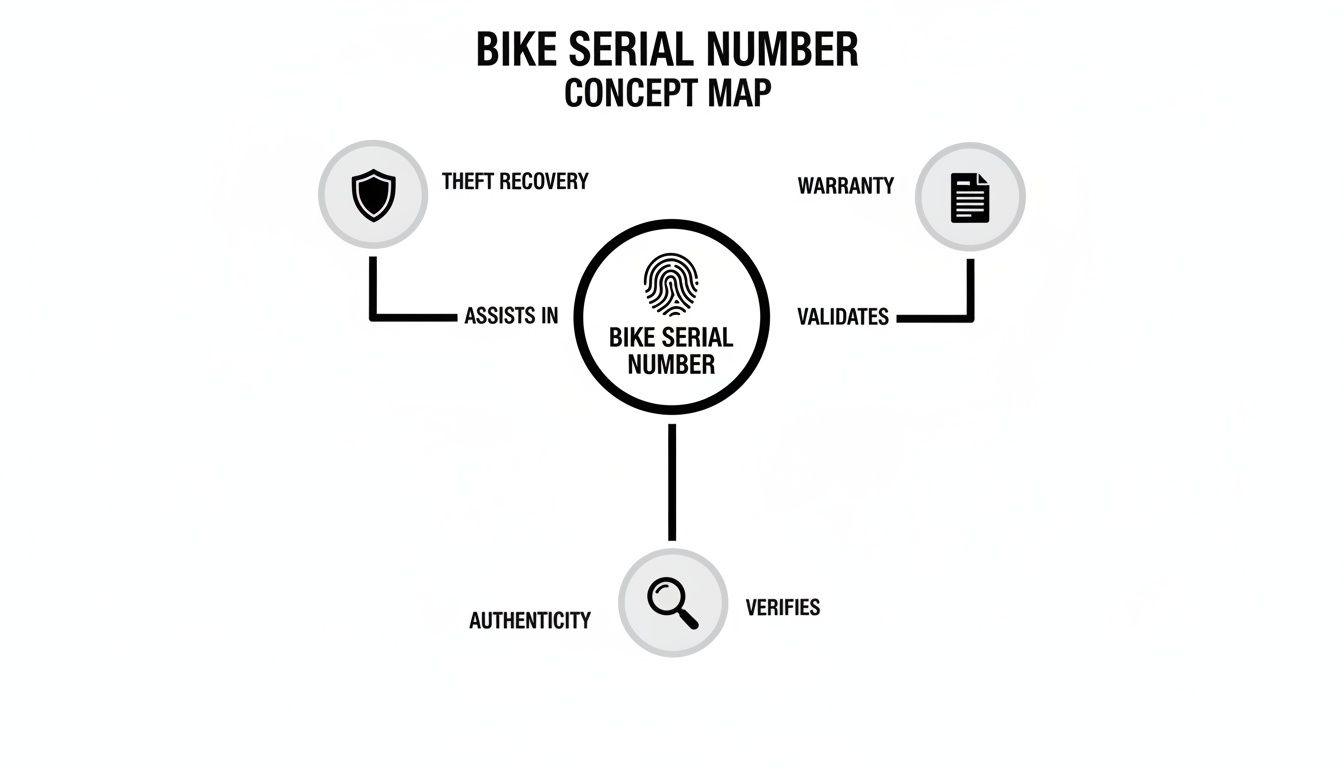
This single number is the key to everything from proving ownership after a theft to validating your warranty, which is why taking a moment to find and record it is one of the most important things you can do as a new bike owner.
Common Hiding Spots
If you've checked the bottom bracket and come up empty, don't sweat it. There are a few other places manufacturers regularly use. Grab your phone for a flashlight and methodically check these areas next.
- The Headtube: This is the short, vertical tube at the very front of your bike that holds the front fork in place. The serial number is often stamped right on the front of it, facing forward.
- The Seat Tube: Look at the base of the long tube your seat post slides into, right where it joins the bottom bracket. Sometimes the number is stamped on the side or back of this tube.
- The Rear Dropouts: These are the little slots at the very back of the frame that hold your rear wheel. The number might be stamped on the inside or outside surface of either dropout.
Remember, years of dirt, grease, or even a thick coat of paint can easily hide the serial number. It’s always worth taking a rag and wiping the area clean before you give up on a spot.
Pro Tip: I always use my phone's flashlight, even in broad daylight. Holding it at a sharp angle makes the edges of the stamped characters cast a tiny shadow, causing them to "pop" and become much easier to read.
To make things a little easier, I've put together a quick-reference table that shows the most probable locations based on my experience with different types of bikes.
Common Serial Number Locations on Electric Bikes and Dirt Bikes
| Location | Bike Type | Why It's There |
|---|---|---|
| Bottom Bracket | E-Bikes, Road, Mountain | A structurally sound, central part of the frame that’s less likely to get damaged. |
| Headtube | Dirt Bikes, BMX, Some E-Bikes | Highly visible and very strong, making it the go-to spot for most moto-style frames. |
| Rear Stays/Dropouts | Older Bikes, Some Cruisers | This is a more traditional location that you see less often on modern bikes. |
| Seat Tube | Various Types | Often an alternative spot if the bottom bracket's design makes stamping difficult. |
This should give you a solid starting point and help you narrow down your search.
Model-Specific Locations For Your Bike
While the spots listed above cover about 95% of bikes out there, some brands have their own preferred locations. Knowing these little quirks can save you a ton of hassle.
For instance, if you own a UGBEST MB750 electric bike, you can be pretty confident the serial number is right on the bottom bracket. For the UGBK2 and VETRA BLAZER electric dirt bikes, however, your first stop should always be the headtube—that’s the standard placement for frames with that moto-inspired design.
When all else fails, your user manual is the ultimate source of truth. Manufacturers almost always include a little diagram showing you exactly where to look. If you tossed the paper copy, don't worry. Most companies have digital versions online, like this great collection of eBike Gang user manuals, which has saved me more than once.
Making Sense of Your Serial Number (and How to Keep It Safe)
So you've found that string of stamped characters on your bike's frame. What now? It’s more than just a random code—it’s your bike’s unique fingerprint. Think of it as a condensed story about where and when your bike was made. While every brand has its own system, you can often pick out patterns once you know what to look for.
For instance, a serial number might look something like SBCJ21A12345. In this hypothetical example, "SBC" could be the manufacturer's code, "J21" might signify the production month and year (J for October, '21 for 2021), and the last few digits are the unique number for that specific frame. It's a birth certificate, etched in metal.
This isn't a new concept. Enthusiasts have been decoding these numbers for decades to date vintage bikes. Back in the 1960s, for example, certain serial prefixes were standard for CCM bicycles, with H-codes accounting for a whopping 67% of new bike sales in 1965 alone. If you want to go down a fascinating rabbit hole, you can see how these were tracked by exploring dealer logs from that era. It's this level of precision that modern brands rely on for warranty claims.
Create a Secure Digital Record
Knowing what the number means is one thing, but having a permanent, accessible record of it is everything. Trust me, your memory is not enough. The last thing you want during the panic of a theft is to be scrambling for this critical piece of information.
The best strategy is to create multiple digital copies. Redundancy is your friend here. It ensures you can pull up the number from anywhere, even if your phone gets stolen along with your bike. This is a five-minute job that can save you a world of hurt.
Here’s the simple, foolproof system I’ve used for years:
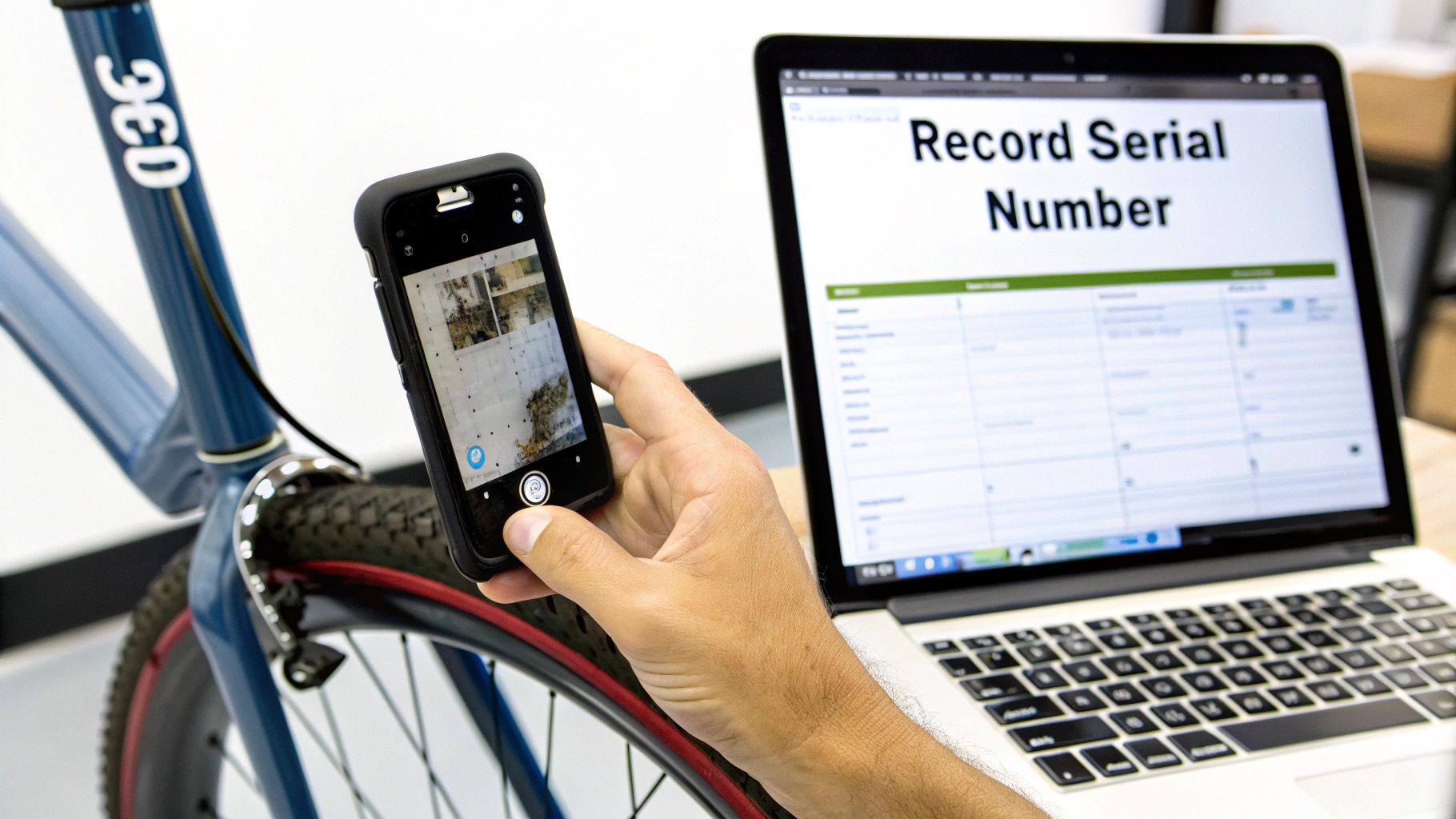
- Snap a Clear Photo: Grab your smartphone and take a well-lit, high-resolution picture of the serial number. Zoom in to make sure every single character is sharp and legible.
- Email It to Yourself: Draft an email with a specific subject line like "UGBK2 Electric Dirt Bike Serial Number" and attach the photo. Send it. Now it's permanently searchable in your inbox.
- Save It to the Cloud: Upload that same photo to a secure cloud service you already use, like Google Drive, Dropbox, or iCloud. I keep a folder called "Important Documents" just for things like this.
Key Takeaway: The goal is to make your bike's serial number impossible to lose. By creating multiple digital records, you ensure you'll have it the moment you need it for a police report or warranty claim.
Keep a Full Inventory—Digital and Physical
Don't just stop with a photo. The smartest move is to integrate your bike’s serial number into a broader inventory of all your valuable possessions. This gives you an extra layer of security and makes things much smoother if you ever need to file an insurance claim.
Here are a few ways to get this done:
- A Simple Spreadsheet: Create a basic spreadsheet listing your valuables. Make columns for the item ("VETRA BLAZER E-Dirt Bike"), serial number, purchase date, and maybe even a link to the photo you saved in the cloud.
- A Syncing Notes App: Use a notes app on your phone that syncs with your computer. Create a dedicated note for your bike and drop in all the key details.
- An Old-School Backup: For a totally non-digital option, grab the original purchase receipt, write the serial number directly on it, and file it away in a safe place with your other important papers.
This little bit of prep work can turn a potential catastrophe into a manageable problem. When you have the serial number handy, you drastically increase the chances of getting your bike back and making the entire process less of a headache.
Putting Your Serial Number to Work: Warranty and Security
Alright, you've found and recorded your bike's serial number. That string of characters might not look like much, but it's the key to protecting your investment. Let's talk about how to turn that number into a powerful tool for warranty claims and theft recovery.
Activating Your Warranty Coverage
Think of your warranty as a safety net. It’s the manufacturer's promise to stand behind their work, but you have to do your part to activate it. The serial number is the non-negotiable proof they need to confirm your bike's identity, its production date, and its eligibility for coverage. Without it, a warranty claim can be a non-starter.
The process is usually pretty simple. You'll head over to the manufacturer's website, find their registration page, and plug in your details along with the serial number you just jotted down.
For anyone riding with eBike Gang, getting registered is crucial. It ensures you're covered by our 12-month limited warranty policy, which handles defects in materials and workmanship. Taking five minutes to do this now could save you a world of headaches later.
Your Best Weapon Against Bike Theft
Now for the big one: security. An estimated 1.5 million bikes are stolen every year across the globe. Just locking it up and hoping for the best simply isn't enough. Your serial number is your single most effective tool if the worst happens.
Registering your bike on a national database is a game-changer. It dramatically increases the odds you'll see your bike again.
Services like Bike Index are fantastic for this. They're free, police departments across the country use them, and they work. Here’s the rundown:
- You create a profile and log your bike's details—make, model, color, and of course, the serial number.
- If your bike gets stolen, you log into your account and mark it as stolen.
- This immediately alerts a massive network of police, pawnshops, and other cyclists. If someone comes across a bike with that serial number, it gets flagged instantly.
This simple action transforms your bike from an anonymous, easy-to-sell object into a high-risk piece of stolen property that's much harder to offload.
A registered bike is a recoverable bike. When police recover a stolen bicycle, the very first thing they do is run the serial number. If it’s registered to you, they know exactly who to call.
This isn't a new concept. Manufacturers have used serial numbers for decades to track production batches and identify specific models. For instance, the classic Italian brand Legnano switched to a simple two-digit system on its seat lugs around 1966, likely to track quarterly production during a huge cycling boom in Europe. Today, we use that same core idea of unique identification to get stolen property back to its rightful owners.
Should you ever have to file an insurance claim, having that serial number on hand is critical. It provides undeniable proof of ownership, which can make the entire process—from theft to payout—much smoother and faster.
What to Do if the Serial Number is Unreadable or Missing
It's a frustrating moment: you flip your bike over, ready to jot down the serial number, only to find a mess of grime, a thick glob of paint, or... nothing at all. Don't panic. This is a common problem, and there are a few practical ways to tackle it.
Most of the time, the number is just hiding under years of accumulated crud. A little careful cleaning is usually all it takes to bring it back to life.
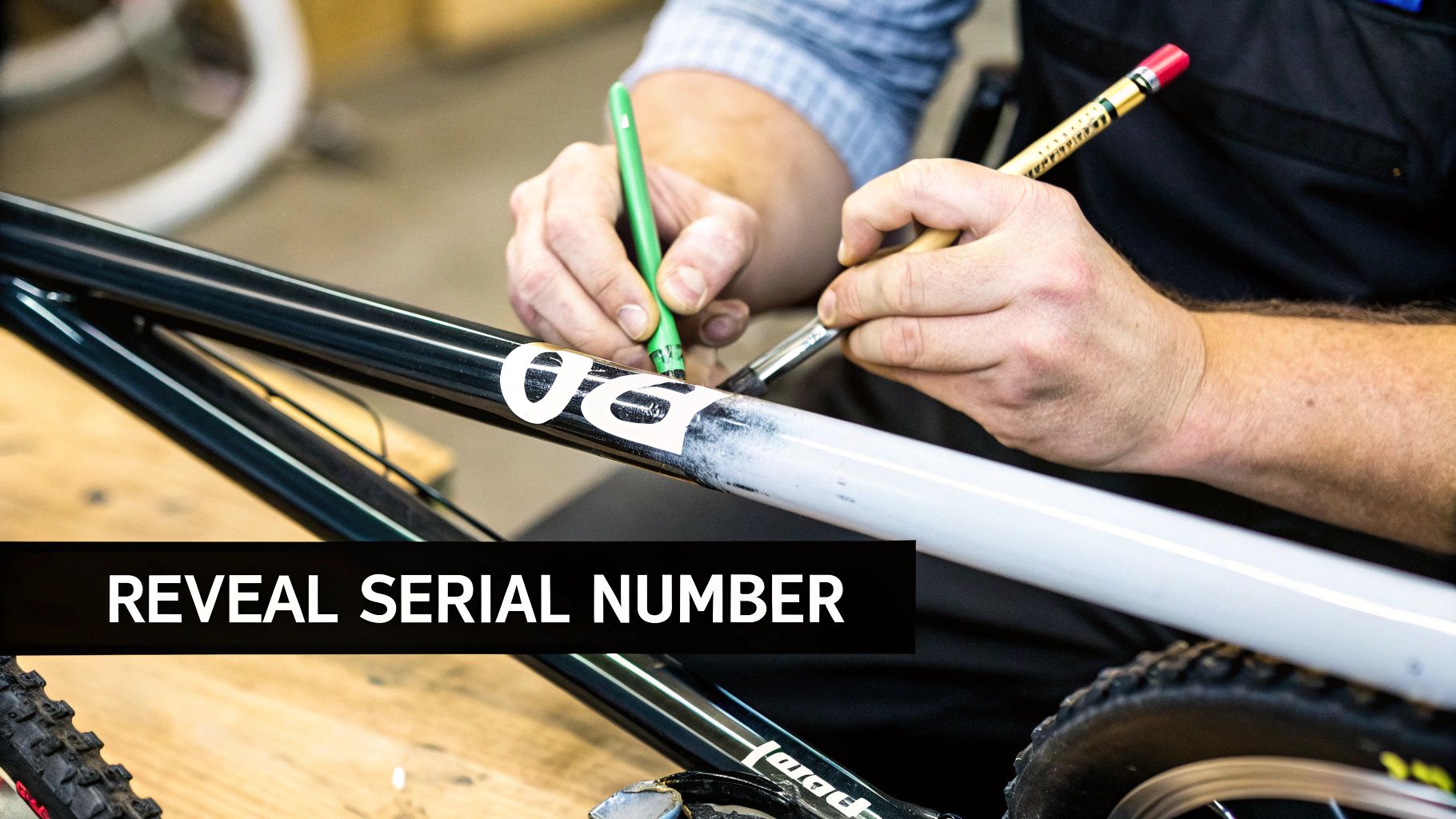
The key here is to be gentle. Whatever you do, don't reach for a wire brush or harsh chemical stripper. You could easily scratch the frame and obliterate the number for good. Always start with the softest touch.
How to Safely Clean the Area
First, grab a soft cloth and a mild degreaser. Gently wipe away any dirt and grease caked onto the frame. This simple step often reveals the number right away.
If it's still hard to read or seems to be under a layer of paint, you can carefully use a small amount of paint thinner or acetone on a cotton swab. Dab it on sparingly and rub a very small, controlled area. The goal is to dissolve just the top coat of paint without damaging the metal beneath.
Got a number that’s clean but very faint? Try an old-school detective trick. Lay a thin piece of paper over the serial number and gently rub the side of a pencil or crayon over it. The indentations of the characters will show up on the paper, creating a perfect rubbing you can photograph for your records.
When the Serial Number is Actually Gone
Sometimes, the number is truly gone. It could be worn away from years of use, damaged in a crash, or—in a worst-case scenario with a used bike—intentionally filed off. If you’ve cleaned the area and there's no trace of a number, it's time to pivot to other forms of identification.
Your original purchase receipt is the next best thing to the serial number itself. It's solid proof of ownership and often includes the serial number right in the transaction details, which is a lifesaver for police reports or warranty claims.
If you can't find a physical number on the frame, here’s your action plan:
- Dig Through Your Paperwork: Check your files for the original sales receipt. Also, look for the owner's manual or any warranty registration cards you might have filled out when you bought the bike.
- Contact the Manufacturer: Get in touch with the bike company's customer support. If you bought the bike directly or registered it online, they might have a record of the serial number tied to your name.
- Call the Bike Shop: If you bought your bike from a local retailer, they're your next best bet. Most shops keep sales records for a few years and can often look up your purchase details, including the serial number.
Even without a visible serial number, these alternative records can provide the crucial proof of ownership you need.
Got Questions? We've Got Answers
You've got the basics down, but what about those tricky "what if" scenarios? From my experience, a few questions always come up when riders start digging into their serial numbers. Let's tackle them head-on so you can feel completely confident about protecting your bike.
Can Two Bikes Have the Same Serial Number?
That's a hard no. Think of a serial number like a fingerprint for your bike's frame—it's one-of-a-kind. Every reputable manufacturer has a system to ensure no two frames ever leave the factory with the same number.
If you somehow stumble upon two bikes with an identical serial, treat it as a serious red flag. It could point to a counterfeit bike or a major slip-up at the factory. In that incredibly rare situation, your best bet is to get in touch with the manufacturer right away.
Will I Void My Warranty if I Remove the Serial Number?
Yes, you absolutely will. Messing with the serial number in any way—sanding it down, painting over it, or trying to remove it—is a surefire way to void your warranty. Manufacturers see that number as the only official proof connecting your specific bike to their records.
Without it, they can't track its history, confirm it's a legitimate product, or process a warranty claim. That little string of characters is your golden ticket to support, so keep it safe and sound.
Key Takeaway: Your serial number is the official link between your bike and the manufacturer. If you alter it, that link is broken, and so is your warranty coverage. It also makes recovering a stolen bike nearly impossible.
Is the Serial Number the Same as the Model Number?
It's easy to get these two mixed up, but they serve totally different purposes.
- The Model Number is broad. Think "UGBK2" or "Vetra Blazer." It identifies the product line, and thousands of other riders will have a bike with the same model number.
- The Serial Number is specific. It's the unique ID for your individual frame.
When you register a warranty or file a police report, you'll need both. The model number says what kind of bike it is, and the serial number proves which one is yours.
How Can I Check a Used Bike's Serial Number History?
Smart move! Before buying a used bike, running a quick background check on its serial number can save you a world of trouble. Your best tool for this is a national database like Bike Index.
Just pop the serial number into their search bar to see if it’s ever been flagged as stolen. It’s a simple, powerful step to make sure you aren't accidentally buying someone else's stolen ride. Once the bike is yours, don't forget to register it in your own name.
For more quick answers, you can always check out our detailed eBike Gang FAQ page.
Ready to ride with confidence? At eBike Gang, every bike we sell is backed by a solid warranty and the support you need to keep your investment secure. Explore our collection of high-performance electric bikes and dirt bikes today.