

So, you're wondering how long that pricey e-bike battery is going to last. The short answer most people give is 3 to 5 years. That's a decent ballpark figure, but the real story is a bit more nuanced than that.
What to Expect from Your E-bike Battery Lifespan
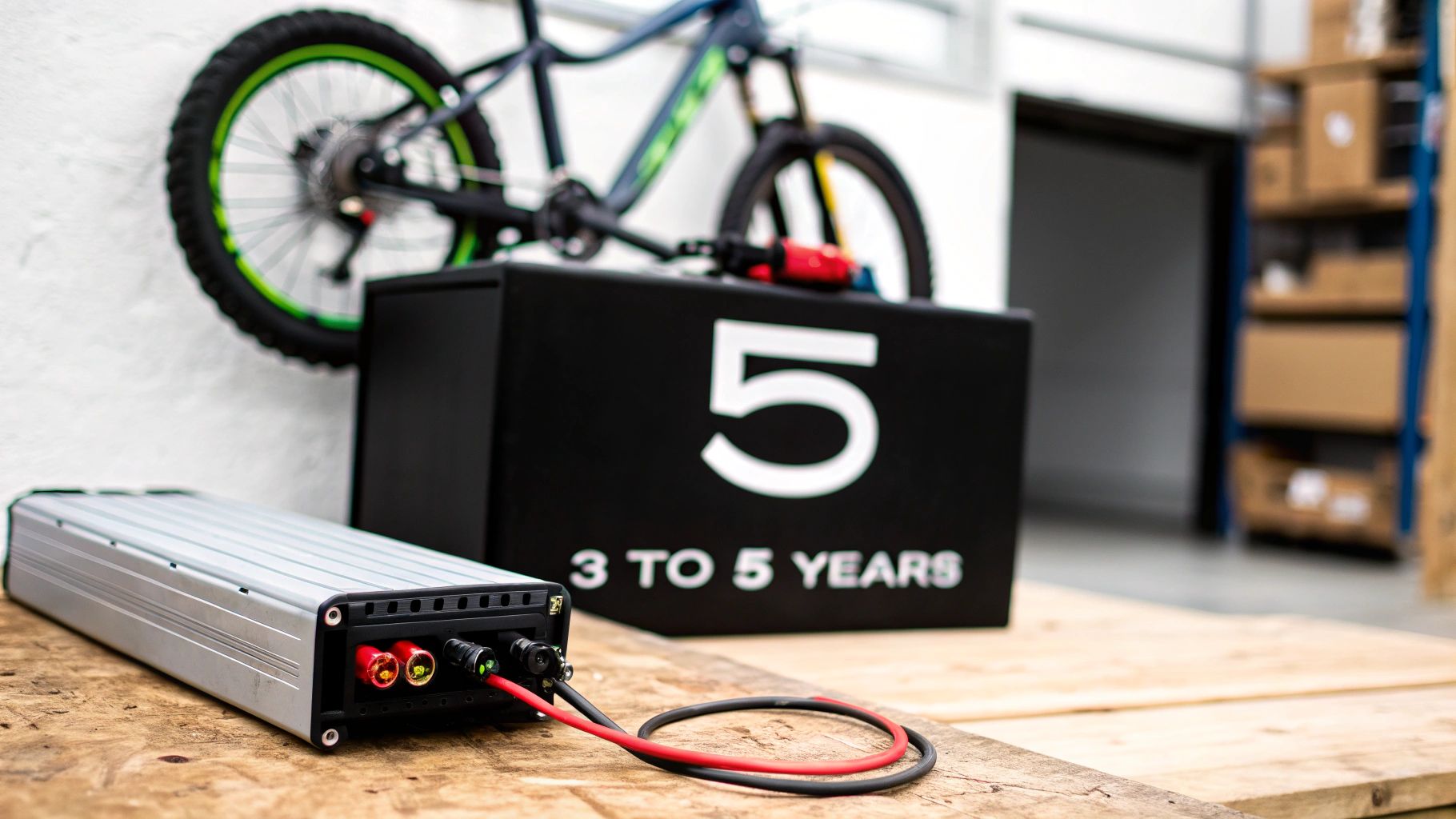
Think of that 3 to 5 year estimate more like a guideline than a guarantee. The true lifespan of your battery has everything to do with how you treat it. It’s a lot like the tread on your car’s tires—your driving habits dictate how quickly they wear out. In the same way, your riding and charging routines have the biggest say in your battery's long-term health.
A typical lithium-ion e-bike battery is good for about 500 to 1,000 charge cycles. But what exactly is a "charge cycle"? It's not just every time you plug it in. One full cycle means you've used up 100% of the battery's juice—whether that happens in one long ride that drains it completely or two separate trips that each use 50%. This is a critical concept to grasp because it shows how your usage directly chips away at the battery's life.
How Your Riding Style Impacts Battery Life
It's simple, really: the more you ride, the more you charge. And the more you charge, the faster you'll burn through those precious cycles. Someone who relies on their e-bike for a daily commute will put a lot more wear and tear on their battery than a casual weekend rider. If you're looking for the perfect ride for your daily trip, our guide on choosing an electric bike for commuting can help.
Because of that constant use, a daily rider might find their battery's performance starting to fade closer to the 2 to 4 year mark. This lines up with what we see across rider communities and hear from manufacturers. The battery won't just die one day; you'll just notice it can't hold as much charge as it used to.
E-bike Battery Lifespan at a Glance
To make this a bit clearer, I've put together a table that breaks down how different riding habits can affect your battery's longevity.
| Rider Profile | Typical Charge Cycles Per Year | Estimated Years of Use | Common Factors |
|---|---|---|---|
| Daily Commuter (Rides 5 days/week) | 150 - 250 Cycles | 2 - 4 Years | Heavy use, frequent charging, varied weather |
| Weekend Adventurer (Rides 1-2 days/week) | 50 - 100 Cycles | 4 - 6+ Years | Moderate use, less frequent charging cycles |
| Casual Rider (Rides a few times/month) | 20 - 40 Cycles | 5 - 7+ Years | Light use, calendar aging becomes a bigger factor |
This gives you a realistic idea of what to expect based on your own habits. The goal isn't to stop the battery from aging—that's impossible—but to slow the process down as much as possible.
Key Takeaway: Your e-bike battery doesn't just suddenly die. It gradually loses its ability to hold a full charge over time. The good news is that you have a lot of control over how quickly this happens, and we'll dive into the smart habits that make all the difference.
Understanding the Three Sides of E-Bike Battery Health
When people ask how long an e-bike battery lasts, they're usually looking for a single number. But the truth is, there isn't one. The lifespan of your battery is a lot like the health of a car—you can't judge it just by its top speed. You also have to consider its fuel economy and how many miles are on the odometer.
To really get a handle on your battery's condition, we need to look at it from three different angles: its charge cycles, its calendar age, and the real-world range you get out of it. Understanding how these three things work together is the secret to managing your expectations and getting every last mile out of your investment. It also helps you see that battery wear is a slow, gradual fade, not a sudden cliff.
Charge Cycles: The Tread on Your Tires
The most common metric you'll hear about is charge cycles. Most of the lithium-ion batteries found in today's e-bikes are rated for somewhere between 500 and 1,000 full charge cycles before their performance starts to noticeably dip. But what exactly is a "cycle"?
It’s not just every time you plug it in. One full charge cycle means using 100% of the battery's capacity. So, if you ride until your battery is down to 50% and then recharge it back to full, that’s only half a cycle. Do the same thing tomorrow, and you’ve completed one full cycle.
A great way to think about this is like the tread on a car tire. Every mile you drive wears away a tiny fraction of the rubber. Similarly, every bit of energy you pull from the battery and then put back in wears down its internal chemistry. And just like flooring the gas and slamming the brakes wears out your tires faster, frequently draining your battery to empty will burn through its available cycles much more quickly.
Calendar Aging: The Unavoidable March of Time
While charge cycles are all about use, calendar aging happens whether you're riding or not. From the moment it leaves the factory, the chemical cocktail inside a lithium-ion battery begins a slow, irreversible process of breaking down. It's just the nature of the beast.
Think of a vintage car stored in a garage. Even if it never turns a wheel, the rubber hoses and tires will get brittle and crack over the years. Your e-bike battery is doing the same thing on a chemical level.
A brand-new battery that's been sitting on a shelf for a year simply won't hold as much charge as it did on day one. Heat is the biggest enemy here—storing a battery in a hot shed or car trunk will dramatically accelerate this chemical decay.
This is why even a lightly used e-bike battery will still need replacing after a few years. You can't stop time, but as we'll discuss later, you can definitely slow it down with smart storage habits.
Range Per Charge: Your Real-World Performance Gauge
This brings us to the metric that matters most on your daily rides: range per charge. This is the simple, practical answer to the question, "How far can I go?" When your bike is fresh out of the box, you might get 50 miles on a charge. A year later, riding the same route in the same way, you might only get 45.
This slow decline in range is the most obvious symptom of both cycle and calendar aging doing their work. It’s your battery’s real-time report card.
While cycles and aging are the behind-the-scenes causes, your shrinking range is the result you'll actually feel. It’s the clearest indicator of how much juice your battery has left for your adventures. Once your maximum range drops so low that it's no longer practical for your needs—usually around 60-70% of its original capacity—that's the real-world signal that it’s time to start shopping for a replacement.
The Key Factors That Impact Your Battery's Lifespan
Your e-bike's battery life isn't a fixed number set at the factory; it's a direct result of your daily habits and the environment you ride in. Think of it like a car's fuel efficiency—the way you drive dramatically affects how far a tank of gas gets you. The same principle applies here: you have significant control over how long your battery lasts.
Understanding what helps and what hurts is the first step to making your battery last for years, not just months. By adopting a few simple habits, you can maximize your investment and keep riding farther, for longer.
This diagram breaks down the core elements of battery health, showing how both use (charge cycles) and time (calendar aging) chip away at your e-bike's total range.
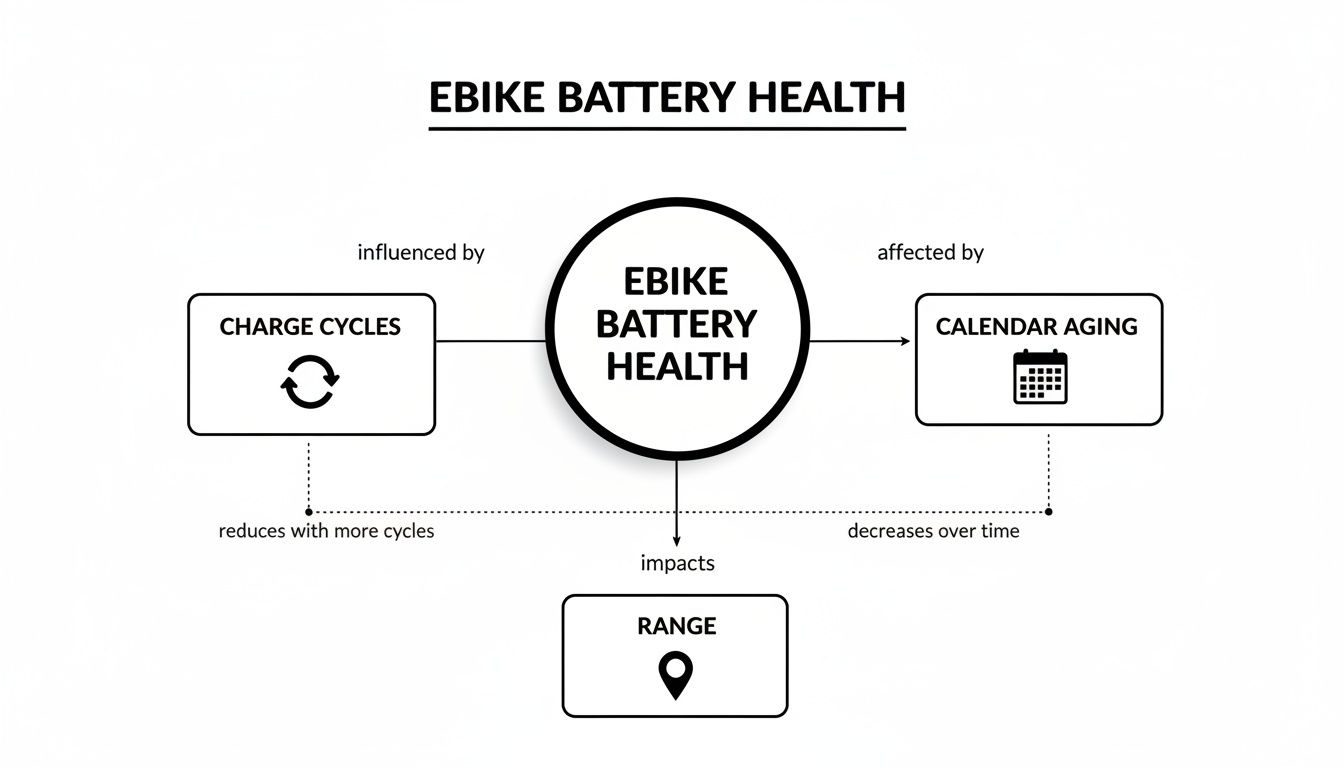
As you can see, the range you get on any given day is the ultimate reflection of your battery's internal condition.
Smart Charging Habits Are Your Best Friend
How you charge your battery is probably the single most important factor in its longevity. A common mistake is to drain it completely and then charge it to 100% after every single ride. This habit actually puts a ton of unnecessary stress on the battery cells.
Think of a lithium-ion battery like a rubber band. Keeping it constantly stretched to its maximum (100% charge) or letting it go completely slack (0% charge) causes it to wear out faster. The sweet spot is somewhere in the middle.
The 20-80% Rule: For everyday riding, try to keep your battery's charge level between 20% and 80%. This simple practice reduces wear on the cells and can potentially double the number of effective charge cycles you get over its lifetime.
This doesn't mean you can never charge to 100%. If you have a huge ride planned and need all the range you can get, go for it. Just don't make a habit of leaving it plugged in at 100% every single night.
Temperature: The Silent Killer
Your e-bike battery is a bit of a Goldilocks—it doesn't like things too hot or too cold. Extreme temperatures are one of the quickest ways to permanently damage its ability to hold a charge.
Leaving your battery in a hot car on a summer day is a recipe for disaster. High heat accelerates the chemical reactions inside the cells, permanently degrading them.
Cold weather brings its own problems. While a cold battery will temporarily give you less range, the real damage happens if you try to charge it while it's still frozen. Charging a lithium-ion battery below freezing (32°F or 0°C) can cause an irreversible process called "lithium plating," leading to a sudden and permanent loss of capacity.
- Hot Storage: Never leave your battery in direct sunlight or in a place that gets scorching hot, like a car trunk or a metal shed.
- Cold Charging: If you've been riding in the cold, always bring your battery inside and let it warm up to room temperature for a couple of hours before you plug it in.
The effect of heat is huge. Data shows a battery stored at 0°C might retain 94% of its capacity after a year, but at a sweltering 60°C, that can plummet to just 60%. This is especially important in hot climates like Australia, where summer temperatures can easily average 35°C+. Some rider surveys suggest that up to 60% of users replace their batteries within three years due to this kind of degradation. You can find more insights into how riding conditions impact e-bike performance on Biktrix.com.
Your Riding Style and Motor Strain
How you ride directly affects your battery. Constantly mashing the throttle and accelerating hard from a standstill draws a massive amount of current, putting serious strain on the battery's internal parts.
Using the pedal-assist modes, on the other hand, is much gentler. By adding your own leg power, you lighten the load on the motor and, in turn, the battery. This not only extends your range per charge but also helps preserve the battery’s long-term health by avoiding those constant high-stress power draws.
Depth of Discharge Matters
Closely related to charging habits is the depth of discharge (DoD). This is just a technical term for how much of the battery's capacity you use before plugging it back in.
Routinely draining the battery all the way to empty (a 100% DoD) is much harder on it than doing several shallower discharges. For example, two rides that each use 50% of the battery are far better for its lifespan than one ride that drains it completely from 100% to 0%. This is another reason the 20-80% rule works so well—it encourages those gentler, partial cycles.
The small habits you build can have a massive cumulative effect on your battery's lifespan. The table below illustrates how seemingly minor choices add up over time.
Impact of Daily Habits on Battery Health
| Habit | Good Practice (Extends Life) | Bad Practice (Shortens Life) | Estimated Impact |
|---|---|---|---|
| Charging | Keep charge between 20-80% for daily use. | Always charging to 100% and leaving it plugged in. | Can nearly double the number of charge cycles. |
| Discharging | Recharge before it drops below 20%. | Regularly draining the battery to 0%. | Avoids deep discharge stress on cells. |
| Temperature | Store and charge at room temperature (15-25°C). | Leaving the battery in a hot car or charging below 0°C. | Can prevent up to 40% capacity loss from heat alone. |
| Riding Style | Use pedal-assist and smooth acceleration. | Heavy reliance on the throttle for acceleration. | Reduces peak current draw and component strain. |
Ultimately, treating your battery with a bit of care goes a long way. By avoiding the "bad practices" and leaning into the "good," you're not just getting more range today—you're investing in more rides for years to come.
Your Practical Guide to Maximizing Battery Health
Knowing what affects your battery is one thing, but turning that knowledge into a simple, effective routine is what really counts. The good news? You don't need a degree in battery science to keep your e-bike in fantastic shape. A few straightforward habits can make a huge difference, extending your battery's life and ensuring you get the most out of your investment.
Think of this as your preventative maintenance plan for the heart of your bike. These tips will quickly become second nature and pay you back with better performance and a longer-lasting battery.
Master Your Charging Routine
How you charge your battery day-to-day has the single biggest impact on its long-term health. Instead of just plugging it in after every single ride and forgetting about it, a more mindful approach can dramatically slow down the aging process. The main goal is to avoid the stress that comes from pushing the battery to its absolute limits—either totally full or completely empty.
Here’s a simple routine that works wonders:
- Embrace the 80% Rule: For most daily rides, you probably don't need 100% of your range. Try to stop charging once the battery hits 80-90%. This simple trick avoids the high-stress state of a fully topped-off battery.
- Recharge Before It's Empty: On the other end of the spectrum, try not to let your battery regularly dip below 20%. Deep discharges are much harder on the internal chemistry than shallower cycles.
- Charge at Room Temperature: Never, ever charge a frozen battery. If you've been riding in the cold, bring the battery inside and let it warm up to room temperature for a couple of hours before plugging it in. Charging it while it's still cold can cause permanent damage.
The Art of Smart Storage
What you do when you’re not riding is just as important, especially if you're putting your bike away for a while, like over the winter. Leaving a battery fully charged or completely dead for months is a surefire way to shorten its life.
The sweet spot for storing a lithium-ion battery is a partial charge. Think of it like putting the battery into a comfortable hibernation—not leaving it fully energized (100%) or totally exhausted (0%).
If you're storing your bike for more than a few weeks, follow these steps:
- Aim for a 40-60% Charge: This is the most stable state for the battery's chemistry, minimizing degradation while it sits.
- Store in a Cool, Dry Place: Find a spot with a stable temperature, ideally between 15-25°C (60-77°F). A hot garage or a damp basement is not your battery's friend.
- Check In Periodically: Set a reminder to check the battery's charge level every month or two. If it’s dropped a lot, just top it back up to that 40-60% range before putting it back into storage.
Your Battery's Built-In Bodyguard
Every modern e-bike battery, including those on our UGBEST MB750 and VETRA BLAZER models, has a secret weapon inside: the Battery Management System (BMS). This small, integrated circuit board is the unsung hero, acting as the battery's brain and bodyguard.
The BMS is constantly monitoring the health of every individual cell, protecting the pack from common dangers that could wreck its lifespan. This silent guardian is always on duty, working to:
- Prevent Overcharging: It’s what tells the charger to shut off once the battery is full.
- Stop Over-Discharging: The BMS will cut power before the battery drains to a critically low, damaging voltage.
- Balance Cell Voltages: It ensures all the cells inside the pack charge and discharge evenly, which is critical for both performance and safety.
- Manage Temperature: If things get too hot during charging or heavy use, the BMS can step in and shut the battery down to protect it.
While the BMS is a fantastic safety net, it isn't a replacement for good habits. When you follow proper charging and storage routines, you're working with the BMS to give your battery the longest, healthiest life possible. For more on keeping both you and your equipment safe, take a look at our guide on essential electric bike safety tips.
Signs It’s Time to Replace Your E-Bike Battery
Just like the tyres on your bike, the battery has a limited lifespan. It won't suddenly give up the ghost one day; instead, you’ll notice a slow, steady decline in its performance. Learning to spot the tell-tale signs of a tired battery means you can plan for a replacement before you get stranded miles from home.
The great news is that battery tech has come a long way. Back in the early 2010s, a good battery might last 300-500 charge cycles. Fast forward to today, and thanks to advancements in lithium-ion chemistry, modern batteries are often rated for 800-1,200 cycles. This leap, much like what we've seen in the electric car world, has helped fuel the massive e-bike boom, with global sales jumping from 2 million in 2015 to an incredible 40 million by 2023. As you can find out on Goat Power Bikes, a well-maintained battery from just a few years ago can still perform brilliantly today.
Performance Problems You Can Feel
The most telling signs of a dying battery are the ones you experience out on the road. These are the little frustrations that hint at bigger problems with the battery's internal chemistry. Keep an eye out for these red flags.
- Dramatically Reduced Range: This is the big one. If a route that used to take only half your charge now leaves you running on empty, your battery has lost a serious amount of its original capacity.
- Sudden Power Loss on Hills: A healthy battery delivers smooth, consistent power when you need it most. If your bike starts to stutter or the motor cuts out entirely on a steep climb, the battery is struggling to deliver the required voltage under load.
- Inconsistent Power Delivery: Does the motor feel jerky or hesitant, even when the display shows plenty of charge? This often points to failing cells that can no longer provide a steady flow of energy.
As a general rule, once a battery’s capacity dips to around 60-70% of what it was new, it starts to become more of a hassle than a help.
Rider's Rule of Thumb: When you start planning your rides around your battery's limitations instead of your own, it’s a pretty clear sign a replacement is on the horizon.
Charging and Physical Warning Signs
The problems aren't always limited to your rides; they can also appear when the bike is parked or plugged in. A quick visual inspection should be part of your routine, as physical changes can signal serious safety issues.
Start by paying attention to its charging habits. Is it taking way longer to charge than it used to? Or maybe it just won't hold a charge for more than a day, even when you aren't riding it? Both are classic symptoms of a battery that can't store energy efficiently anymore.
Next, give the battery itself a good once-over. Be on the lookout for these critical warning signs:
- Visible Swelling or Bulging: If the battery case looks puffy or distorted in any way, stop using it immediately. This is caused by gas buildup inside and is a major safety hazard.
- Cracks or Damage to the Casing: The hard case protects the delicate cells inside. Any crack can let in moisture or expose the cells to damage, creating a serious risk.
- Corrosion on the Connectors: Check the metal contacts where the battery connects to the bike. Any rust or green-ish corrosion can cause a poor connection, leading to power dropouts and charging issues.
If you spot any physical damage—especially swelling—it’s time for an immediate replacement. Your safety always comes first.
Navigating Battery Replacement and Recycling
Sooner or later, every battery powers its last ride. When your e-bike’s power source just can't hold a practical charge anymore, you have two jobs ahead: finding a good replacement and getting rid of the old one responsibly. It sounds like a hassle, but it's pretty straightforward once you know the steps.
When it's time for a new battery, you've got a few different ways you can go. Each path has its own balance of cost, reliability, and convenience. Making the right call here is what gets your bike back on the road safely and running just the way you expect it to.
Choosing Your Next Battery
Your first, and honestly, your best bet is to go straight to the source. Buying an Original Equipment Manufacturer (OEM) battery directly from your bike's brand—like us at eBike Gang—is the surest way to get it right. It guarantees a perfect handshake with your bike's motor, controller, and mounting bracket. It might cost a little more upfront, but it's easily the most reliable option.
Of course, you could look into third-party batteries. They often have a more attractive price tag, but they come with some real risks. You have to nail the specs perfectly: the voltage, the physical dimensions, the connector type. Get it wrong, and you could end up with a battery that underperforms, fries your bike's electronics, or even worse, becomes a safety hazard.
There's also a third route: professional rebuilding. This is where a specialist takes your original battery casing and replaces the worn-out cells inside with new ones. It can be a great way to save money, but your success hinges entirely on finding a reputable service that knows their way around your specific battery model.
Key Insight: While the savings from a third-party battery can be tempting, think of an OEM battery as an investment in your bike's long-term health and your own safety. A mismatch in electronics can cause headaches and expensive repairs you didn't bargain for.
Understanding Your Warranty
Before you pull out your wallet, dig up your e-bike’s warranty information. Most manufacturers, eBike Gang included, provide a 12-month limited warranty that covers any defects from the manufacturing process. It won't cover the natural wear and tear from regular use, but it's your safety net against a battery that fails way too soon. Knowing your coverage can save you a chunk of change.
If you're still in the shopping phase and comparing different models, our comprehensive electric bike buying guide can offer some great insights on what to look for in a warranty.
The Importance of Responsible Recycling
Okay, so you've got a shiny new battery. What about the old one? There's one golden rule here: never, ever throw a lithium-ion battery in the regular trash.
These batteries can cause serious, hard-to-extinguish fires if they get punctured or crushed in a garbage truck or landfill. On top of that, they're filled with heavy metals that can leach into the soil and water, causing real environmental damage.
The good news? Recycling is easy and usually free. Here’s how to do it the right way:
- Find a Local Center: Check with your local recycling facility. Many big-box home improvement stores and even local bike shops have dedicated programs for battery drop-offs.
- Use Online Resources: Websites like Call2Recycle have handy search tools that make it simple to find a certified e-bike battery recycling spot near you.
- Prepare for Drop-off: It’s a smart move to cover any exposed connectors on the old battery with a bit of electrical or clear packing tape. This simple step prevents any chance of a short circuit.
Recycling your battery ensures those valuable materials get a second life and keeps hazardous waste out of our environment. It's a small step that makes a big difference.
Got Questions? We've Got Answers
Even after going through all the details, you probably still have a few questions rolling around in your head. That's totally normal. Here are some quick, straightforward answers to the most common things riders ask about their e-bike batteries.
Is It Okay to Leave My E-Bike Battery Charging Overnight?
Look, most modern chargers are smart enough to shut off automatically, so you're not likely to cause a fire. But making a habit of overnight charging isn't doing your battery any favors.
When you leave it plugged in for hours on end, it sits at a 100% charge, which is a high-stress state for the battery's chemistry. Over time, this constant stress accelerates its aging process. Your best bet? Try to unplug it within an hour or two of it hitting full. It's a small habit that pays off in the long run.
Can I Ride My E-Bike in the Rain?
Most e-bikes can handle a little rain just fine—they're built to be water-resistant, not waterproof. Think of it like a light drizzle versus a full-on monsoon. You'll want to avoid torrential downpours or riding through deep puddles that could submerge the battery and motor.
Here's the most important part: never, ever charge a wet battery. Always make sure the battery case and all its connection points are bone dry before you even think about plugging it in. It's a major safety hazard and a surefire way to fry the electronics.
Does Leaning on the Throttle Kill the Battery Faster?
Oh, absolutely. Using the throttle is like hitting the gas pedal hard. It demands a massive, continuous surge of power from the battery, which drains your range much faster than gentle pedaling with assist.
But it's not just about range per charge. This high-drain activity puts a ton of strain on the battery cells, which can shorten their overall lifespan. Think of pedal-assist as a smooth, steady jog, while the throttle is an all-out sprint. The gentler you are, the longer your battery will last.
My E-Bike Sat in Storage for a Year. Is the Battery Toast?
It really all comes down to how it was stored. If you were savvy and left it with a 40-60% charge in a cool, dry spot, you're probably in good shape. It will have lost a bit of its total capacity, but it should still be perfectly usable.
On the other hand, if you left it completely dead or fully charged, there's a good chance it has degraded quite a bit. The only real way to find out is to give it a full charge, take it out for a normal ride, and see how far you get. That real-world test will tell you everything you need to know about its current health.
Ready to feel the difference a top-tier e-bike makes? Come check out the full lineup at eBike Gang. Every bike we sell is backed by our passion for quality and a solid 12-month warranty. Find your perfect ride today at eBikeGang.com.