

When you see e-bikes on the street, they generally top out at either 20 mph (32 km/h) or 28 mph (45 km/h), depending on their legal classification. Off-road electric dirt bikes, on the other hand, are a completely different animal. Built purely for performance, they can easily blow past those speeds on private trails.
It’s like comparing a reliable daily commuter car to a track-ready race car. Both are fantastic at what they do, but they’re engineered for entirely different environments and expectations.
Decoding E-Bike Speed Limits and Classes
Asking "how fast can an e-bike go?" isn't a simple question with a single answer. An e-bike's top speed is more of a spectrum than a fixed number. It’s a carefully balanced mix of engineering choices, government regulations, and the real-world conditions you're riding in.
To bring some order to all this, the United States uses a straightforward classification system that every rider really ought to know. It’s what separates a street-legal ride from a trail-only machine.
This system puts a cap on the top assisted speeds to keep things safe on shared roads and bike paths. You’ll find Class 3 models leading the pack at 28 mph with pedal-assist, while Class 1 (pedal-assist only) and Class 2 (throttle-equipped) are both limited to 20 mph. This framework creates clear boundaries for both manufacturers and riders.
A Quick Look at US E-Bike Classes
This three-class system is the bedrock of e-bike speed regulation in the U.S. Each class has specific rules that dictate how the motor can help you and, crucially, the maximum speed it can help you reach.
-
Class 1: The motor gives you a boost only when you're pedaling and cuts off completely once you hit 20 mph.
-
Class 2: These bikes have a throttle that can power the bike up to 20 mph without you needing to pedal at all. For a deeper dive, check out our guide to understanding the Class 2 ebike.
-
Class 3: The speed demons of the street-legal world. The motor assists your pedaling up to a brisk 28 mph, which is why they're such a popular choice for commuters looking to shorten their travel time.
To make this crystal clear, here’s how the classes stack up against each other.
US Ebike Classes and Speed Limits At a Glance
This table breaks down the essentials of each class, showing how fast they can go and how the motor delivers its power.
| Ebike Class | Maximum Assisted Speed | How it Works (Assist Type) |
|---|---|---|
| Class 1 | 20 mph (32 km/h) | Pedal-Assist Only |
| Class 2 | 20 mph (32 km/h) | Throttle and Pedal-Assist |
| Class 3 | 28 mph (45 km/h) | Pedal-Assist Only |
Understanding these classes is the first step in figuring out what kind of speed you can expect and which type of e-bike is the right fit for your local laws and riding style.
Inside the Powertrain: What Determines an E-Bike's Top Speed?
To really get what makes an e-bike fly, you have to look past the pedals and into its electric heart. An e-bike's powertrain is a tight-knit trio of components all working together to create speed. Think of it like a band—each instrument has to be in sync for the music to sound right.
You've got the motor providing the raw muscle, the battery supplying the juice, and the controller acting as the conductor, telling everything what to do. The back-and-forth between these three parts is what ultimately sets your e-bike's top speed.
The Motor Is Your Engine
The motor is the most obvious part of the power equation, and its strength is measured in watts (W). You’ll usually see two key numbers: nominal wattage and peak wattage.
Nominal wattage is the power the motor can put out continuously without overheating, like a marathon runner's steady pace. Peak wattage is the max power it can crank out in short bursts, perfect for getting a jump start at a green light or tackling a steep hill. It's the sprinter's final kick.
A higher wattage motor generally gives you more torque for punchier acceleration and better climbing. But here’s the catch: more watts doesn't automatically mean a higher top speed. Why? Because the controller and legal e-bike classifications often act as a governor. A 750W motor will feel a lot stronger off the line than a 250W one, but both could be legally capped at the same 20 mph top speed on a Class 2 e-bike.
The Controller Is The Brain
If the motor is the muscle, the controller is the brain. This little electronic box is the unsung hero of your e-bike's performance. It takes the signals from your throttle or pedal sensor, pulls the right amount of power from the battery, and feeds it to the motor to give you a smooth, controlled ride.
The controller is also the gatekeeper. It’s programmed from the factory to enforce the legal speed limits for your e-bike's class. This is the main reason you can’t just swap in a bigger motor and expect to go faster. The controller will still cut the assistance once you hit that pre-set limit, whether it's 20 mph or 28 mph. It’s there to keep the whole system running safely and, just as importantly, legally.
If you want to dive deeper into how the controller manages your pedaling input, our guide on what pedal assist on an ebike is breaks it all down.
This diagram shows the key differences between the three e-bike classes at a glance.
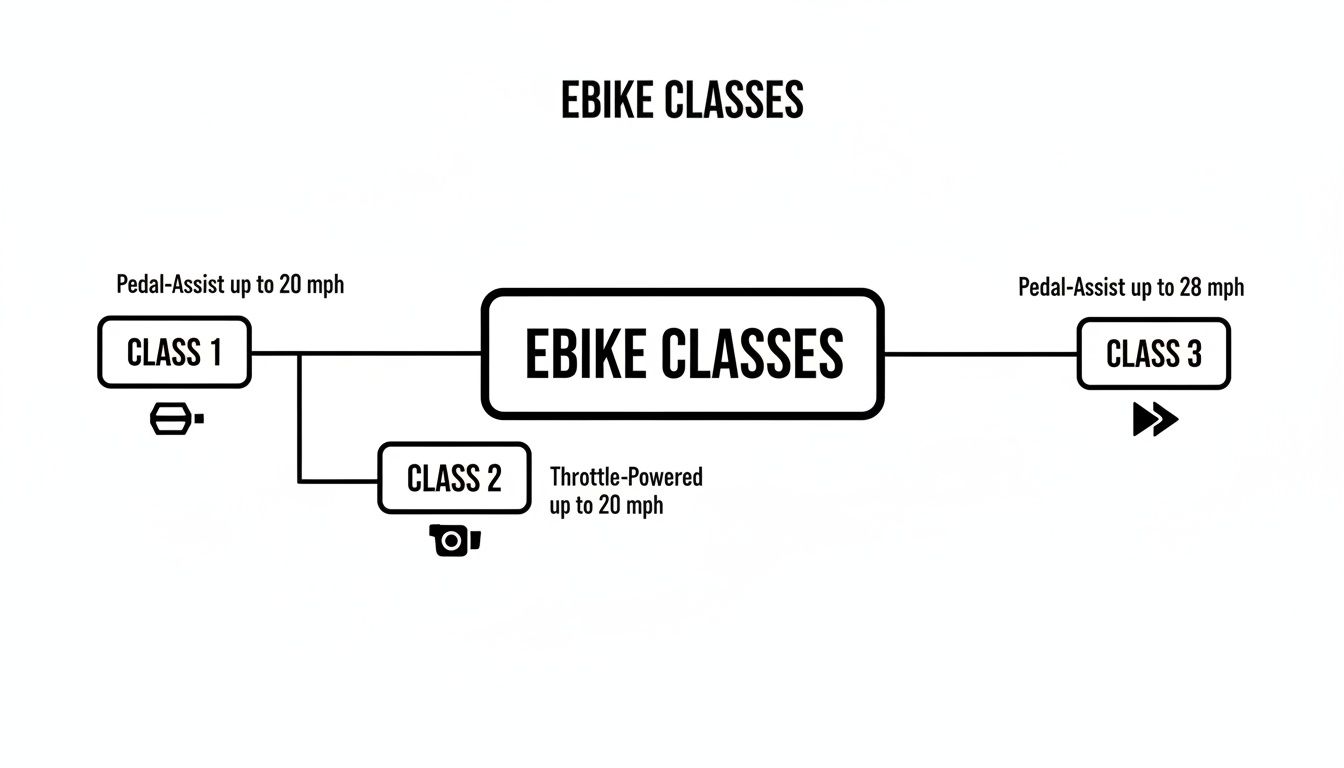
As you can see, Class 1 and Class 3 are all about pedal assist, while Class 2 gives you that handy throttle for power whenever you want it.
The Battery Is The Fuel Tank
Last but not least, you have the battery—the fuel tank. Its capacity is measured in watt-hours (Wh), which tells you how long it can run. But when it comes to speed and power, its voltage (V) is the real star of the show.
Think of it this way: a higher voltage battery can push electricity to the motor with more force, just like higher water pressure makes a hose spray farther and harder.
A higher voltage system, like 48V or 52V, will almost always feel peppier and hold its top speed better than a lower 36V system, even if the motors are rated at the same wattage.
The motor, controller, and battery are a package deal. A beast of a motor won't do you any good if the controller can't handle the power or the battery can't supply enough voltage. Understanding how these parts play together is the first step to figuring out how fast your e-bike can really go.
Beyond the Motor: How Real-World Conditions Affect Your Speed
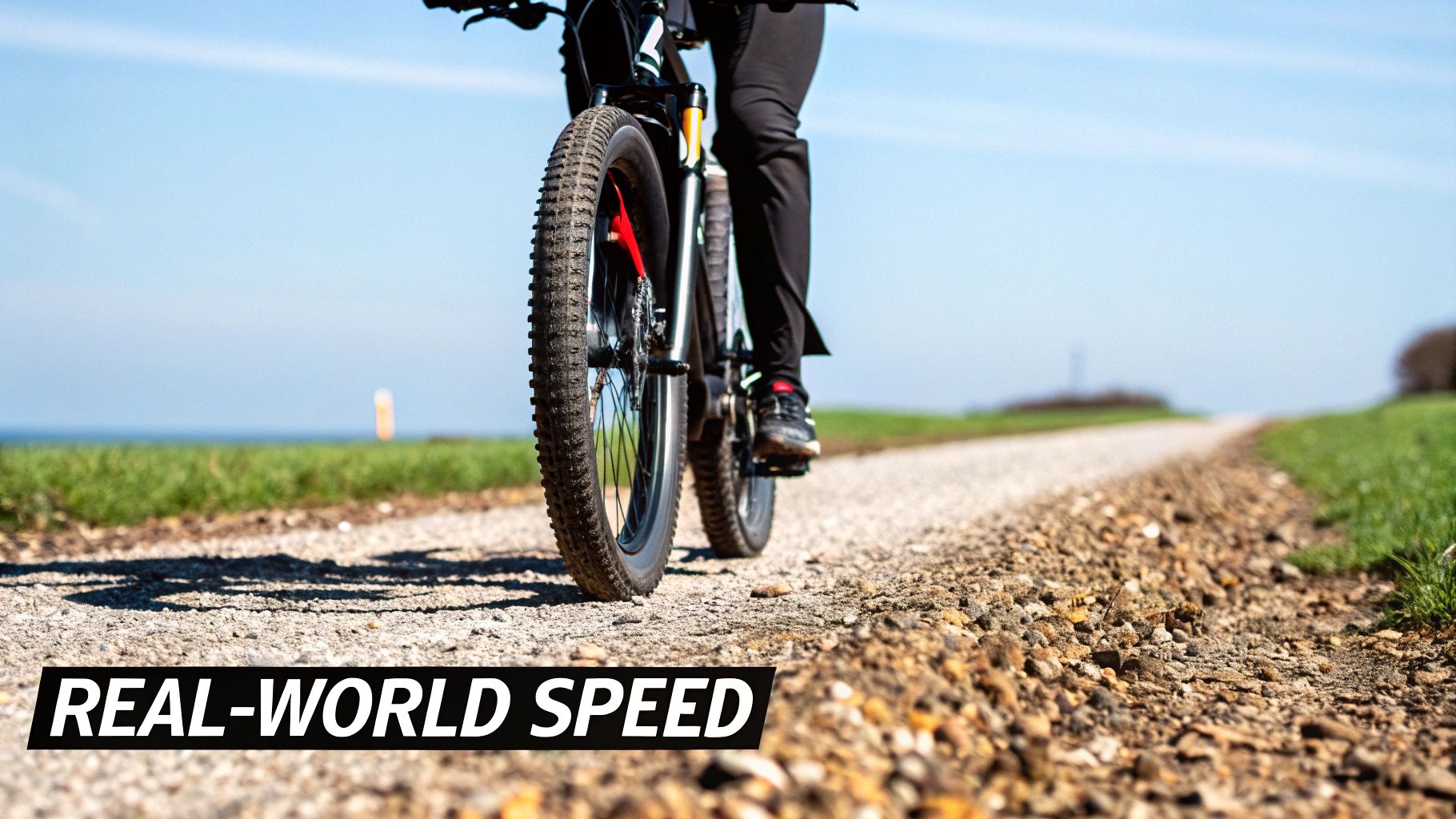
A powerful motor and a high-voltage battery are the heart of a fast e-bike, but they don't tell the whole story. Once you hit the pavement, a whole new set of forces takes over. It’s like having a race car engine—you still need the right tires and an aerodynamic body to actually win the race.
Your e-bike is no different. The top speed listed on the box is a number achieved in a perfect, sterile lab environment. Out in the real world, things like your gearing, tire choice, total weight, and even your riding posture are what truly determine how fast you can go. These elements can either help you cruise past that advertised number or hold you back significantly.
The Impact of Weight and Aerodynamics
Physics is your silent riding partner, and it never takes a day off. Two of its biggest rules involve weight and wind resistance, and getting a handle on them is the key to unlocking better performance.
The total weight—that’s you, your bike, and any cargo you’re carrying—has a direct impact on acceleration and climbing. A lighter setup needs less energy to get moving and even less to fight gravity on a hill. While a few extra pounds might not slash your top speed on a flat road, it will definitely make the motor work harder and drain your battery much faster.
Then there’s aerodynamics, the invisible wall you’re pushing against every second you ride. The faster you go, the harder it pushes back.
It's a surprising fact: at speeds above 15 mph, wind resistance becomes the single biggest force you have to overcome. Just tucking your body down a bit can shrink your profile and make a huge difference in drag.
This is why you see pro cyclists hunched over their handlebars. It’s not just for show; it’s a smart way to slice through the air and maintain a higher speed with less work.
How Gearing and Tires Make a Difference
Beyond the big forces of physics, the parts of your bike that actually touch the world play a massive role. Your gears and tires are where the rubber meets the road—literally—and they can completely change the character of your ride.
-
Tire Selection: Big, knobby mountain bike tires are brilliant for gripping a muddy trail, but on smooth asphalt, they create a ton of rolling resistance. That friction is like a constant, tiny brake slowing you down. On the other hand, smoother, narrower commuter tires have less road contact, which means less resistance and a faster, more efficient roll.
-
Gearing Efficiency: Just like on a regular bike, using your gears properly is crucial. Starting in a low gear helps the motor get you up to speed without straining. As you gain momentum, shifting into higher gears lets you pedal along and help the motor maintain that top speed. Smart shifting keeps both the motor and your legs in their happy place, working efficiently.
Commuters vs. Trail Blazers: Why Not All E-bikes Are Built for Speed
To really get a feel for top speed, you have to look at how e-bikes are built and what they're built for. The motors, batteries, and other parts we've talked about aren't just thrown together randomly; they're all chosen to create a specific kind of ride. Let's pit two very different types of e-bikes against each other to see what I mean.
On one side, you have a classic urban commuter, something like the UGBEST MB750. This bike is made for the daily grind—getting to work, running errands, and zipping through city streets. Its main job is to be reliable, efficient, and to get you around traffic safely, all while playing by the rules. The motor is tuned for a smooth, gentle push off the line at a stoplight, not for neck-snapping acceleration.
Everything about its design supports that mission. It has thinner, smoother tires that roll easily on pavement, a comfortable, upright riding position, and a frame that can take on a pothole without flinching. For a bike like this, a top assisted speed of 20 or 28 mph isn't just a limit; it's the sweet spot for getting around town without drama.
The Off-Road Powerhouse
Now, let's flip the script and look at a totally different animal: an off-road beast like the VETRA BLAZER. This machine is built with a single-minded purpose—unleashing maximum performance on private trails where speed limits are a foreign concept. It trades street legality and commuter comfort for raw, unfiltered power.
Here, you're going to find a monster of a motor paired with a high-voltage battery system, all designed for brutal, instant torque. Every single part is beefed up for the insane demands of off-road riding:
- Robust Suspension: Think long-travel forks and heavy-duty rear shocks built to soak up massive hits from jumps and rock gardens.
- Knobby Tires: These are essential for clawing into dirt, mud, and gravel to find grip where a road tire would just spin.
- Aggressive Gearing: The drivetrain is all about delivering massive torque to power up ridiculously steep and technical climbs.
It's in this category of unrestrained performance that the line between an "e-bike" and an electric motorcycle gets pretty blurry. These bikes are engineered to be pushed to their limits, chasing a thrill you simply can't find on a city street.
The following table breaks down the core differences between these two philosophies, showing why one is perfect for your commute and the other is built for the weekend warrior.
E-bike Speed Showdown: Urban Commuter vs. Off-Road Dirt Bike
| Feature | Urban E-bike (e.g., MB750) | Electric Dirt Bike (e.g., VETRA BLAZER) |
|---|---|---|
| Primary Use | City commuting, daily errands | Aggressive trail riding, off-road recreation |
| Top Speed | Legally limited (e.g., 20-28 mph) | Unrestricted (often 50+ mph) |
| Motor Power | 250W - 750W | 3,000W - 8,000W+ |
| Battery | Optimized for range & efficiency | Optimized for max power output |
| Tires | Narrow, slick for pavement | Wide, knobby for dirt/mud traction |
| Suspension | Minimal or short-travel | Long-travel, heavy-duty |
| Legal Status | Street-legal as a bicycle | Not street-legal; for private property only |
As you can see, the performance gap is massive, because the intent behind the design is completely different. One is a practical tool, the other is a high-performance toy.
And just how fast can electric two-wheelers go when you throw all the rules out? In 2021, the Voxan Wattman absolutely demolished the electric motorcycle speed record, hitting a mind-boggling 283.182 mph on a closed course. You can read more about this incredible feat of engineering to see what's possible when performance is the only goal.
Ultimately, comparing these two makes it crystal clear: e-bike top speed is all about purpose. One gets you to work, and the other gives you an adrenaline rush.
The Tradeoff Between Speed and Battery Range
Every e-bike rider knows the feeling. You want to feel the wind in your hair, but you also need enough juice to get home. This is the classic balancing act: speed versus range.
Think of your e-bike's battery as the gas tank in a car. If you're constantly flooring it from a dead stop and weaving through traffic, you'll burn through that tank of gas in no time. But if you cruise at a steady, efficient speed on the highway, you can go for miles. Your e-bike works the exact same way.
When you push your bike to its top speed, especially just using the throttle, you're asking the motor and battery to work overtime. It has to pull a huge amount of power to fight wind resistance and keep you moving that fast. This constant high-current draw is what makes your battery meter nosedive.
How Speed Sucks Your Battery Dry
Here’s the thing most people don't realize: the relationship between your speed and how much power you use isn't a straight line. It’s exponential.
That means doubling your speed takes way more than double the power. As you go faster, wind resistance becomes the biggest enemy, and your motor needs to work incredibly hard just to maintain that pace.
For instance, cruising along at a comfortable 15 mph might barely sip power from your battery. But trying to hold a 28 mph pace could easily guzzle three or four times as much energy to cover the same distance. That's a massive difference, and it’s why your estimated range seems to vanish into thin air when you're flying.
The core takeaway is simple: the faster you go, the shorter your ride will be. Pushing the limits all the time can easily slash your potential range by 30-50%, sometimes even more, compared to riding at a more sensible pace.
Finding the Sweet Spot for Your Ride
The good news? You're the one in control. Finding that perfect balance between a thrilling ride and a practical one is all about making a few smart choices. With a little adjustment, you can seriously extend how far you get on a single charge.
Here are a few tips that actually work:
- Ease Up on the Assist: "Turbo" mode is fun, but it's a battery killer. Stick to lower pedal-assist levels on flat ground to save a ton of energy.
- Be the Engine: Your legs are a free, rechargeable power source! Use the motor to assist your pedaling, not replace it. The more you pedal, the farther you'll go.
- Ride Smooth: Constant acceleration and braking burns through your battery. Try to maintain a steady, consistent speed instead of constantly speeding up and slowing down.
Mastering this balance is the key to getting the most out of every ride. For a deeper dive into battery care, check out our guide on how long ebike batteries last.
Riding Fast and Staying Safe
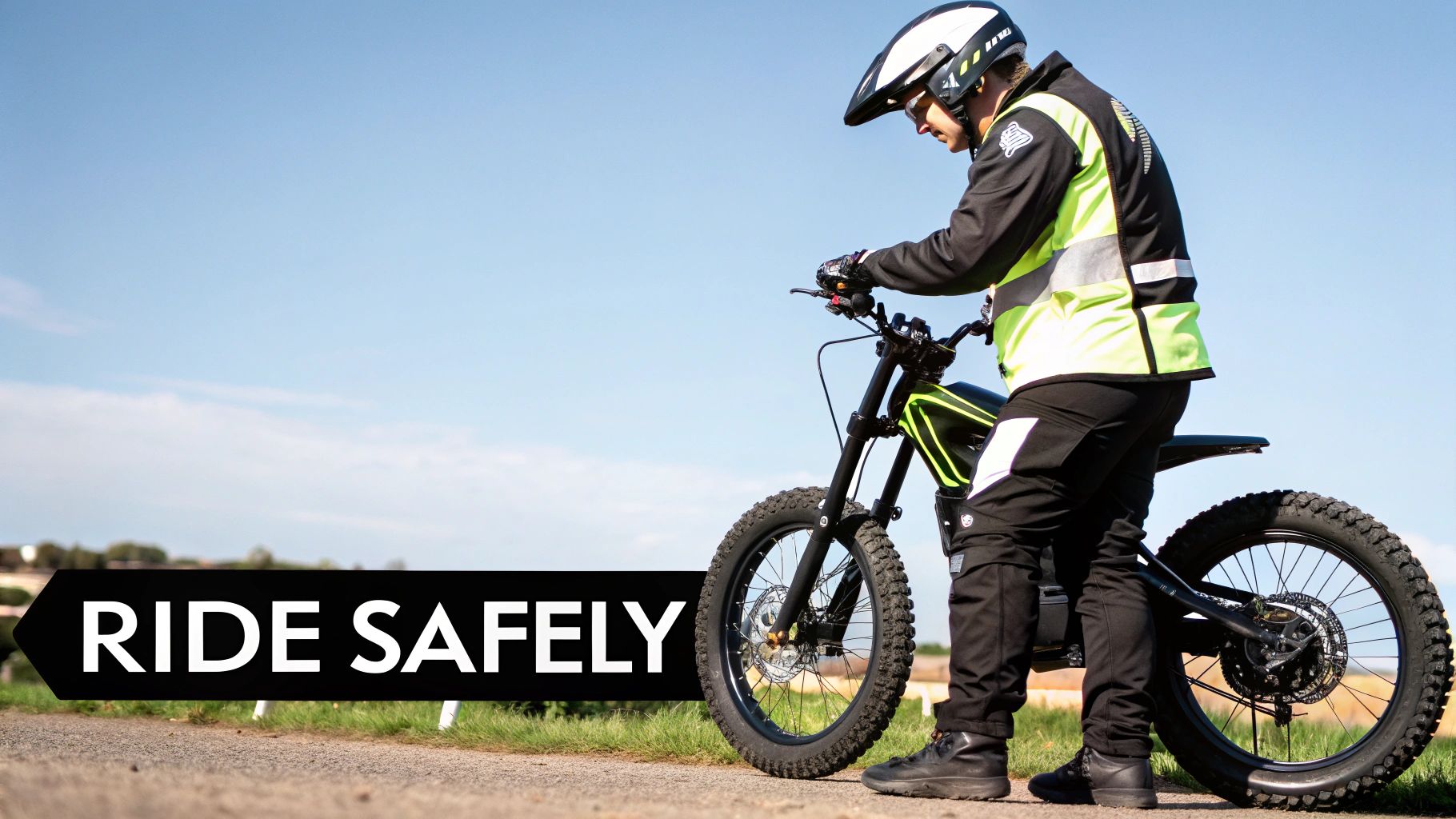
There's no denying it—hitting top speed on an e-bike is a thrill. But as the miles per hour climb, so does the need to get serious about safety. More speed means more responsibility, and that starts with having the right gear before you even clip in. Think of it as your first line of defense.
A top-quality, certified helmet is the single most important piece of gear you'll ever own. Don't settle for less. In the US, look for a CPSC (Consumer Product Safety Commission) sticker, which means it’s passed serious impact testing. If you’re pushing the limits, a full-face helmet that protects your chin and jaw is an even smarter investment.
And don't forget the rest of your body. Abrasion-resistant jackets, proper riding gloves, and sturdy closed-toe shoes can be the difference between a minor scrape and a major injury if you take a spill. The old motorcycle wisdom applies here: dress for the slide, not just for the ride.
Your Brakes Are Your Best Friend
All that power is useless without control. On a fast e-bike, your brakes aren't just a feature; they're the most critical performance component you have. The faster you go, the longer it takes to stop. It's simple physics, and it’s why powerful, reliable brakes are an absolute must.
- Hydraulic Disc Brakes: This is the gold standard for a reason. They deliver way more stopping power and finer control (what riders call "modulation") than older mechanical brakes. Plus, they work just as well in the pouring rain as they do on a dry, sunny day.
- Regular Maintenance: Brakes aren't a "set it and forget it" part. You need to keep an eye on your brake pads for wear and make sure your system is working perfectly. A well-maintained set of brakes can literally save your skin.
When you're riding at higher speeds, you have to be conscious of the potential for e-bike accidents and do everything you can to prevent them. Nothing is more important than your ability to stop on a dime.
Situational Awareness is Key
At the end of the day, the best safety feature isn't on your bike—it's you. Always be scanning the road ahead, trying to anticipate what drivers, pedestrians, and other cyclists are going to do next.
Know your local e-bike laws, respect the speed limits, and stick to paths where you're legally allowed to ride. Riding fast is a blast, but riding smart is what ensures you get to do it again tomorrow.
E-Bike Speed: Your Questions Answered
Let's dig into some of the most common questions riders have about how fast e-bikes really go. Getting these concepts straight will help you understand your bike better and ride smarter.
Can I Legally Remove My E-Bike's Speed Limiter?
This is a big one, and the short answer is almost always no. That speed limiter is what keeps your e-bike classified as a bicycle under the law, whether it's a Class 2 or Class 3.
Messing with it does two things, neither of them good. First, you've likely just created an unlicensed motor vehicle, making it illegal to ride on bike paths and public roads. Second, you can kiss your warranty goodbye. Manufacturers will void it in a heartbeat.
Beyond that, you're playing with fire. The controller, motor, and battery are designed to work together as a balanced system. Bypassing the controller—the brain of the operation—is like redlining a car engine 24/7. It puts a ton of stress on all the components and is a recipe for an expensive, premature failure.
Does a 750W Motor Automatically Mean a Faster E-Bike?
Not really, at least not in the way most people think. A 750W motor gives you a huge boost in torque—that raw, get-up-and-go power. You'll accelerate way faster and conquer hills with much less effort compared to a 250W motor.
But the bike's top assisted speed is still governed by its legal classification and what the controller is programmed to do.
A Class 2 e-bike with a burly 750W motor is still legally capped at 20 mph of assistance. It will feel like a beast getting there, but the motor will stop helping you right at that 20 mph mark, just like a less powerful Class 2 bike would.
Think of it this way: a powerful engine doesn't change the speed limit on the highway. Wattage is about muscle, not the legally allowed ebike top speed.
How Much Does My Weight Impact Top Speed?
Your weight plays a much bigger role in acceleration and range than it does on your absolute top speed on a flat road.
Heavier riders make the motor work harder to get going and to maintain speed, especially on hills. This draws more power from the battery, which you'll see reflected in your total range.
Once you’re cruising on a flat, level surface, though, the motor can almost always get you to its programmed speed limit. The main difference you'll feel is how long it takes to reach that speed and how much juice you burned to get there.
Ready to experience the perfect blend of power, performance, and legal compliance? Explore the full range of electric bikes at eBike Gang, LLC and find the ride that’s built for your adventure. Visit us today at https://ebikegang.com to find your next ebike.