

Think of your e-bike charger as more than just a plug and a cord. It’s the lifeline for every ride, the single most important piece of gear for keeping your battery healthy and your adventures going.
Getting the charging process right is absolutely crucial for the long-term health of your e-bike, your safety, and getting the performance you paid for. Let's break down what really matters.
Your E-Bike Charger Is The Heartbeat Of Your Ride
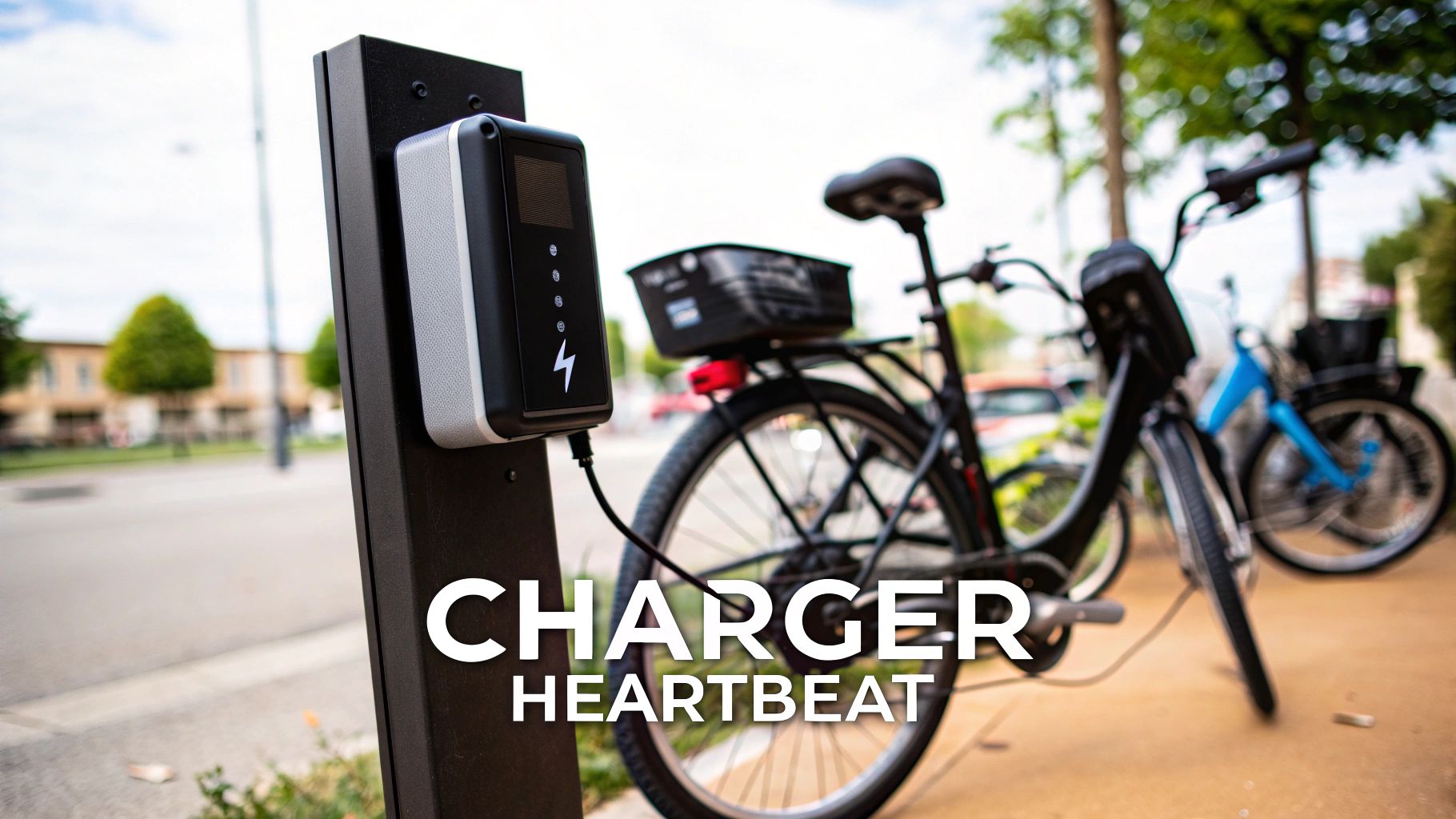
It’s easy to see the charger as just an accessory, but it’s better to think of it as your e-bike's heart. It's the device that methodically pumps electrical energy back into the battery, getting it ready for whatever you throw at it next. A strong, reliable heart is vital for performance, and the same goes for your charger—it's the key to unlocking your bike's true range, power, and overall lifespan.
This guide will help you see past the plastic box and understand the critical piece of tech that truly dictates your freedom on two wheels. Knowing your charger inside and out is the best way to protect your investment and guarantee years of happy riding.
Why Your Charger Matters So Much
It’s not just about plugging it in and forgetting about it. Having a solid grasp of how your charger works directly affects your entire e-bike experience in a few key ways.
- Maximizing Battery Lifespan: The right charger works hand-in-glove with your battery’s internal management system. This prevents overcharging and unnecessary stress, both of which can drastically shorten its operational life.
- Ensuring Rider Safety: This is a big one. Using a cheap, incompatible, or damaged electric bike charger is one of the top causes of battery fires and other accidents. Sticking with the correct, high-quality equipment is your number one defense.
- Unlocking Full Performance: Whether you're cruising on a commuter model like the UGBEST MB750 or hitting the trails, your bike can only deliver the power and range it was designed for when its battery is charged properly.
To truly appreciate the role of your charger as the heartbeat of your ride, understanding the factors that determine how long ebike batteries last is essential.
Knowing this stuff gives you the confidence to pick the right charger, use it correctly, and take care of it like a pro. And you’re not alone—the e-bike boom is real. The market for electric bike chargers hit an incredible USD 1.2 billion in 2024 and is on track to more than triple to USD 3.5 billion by 2032. It's all part of a huge global shift toward electric transportation.
Decoding Your Charger's Technical Specifications
That little black box that juices up your e-bike? It's more than just a plug. The label on your electric bike charger is packed with information that might look like gibberish at first, but it’s the key to your battery's health and performance.
Getting these specs right isn't just about charging speed. It's about safety. Using the wrong charger can, at best, fail to charge your bike. At worst, it can cause permanent damage to your battery or create a serious hazard. Let's break down what those numbers actually mean so you can keep your ride ready and your battery healthy for years to come.
To make things simple, think of your battery as a water tank and the charger as the hose filling it up.
E-Bike Charger Specs At a Glance
Here’s a quick rundown of the three core electrical specs you'll find on any charger label. Understanding them is the first step to becoming a pro at e-bike maintenance.
| Specification | What It Means (Analogy) | Why It Matters |
|---|---|---|
| Voltage (V) | The water pressure in the hose. | Must match your battery’s voltage. Too high, and you'll damage the battery; too low, and it won't charge at all. |
| Amperage (A) | The flow rate of the water. | Determines charging speed. Higher amps mean a faster charge but can generate more heat and stress on the battery over time. |
| Wattage (W) | The total power delivered (Pressure x Flow). | A quick way to compare the overall power of different chargers. More watts generally means a faster charge. |
By keeping these three things in mind, you can instantly tell if a charger is right for your bike.
Voltage: The Pressure Behind The Power
Voltage, measured in Volts (V), is the single most important spec to get right. In our water tank analogy, this is the pressure. You need just the right amount of pressure to fill the tank—too little and nothing happens, too much and the tank could burst.
It’s the same story with your e-bike battery. The charger's voltage must be compatible with your battery's voltage. A 48V battery needs a charger designed for a 48V system. Simple as that. A lower voltage charger just won’t have the oomph to charge the battery. A higher voltage charger will fry the battery’s sensitive internal circuits, killing it instantly.
Mismatching voltage is one of the fastest ways to permanently damage an e-bike battery. Always confirm the charger's output voltage (e.g., 54.6V for a 48V battery) matches your battery’s requirements before plugging it in.
This is a non-negotiable rule. You can find the voltage printed right on your battery or in your bike's manual. For instance, the eBike Gang UGBEST MB750 has a very specific voltage requirement, and only the correct charger will do the job safely.
Amperage: The Speed Of The Flow
If voltage is the pressure, then amperage (Amps or A) is the flow rate—how fast the current is moving into your battery. The higher the amps, the faster your battery will charge.
Most standard e-bike chargers are around 2A. You might see "fast chargers" rated at 4A or even 5A. While getting back on the road faster is great, it's a bit of a trade-off. Pushing a lot of current into a battery quickly generates more heat and puts more strain on its internal cells, which can shorten its overall lifespan if you do it all the time.
A good way to think about it is:
- 2A Charger: A slow and steady charge. Perfect for plugging in overnight, as it's gentler on the battery and great for its long-term health.
- 4A Charger: A quick top-up. Ideal for when you need to get some juice in before a ride, but best used in moderation.
Thankfully, your battery has a built-in "gatekeeper" called the Battery Management System (BMS) that prevents it from taking in more current than it can safely handle. Still, the best practice is to stick with the charger amperage recommended by your bike's manufacturer.
Wattage: The Total Power Output
Finally, there’s wattage (W). This is just a simple way to talk about the charger’s total power output. You get this number by multiplying the other two specs.
Volts (V) x Amps (A) = Watts (W)
So, a standard 48V charger with a 2A output is a 96W charger (48 x 2 = 96). A faster 4A charger for that same battery would be a 192W charger.
Wattage gives you a quick, at-a-glance way to compare the overall punch of different chargers. A higher number means more power and a faster charge—just remember what we said about speed versus battery longevity
Choosing The Right Charger And Connector Type
Stepping into the world of electric bike chargers can feel a bit like trying to find the right key for a very specific lock. With so many options out there, from the one that came in the box to countless third-party alternatives, making the right call is critical for your bike's health and your own safety.
A charger isn't just a simple power cord. It’s a vital piece of equipment that directly impacts how fast your battery juices up and, more importantly, how long that battery will last. Let's break down the key differences to make sure you can confidently pick the perfect match for your ride.
OEM vs Aftermarket Chargers
When you need a new or spare charger, your first big decision is whether to stick with the Original Equipment Manufacturer (OEM) charger or grab a cheaper aftermarket one. I'll be honest—while a low price tag on a generic charger is tempting, it’s a gamble that almost never pays off in the long run.
An OEM charger is the one designed and certified by your bike's manufacturer, like the specific ones made for the eBike Gang UGBEST MB750 or VETRA BLAZER. It’s been precisely engineered to talk to your battery's management system, delivering the exact voltage, amperage, and charging profile it needs to thrive.
Using an OEM charger is your best guarantee for safety and performance. It's built to the exact specifications of your battery, which minimizes the risk of overheating, overcharging, or other electrical faults that could permanently damage your battery or even create a fire hazard.
Aftermarket chargers are made by third-party companies and often claim to be "compatible." While a few reputable brands exist, many are cheaply made. They might not meet safety standards or could deliver an inconsistent current, slowly chipping away at your battery's health and potentially even voiding your e-bike’s warranty. That peace of mind and reliability you get with an OEM charger is well worth the investment.
Standard Chargers vs Smart Chargers
Beyond who makes the charger, the technology inside makes a huge difference. The two main types you'll encounter are standard "brick" chargers and the more advanced "smart" chargers.
-
Standard Chargers: Think of these as the straightforward workhorses. They deliver a steady flow of power until the battery is full, then they simply shut off. They get the job done but don't have the sophisticated features needed to truly optimize your battery's health.
-
Smart Chargers: These are the brains of the operation. A smart charger is in constant communication with the battery's BMS. It can adjust the charging rate based on the battery's temperature and how full it is, often slowing the current down as it approaches 100% to reduce stress on the cells. This intelligent process can significantly extend the overall lifespan of your battery.
Thankfully, most modern e-bikes, including all models from eBike Gang, come equipped with smart chargers. This technology is a huge reason why today's batteries last longer and perform more reliably than ever before.
A Visual Guide To Common Connector Types
The final piece of the puzzle is the physical plug. Even if the voltage and amps are perfect, a charger is useless if it can't connect to your battery. This is a common and frustrating mistake. Here are some of the most prevalent connector types you'll see on the trail.
-
XLR Connectors: These beefy connectors look like something you'd find on a professional microphone cable, with three or four pins. They click securely into place, providing a rock-solid connection that's known for its durability.
-
Coaxial (Barrel) Connectors: This is probably the most common type out there, resembling the plug on a standard laptop charger. It’s a simple, single-pin design that’s easy to use, but you have to be absolutely sure the pin and barrel diameter are an exact match.
-
Rosenberger Connectors: Often found on higher-end e-bikes, these are a premium, high-tech option. They use magnets to create a secure, self-aligning connection that’s both incredibly safe and satisfyingly easy to snap into place.
Before buying any replacement electric bike chargers, do yourself a favor and double-check your e-bike’s manual or look at the original charger to identify the exact connector you need. This simple step can save you a world of hassle. Speaking of gear, you can explore more must-have items in our guide on the best electric bike accessories.
This decision tree helps visualize the simple checks you need to make every time.
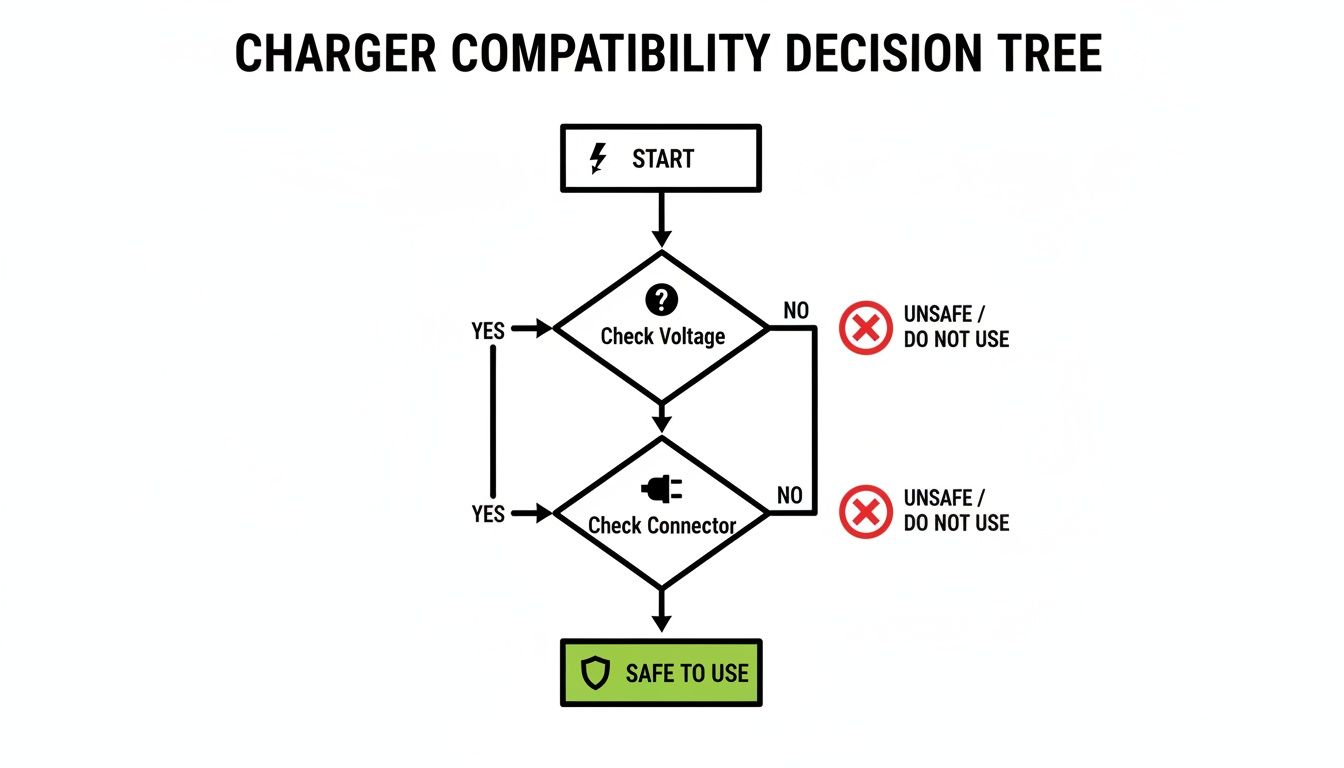
As this guide shows, safety is a two-step process: you need a perfect match in both the electrical specs and the physical plug.
The need for reliable charging is exploding well beyond our home garages. The global market for e-bike charging stations is expanding rapidly as electric bikes become a permanent fixture in cities and on trails. The market was valued at USD 3,113.3 million in 2025 and is projected to hit USD 4,141.2 million by 2032. This growth just underscores how important standardized and safe charging infrastructure has become.
How To Charge Your E-Bike Safely And Efficiently
Properly charging your e-bike is about so much more than just plugging it in. Think of it as a crucial maintenance routine—just as important as checking your tire pressure or cleaning the chain. It’s a deliberate process that has a huge impact on your battery's long-term health, its day-to-day performance, and most importantly, your safety.
By adopting a few simple but powerful habits, you can seriously extend the lifespan of your battery. This means getting the maximum number of charge cycles and miles out of your investment. It's not about memorizing rules; it's about understanding what makes your battery tick and working with it, not against it.
The 80/20 Rule For Optimal Battery Health
One of the best-kept secrets for a long-lasting lithium-ion battery is the 80/20 Rule. The concept is incredibly simple: whenever possible, try to keep your battery’s charge level between 20% and 80%. Why? Because constantly pushing it to a full 100% or letting it die completely puts a lot of stress on the battery's internal cells.
Think of it like a balloon. If you inflate it to its absolute maximum capacity every single time, the material will weaken and become more likely to pop. It's the same idea with your battery. Keeping it at its voltage extremes—either fully charged or totally empty—degrades the chemistry inside much faster. Sticking to the 80/20 guideline keeps the battery in its "happy zone" where it experiences the least amount of stress.
Of course, if you have a long ride planned and need every bit of range, charging to 100% is totally fine. Just try not to make it a daily habit if you don't have to. For a deeper look at battery care, check out our complete guide on how long do e-bike batteries last.
Your Essential Charging Safety Checklist
When you're dealing with powerful electric bike chargers and batteries, safety has to be your number one priority. The great news is that keeping things safe is easy if you build a consistent routine.
Here’s a practical checklist to run through every time you plug in:
- Find the Right Spot: Always charge your battery indoors in a dry, well-ventilated space with a moderate temperature. Stay away from direct sunlight, damp basements, or freezing cold garages.
- Stick with the Original: Only use the Original Equipment Manufacturer (OEM) charger that came with your e-bike. Whether it's for the UGBEST MB750 or the VETRA BLAZER, that specific charger is designed to communicate perfectly with your battery’s management system (BMS).
- Do a Quick Inspection: Before plugging anything in, give your charger and its cables a quick once-over. If you see a frayed cord, a cracked casing, or bent connector pins, don't use it.
- Don't Charge and Go: Modern smart chargers are great and have auto-shutoff features, but it's still best practice not to leave a battery charging overnight or while you're out of the house.
Following these basic safety steps is non-negotiable. While e-bike chargers have their own specific needs, many of the core principles of safety overlap with what's seen in electric car home charging practices.
Calculating Your E-Bike Charging Time
Ever found yourself wondering exactly how long it'll take to get back on the road? You don't have to guess. There’s a straightforward formula that gives you a surprisingly accurate estimate, so you can plan your rides better.
Battery Capacity (Ah) ÷ Charger Output (A) = Charging Time (Hours)
Let's break that down. Say you have a 15Ah (Amp-hour) battery and you're using a standard 2A (Amp) charger. The math looks like this:
15Ah ÷ 2A = 7.5 hours
That's it! It will take roughly 7.5 hours to charge your battery from completely empty to completely full. This simple calculation puts you in control, letting you know exactly when your bike will be ready for its next adventure.
Troubleshooting Common E-Bike Charger Problems
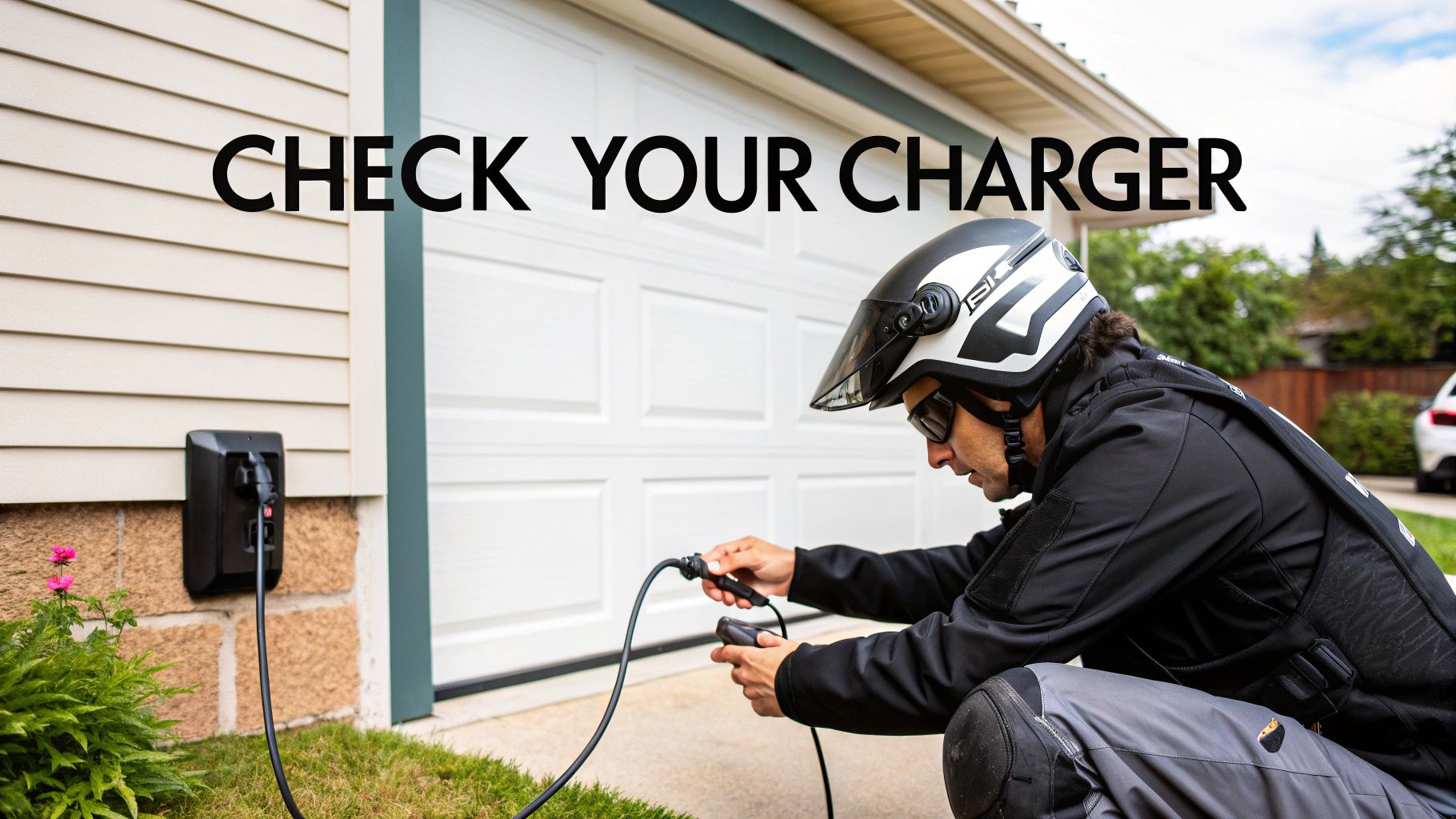
So, you’ve plugged in your e-bike, but nothing’s happening. It’s a frustrating moment for any rider, but don't panic. More often than not, the solution is surprisingly simple, and a little systematic troubleshooting can get you back up and running.
This guide will walk you through the most common hiccups, step-by-step. Learning to spot these signs means you can handle minor issues on your own and get back to what you love—riding.
Initial Diagnostic Checklist
Before you start worrying about complex electrical faults, let’s cover the basics. You'd be surprised how many "broken" chargers are fixed with these simple checks.
- Check the Power Outlet: First things first, is the outlet even working? Grab a lamp or your phone and plug it in to make sure you have power.
- Secure All Connections: Wiggle the plugs. Make sure the charger is pushed all the way into the wall and that the connector is snug in your bike's charging port. A loose connection is the number one cause of charging failures.
- Inspect All Cables: Give the cords a quick once-over. Look for any visible damage like cuts, frayed wires, or bent pins on the connector end.
If you’ve run through this list and still have no luck, it's time to dig a little deeper.
Problem: The Charger Light Won’t Turn On
You plug in the charger, and... nothing. No light, no hum, just silence. This is a dead giveaway that power isn't flowing through the charger at all.
After you've confirmed the wall outlet is live, the charger itself is the next suspect. Some chargers have an external fuse on the case or plug. If you see one, check if it's blown—a quick replacement could be all you need.
If there's no fuse or a new one doesn't help, the charger's internal guts have likely failed. Don't try to be a hero and repair it yourself; it’s not safe. The only real solution here is to get a new charger.
A dead charger light is a clear signal to stop and investigate. Continuing to use a potentially faulty charger poses a significant safety risk, so never ignore this warning sign.
Problem: The Light Stays Green When Connected
The charger light is supposed to be red or orange while charging and turn green when it's done. But what if it goes straight to green the second you plug it into a dead battery? This usually means the charger can't "see" that the battery needs juice.
Often, this points to an issue with the battery’s built-in Battery Management System (BMS) or a bad connection at the charging port. Take a close look at the port on your e-bike. Is there any dirt, dust, or gunk in there? Sometimes debris can prevent the connector from making solid contact.
If the port is clean and the connection feels solid, the problem is likely inside the battery itself. For specific advice on your model, it's always best to consult the official eBike Gang user manuals on our website.
Problem: The Charger Gets Excessively Hot
It’s completely normal for electric bike chargers to get warm while they work. They're busy converting AC power from your wall outlet into DC power for your battery, and that process generates heat. But there’s a big difference between warm and hot. If your charger is too hot to comfortably touch, unplug it immediately.
Excessive heat is a major red flag and usually points to one of three things:
- Poor Ventilation: Is the charger buried under a pile of clothes or tucked away in a cramped space? It needs to breathe. Make sure it's in an open area with its air vents clear.
- Internal Fault: Serious overheating can mean a component inside is failing, which is a genuine fire hazard.
- Incompatibility: Using a charger that wasn't designed for your battery can force it to work too hard, leading to dangerous temperatures.
If giving the charger more space to cool down doesn't solve the problem, stop using it for good and get a proper replacement. Your safety isn't worth the risk.
Your Guide to E-Bike Charger Questions
When it comes to electric bike chargers, a lot of questions pop up. It makes sense—you want to do things right. Getting good, clear answers is the key to charging confidently, protecting your bike, and making sure every ride is a safe one.
Let's dive into the most common questions we hear from riders. Think of this as your quick reference for sorting out everything from which charger to use to the best way to handle it daily.
Can I Use Any Charger With My Electric Bike?
In a word: no. This is one area where you absolutely can't mix and match. You should always use the specific charger that came with your e-bike or an exact replacement from the manufacturer.
Why the strict rule? An incompatible charger isn't just a bad idea; it's a serious safety risk. Using the wrong one can permanently damage your battery, create a fire hazard, and you can bet it will void your warranty instantly. The charger's voltage and the battery's voltage have to be a perfect match, and the connector plug has to fit just right to make a safe connection.
Is It Safe To Leave My E-Bike Charging Overnight?
This is a common one. While most modern e-bike chargers are "smart"—meaning they automatically shut off when the battery is full—it's still not the best habit to leave it charging unattended for long stretches, especially overnight.
The safest bet is to unplug the charger once your battery hits 100%. This simple step does more than just prevent accidents; it also helps extend your battery's overall lifespan. Batteries don't love sitting at a full state of charge for hours on end, so unplugging it gives it a break.
How Can I Make My E-Bike Charger Last Longer?
Your charger is a tough piece of equipment, but it's not indestructible. A little bit of care goes a long way in making sure it lasts for years.
- Handle Gently: It sounds obvious, but try not to drop it or yank the cord out of the wall.
- Store Properly: Find a cool, dry spot for it. Extreme heat or cold isn't its friend.
- Keep It Clean: The little vents on the charger are there for a reason—to keep it from overheating. Make sure they stay clear of dust and gunk.
- Coil Loosely: When you're putting it away, don't wrap the cord super tight. A loose coil prevents stress on the internal wires.
A well-maintained charger is a reliable charger. Treating it like the essential piece of equipment it is ensures it will be ready to power countless future adventures.
What Do The Lights On My E-Bike Charger Mean?
Those little lights are your charger's way of talking to you. While the exact colors might vary a bit from brand to brand, they almost always follow the same basic logic.
Typically, a red light means the battery is currently charging. When the light turns green, it's telling you the job is done and the battery is full. If you see a green light when the charger is plugged into the wall but not your bike, that just means it has power and is ready to go. If you ever spot a flashing light or a color you don't recognize, check your owner's manual right away—it could be signaling a problem.
Ready to ride with confidence? Explore the powerful and reliable electric bikes and dirt bikes from eBike Gang. Find your perfect match and all the essential accessories on our website.