

Trying to figure out electric bike laws by state can feel like untangling a mess of wires, especially since the rules can change the second you cross a state line. But there's a key to making sense of it all: the three-class system. It’s the framework most states use to define what an e-bike is based on its speed and motor, which in turn determines where you're legally allowed to ride.
Understanding The Three-Class E-Bike System
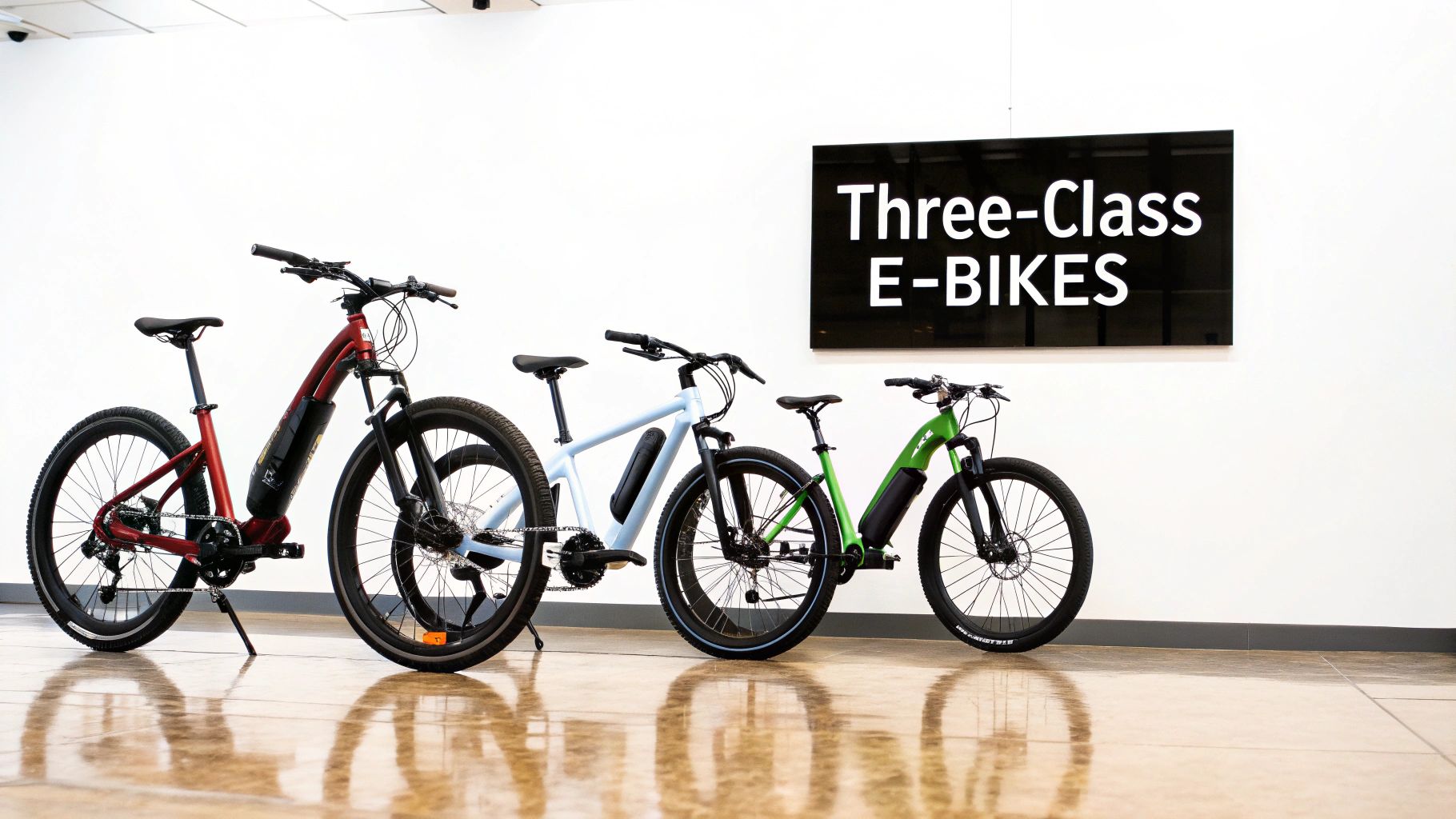
Before we get into the nitty-gritty of individual state laws, you need to get a solid handle on this three-class system. Think of it as the foundation for everything else. The vast majority of states have adopted this framework to standardize how e-bikes are categorized, which makes understanding local rules a whole lot easier. Without it, you’re just guessing when it comes to age limits, helmet laws, and trail access.
The system really boils down to two simple things: how the motor helps you go (do you have to pedal, or can you use a throttle?) and the top speed the motor will help you reach before it cuts out.
The Three Classes Explained
The good news is that you don't have to guess what class your bike is. Manufacturers are required to put a label on the bike—usually on the frame—that clearly states its classification. This sticker is your cheat sheet for staying on the right side of the law.
Here’s a quick breakdown of each category:
- Class 1 E-Bike: The motor on these bikes only kicks in when you're actively pedaling, a feature known as pedal-assist. It will stop helping you once you hit 20 mph. Because they function most like a traditional bicycle, these are the most widely accepted e-bikes and are generally allowed wherever regular bikes can go.
- Class 2 E-Bike: This class also tops out at an assisted speed of 20 mph, but it comes equipped with a throttle. This means you can get the bike moving without pedaling at all, much like a moped. They are also very common, though some specific trails or paths might restrict throttle-only use.
- Class 3 E-Bike: As the speed demons of the group, these e-bikes are pedal-assist only (no throttle), but the motor will keep helping you all the way up to 28 mph. That extra speed means they often come with more rules, like mandatory helmets, minimum age requirements, and are frequently prohibited from multi-use paths.
This system has thankfully created a more predictable legal landscape for riders across the country. As of 2025, an impressive 44 out of 50 U.S. states have passed laws that specifically define electric bicycles. Digging deeper, 37 of those states have adopted this exact three-class model, which brings a welcome dose of consistency to the rules.
Knowing the difference between throttle power and pedal-assist is central to navigating these laws. If that's new territory for you, it’s worth reading our guide on what pedal assist on an e-bike means. Getting this basic knowledge down is the first real step toward riding legally and with confidence, no matter what state you're in.
Quick Reference Table of State E-Bike Laws
Trying to untangle the web of electric bike laws by state can feel like a full-time job. For riders who just need fast answers, this master reference table pulls together the most important e-bike regulations for all 50 states. Think of it as your go-to cheat sheet for checking the rules on the fly.
This at-a-glance format is perfect whether you're a daily commuter, a weekend trail rider, or traveling with your e-bike. Use it to get a quick read on the legal landscape before you head out, then jump to our detailed state-by-state breakdowns for the finer points.
State-by-State E-Bike Law Snapshot
This table gives you a high-level look at four key areas of the law: whether a state has adopted the industry-standard three-class system, the minimum age to ride, helmet requirements, and if you'll need a license or registration. Just remember, cities and counties can, and often do, add their own local rules, so a quick check of local ordinances is always a smart move.
A Quick Word of Caution: E-bike laws are still pretty new and can change. We work hard to keep this guide updated, but you should always treat your state's official Department of Transportation or legislative website as the final word.
| State | Adopts 3-Class System? | Minimum Age | Helmet Required For | License/Registration Required? |
|---|---|---|---|---|
| Alabama | Yes | 14 | Under 16 | Yes |
| Alaska | No | 14 | None | Yes |
| Arizona | Yes | None | None | No |
| Arkansas | Yes | 16 | Under 21 | No |
| California | Yes | 16 (Class 3) | All (Class 3), Under 18 (All) | No |
| Colorado | Yes | 16 | All Riders | No |
| Connecticut | Yes | 16 | All Riders | No |
| Delaware | Yes | 16 | All Riders | No |
| Florida | Yes | None | Under 16 | No |
| Georgia | Yes | 15 | All Riders | No |
| Hawaii | No | 15 | Under 16 | Yes |
| Idaho | Yes | 15 | Under 18 | No |
| Illinois | Yes | 16 | None | No |
| Indiana | Yes | 15 | All Riders | No |
| Iowa | Yes | None | None | No |
| Kansas | No | None | None | No |
| Kentucky | No | None | None | No |
| Louisiana | Yes | 15 | All Riders | Yes |
| Maine | Yes | 16 | All Riders | No |
| Maryland | Yes | 16 | All Riders | No |
| Massachusetts | No | 16 | All Riders | Yes |
| Michigan | Yes | 14 | Under 18 | No |
| Minnesota | Yes | 15 | None | No |
| Mississippi | Yes | None | None | No |
| Missouri | Yes | 16 | None | No |
| Montana | No | None | None | No |
| Nebraska | No | None | None | No |
| Nevada | Yes | None | None | No |
| New Hampshire | Yes | 16 | Under 18 | No |
| New Jersey | No | 15 | All Riders | Yes |
| New Mexico | No | 15 | Under 18 | Yes |
| New York | Yes | 16 | Under 14 (All), 16-17 (Class 3) | No |
| North Carolina | No | 16 | None | No |
| North Dakota | Yes | 14 | Under 18 | Yes |
| Ohio | Yes | 16 | Under 18 | No |
| Oklahoma | Yes | 16 | Under 18 | No |
| Oregon | No | 16 | None | No |
| Pennsylvania | No | 16 | None | No |
| Rhode Island | No | None | None | No |
| South Carolina | No | 18 | Under 21 | No |
| South Dakota | Yes | 16 | All Riders | No |
| Tennessee | Yes | 14 | Under 18 | No |
| Texas | Yes | 15 | None | No |
| Utah | Yes | 14 | Under 21 | No |
| Vermont | Yes | 16 | Under 18 | No |
| Virginia | Yes | 14 | None | No |
| Washington | Yes | 16 (Class 3) | All Riders | No |
| West Virginia | Yes | 15 | All Riders | Yes |
| Wisconsin | Yes | 16 | None | No |
| Wyoming | Yes | None | None | No |
Hopefully, this gives you the quick answer you were looking for. If you spotted something that needs a closer look—like why some states require registration or have specific age limits for Class 3 bikes—you'll find all those details in our full state-by-state legal guides that follow.
State E-Bike Law Directory: A to M
Trying to figure out e-bike laws can feel like untangling a giant knot. While the three-class system is a great starting point, every state throws its own spin on the rules for age, helmets, licensing, and where you can actually ride. This guide cuts through the confusion, breaking down the specific regulations for states from Alabama all the way to Missouri.
Think of this as your field guide to riding legally and confidently. Just remember, laws can change. It's always a smart move to double-check the official state resources we've linked in each section to get the absolute latest information.
For a quick overview, this chart gives you a bird's-eye view of the big three questions: Does the state use the class system? Is there a minimum age? And what's the helmet situation?
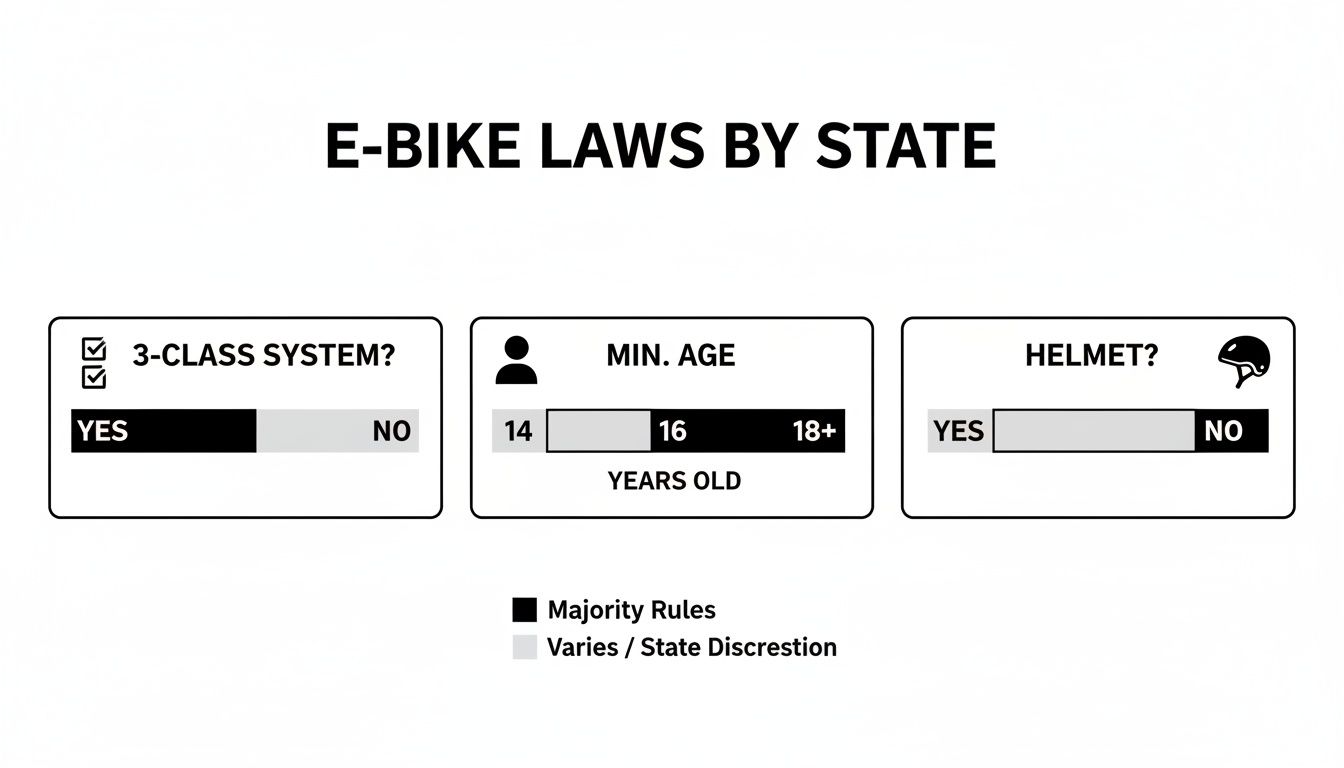
As you can see, the three-class framework is pretty common, but the rules on age and helmets are all over the map.
Alabama
Alabama keeps things simple by fully adopting the three-class system, treating e-bikes just like traditional bicycles. This means you get the same rights—and have the same responsibilities—as any other cyclist.
- Minimum Age: You need to be at least 14 years old to operate an e-bike.
- Helmet Law: Helmets are mandatory for all riders and passengers under the age of 16.
- Licensing and Registration: Here’s some great news: Alabama requires no license or registration for e-bikes.
- Where to Ride: You're good to go on roadways and bike paths, but stay off the sidewalks.
A Quick Local Tip: While state law is straightforward, cities like Birmingham or Mobile can have their own rules, especially in busy pedestrian zones. Always keep an eye out for local signs.
Arizona
If you're looking for a rider-friendly state, Arizona is it. The state uses the three-class system but doesn't tack on many extra restrictions, making it a fantastic place for e-bike enthusiasts of all ages.
There are no statewide age restrictions or helmet laws, leaving it up to individual towns and cities to make their own rules. Generally, e-bikes are welcome on roads, in bike lanes, and on multi-use paths where you'd normally see regular bikes.
California
California's e-bike laws are incredibly detailed and often serve as a blueprint for other states. The state follows the three-class system to the letter but gets specific, particularly when it comes to the more powerful Class 3 bikes.
- Class 1 & 2: No minimum age to ride. Helmets are required for anyone under 18. You can ride these on most paved surfaces where bicycles are allowed.
- Class 3: You must be at least 16 years old to ride a Class 3 e-bike. Helmets are mandatory for all riders, no matter their age. These faster bikes are typically not allowed on bike paths or multi-use trails unless a local ordinance specifically permits them.
No matter the class, you won't need a driver's license or registration for an e-bike in California.
Colorado
In Colorado, the law is built around the three-class structure, but it gives a lot of power to local governments to decide where e-bikes can and can't go.
While you're generally free to ride on roads and in bike lanes, access to sidewalks and multi-use paths can change dramatically from one county or city to the next. For instance, Denver's park rules are completely different from Boulder's trail system regulations.
- Minimum Age: There is no statewide minimum age requirement.
- Helmet Law: The state doesn't have a helmet law, but many local municipalities do, especially for younger riders.
- Class Restrictions: Local authorities have the final say on which e-bike classes are allowed on their trails. It's common to see Class 2 (throttle-assisted) and Class 3 (high-speed) e-bikes restricted on natural surface trails.
Florida
Florida is another state that rolls out the welcome mat for e-bike riders, treating them almost exactly the same as traditional bicycles. The state follows the three-class system and keeps statewide restrictions to a minimum.
You can ride your e-bike on streets, in bike lanes, and on the vast majority of paths open to bicycles. There's no minimum age to ride, and helmets are only required for riders under 16. You can also forget about licenses or registration.
Georgia
Georgia also aligns with the three-class model, granting e-bike riders most of the same rights as standard cyclists.
You have to be at least 15 years old to operate an e-bike here. A helmet is also required for anyone under the age of 16. E-bikes are welcome on roadways and paths, but they are generally prohibited on sidewalks.
Interestingly, Georgia is one of a handful of states that deviates on motor power. While most states like California cap e-bikes at 750W, Georgia is one of six states that allow motors up to 1000W—perfect for that extra off-road kick you'd get from a bike like eBike Gang's VETRA BLAZER. On the other end, Maryland caps motors at 500W, while Florida and Mississippi have no wattage limit at all. It's a great example of how much the rules can vary. You can dig deeper into these nationwide e-bike law variations to see the full picture.
Illinois
Illinois uses the three-class system to define its e-bike regulations and, for the most part, treats them just like regular bikes.
There is no statewide helmet law or minimum age for riding an e-bike. You can take them on roads and bike paths, but be aware that local municipalities have the authority to restrict or ban them from sidewalks and certain trails.
Maryland
Maryland follows the three-class system but with one major catch: the maximum motor power is capped at 500W, which is lower than the common 750W federal standard.
- Minimum Age: Riders must be at least 16 years old.
- Helmet Law: Helmets are mandatory for all riders and passengers, regardless of age. This is a strict rule with no exceptions.
- Licensing and Registration: You don't need a driver's license, but you must carry a valid government-issued ID. Registration is not required.
- Where to Ride: E-bikes are allowed on roads and bike paths but are banned from sidewalks.
Michigan
Michigan's e-bike laws are well-defined, sticking to the three-class model and offering clear guidance for riders.
The minimum age to ride an e-bike is 14, and helmets are required for riders under 18. A huge plus for Michigan riders is that the law grants e-bikes access to many trails, including some non-motorized and natural-surface trails, as long as you ride responsibly. That said, local land managers can still post signs to restrict access, so always check first.
Missouri
Missouri classifies e-bikes with the standard three-tier system and treats them much like traditional bikes. That means no license or registration is needed.
There is no statewide helmet requirement, and the law doesn't specify a minimum riding age. E-bikes are permitted on streets, bike lanes, and multi-use paths. As is common in most states, local authorities can pass their own, more restrictive rules, especially when it comes to riding on sidewalks and trails.
State E-Bike Laws: N to Z
Welcome to the second half of our state-by-state e-bike law directory. Here, we'll cover the specific regulations from Nebraska all the way to Wyoming. It's wild how much things can change just by crossing a state line—what’s perfectly legal in one place might get you a ticket in another, especially when it comes to things like helmet rules or trail access.
Think of this as your go-to reference guide. We’ve broken down each state's rules on classifications, age and helmet requirements, and where you're actually allowed to ride. But remember, laws can change, so for the absolute final word, it's always smart to check the official state government links we've included.
Nebraska
Nebraska keeps things simple by opting out of the common three-class system. Instead, the state has one single definition for an e-bike: it must have working pedals and an electric motor of 750 watts or less, with a top assisted speed of 20 mph. This streamlined approach makes some things easier, but you definitely need to know your bike's specs to ensure it qualifies.
- Rider Requirements: Good news for families—there's no minimum age to ride, and the state doesn't mandate helmets.
- Licensing and Registration: You can skip the trip to the DMV. No license or registration is needed.
- Where to Ride: You're clear to ride on roads and bike paths, but keep it off the sidewalks. Riding on sidewalks is a no-go statewide.
Nevada
If you're riding in Nevada, you'll find the laws are pretty straightforward. The state has fully adopted the three-class system, basically treating e-bikes just like regular bicycles. This makes for a rider-friendly environment with fewer hoops to jump through.
At the state level, there are no age restrictions and no helmet requirements. This gives local towns and cities the authority to set their own rules if they choose. You can freely ride on roads, in bike lanes, and on multi-use paths without a license or registration.
New York
New York follows the three-class framework but throws in some very specific rules, especially concerning age and helmets, to keep younger riders safe. The state draws a particularly clear line for the faster Class 3 e-bikes.
- Minimum Age: You have to be at least 16 years old to operate any class of e-bike in New York.
- Helmet Law: Helmets are mandatory for all riders under 14. If you're 16 or 17 and riding a Class 3 e-bike, you'll need to wear a helmet as well.
- Where to Ride: E-bikes are generally good to go on roads and in bike lanes. However, local governments have a lot of say over trail and sidewalk access. For instance, New York City bans e-bikes from sidewalks entirely.
Ohio
Ohio aligns itself with many other states by using the three-class system to regulate e-bikes. This creates a clear and consistent set of expectations for anyone riding in the state.
If you want to ride a Class 3 e-bike, you'll need to be at least 16 years old. For all other classes, helmets are required for any rider under 18. You can forget about licenses or registration, and e-bikes are welcome on roads and paths where bicycles are permitted, but they're banned from sidewalks.
Oregon
Oregon charts its own course and doesn't use the three-class system. The state defines an "electric assisted bicycle" as a bike with functional pedals, a motor of 1,000 watts or less, and a top speed of 20 mph with motor assistance.
To ride one, you must be at least 16 years old. There's no state-level helmet law, and you don't need a license or registration. Just be sure to stay off the sidewalks, as they are off-limits. For a little extra context on how states approach two-wheeled vehicle laws, it can be interesting to look into related regulations like Oregon's lane splitting laws for motorcycles.
Pennsylvania
Pennsylvania also uses a single-category approach, defining its version of an e-bike as a "pedalcycle with electric assist." For a bike to fit this category, it needs working pedals, a motor under 750W, a total weight under 100 pounds, and a maximum assisted speed of 20 mph.
- Rider Requirements: You must be at least 16 years old to operate one. The state doesn't have a universal helmet law.
- Licensing and Registration: No license or registration is required.
- Where to Ride: These bikes are allowed on most roadways but are strictly prohibited on sidewalks.
Texas
Everything’s bigger in Texas, but the e-bike rules are refreshingly simple. The state follows the standard three-class system, giving e-bike riders the same rights and responsibilities as traditional bicyclists.
The minimum age to ride an e-bike in Texas is 15. There isn't a statewide helmet law, and you won't need to worry about getting a license or registering your bike. E-bikes are permitted on roads and bike paths, though individual cities might have their own rules about riding on sidewalks.
Utah
Utah has embraced the three-class system and laid out some very clear guidelines for riders. The state's laws are built to help e-bikes integrate smoothly and safely with existing traffic.
- Minimum Age: The minimum age to ride an e-bike is 14.
- Helmet Law: Helmets are a must for all riders under the age of 21.
- Licensing and Registration: You don't need a license or registration to ride.
- Where to Ride: You're free to ride on roads, in bike lanes, and on multi-use paths, but sidewalks are off-limits.
Washington
Washington State uses the three-class system but adds an important distinction for Class 3 e-bikes to account for their higher top speed of 28 mph.
While there’s no age floor for Class 1 or 2 bikes, you must be at least 16 years old to ride a Class 3. What really sets Washington apart is its helmet law: a helmet is required for all riders, on every class of e-bike, no matter how old you are. No license or registration is necessary.
Wyoming
Wyoming closes out our list with a very hands-off approach. The state uses the three-class system but maintains a highly permissive legal environment for e-bike riders.
There are no age or helmet requirements mandated by the state. You also don't need a license or registration to ride on roads or paths where regular bikes are allowed. Just like in many other states, however, riding on sidewalks is not permitted.
Key Legal Insight: It’s fascinating how much age restrictions vary. For example, 11 states set the bar at 15, like Texas, while another 18 states, including New York, require riders to be at least 16. This is a critical point for younger off-road fans eyeing something like eBike Gang's UGBK2 electric dirt bike. On another note, 28 states, Wyoming included, have an outright ban on sidewalk riding, pushing most urban riders onto roads and bike paths. You can dig deeper into these nationwide e-bike law variations on velotricbike.com.
Navigating E-Bike Trail Access and Off-Road Rules
While state laws for roads give you a good starting point, heading off-road opens up a whole new can of worms. Just because your e-bike is street-legal doesn't mean you can ride it on your favorite local trail. Trail rules are often managed by entirely different agencies, creating a confusing patchwork of what’s allowed where.
Who's in charge of the trails? Well, it depends. Jurisdiction can fall to a few different groups, and each one plays by its own rules. This means the regulations can change dramatically from one park to the next, even if they're in the same county.
- Local Municipalities: Your city or county is in charge of local parks and paved multi-use paths.
- Park Districts: Many areas have special districts that manage regional trail systems.
- Federal Agencies: Groups like the Bureau of Land Management (BLM) and the National Park Service (NPS) set the rules for vast stretches of federal land.
How E-Bike Classes Affect Trail Access
Land managers lean heavily on the three-class system to decide which e-bikes can go where. The thinking is pretty straightforward: trails built for quiet, human-powered activities aren't always a great fit for faster, throttle-powered bikes. This is especially true on natural-surface singletrack and mountain bike trails.
As a rule of thumb, Class 1 e-bikes almost always have the most access. Since you have to pedal and the motor cuts out at 20 mph, they are typically treated just like traditional mountain bikes.
Class 2 e-bikes, on the other hand, often get restricted from non-motorized trails because of their throttle. And Class 3 e-bikes are almost universally banned from multi-use paths and singletrack due to their higher 28 mph assisted speed.
Before you unload your bike, always check the signs at the trailhead. Assuming you have access can get you a hefty fine and, just as importantly, it gives all e-bike riders a bad name. For a different look at how states handle two-wheeled vehicles, checking out Oregon's lane splitting laws for motorcycles provides some interesting context on how vehicle rules can vary.
If getting out on the dirt is your main goal, you might also want to check out our guide on choosing the best off-road electric bike for adults.
E-Bikes vs. Electric Dirt Bikes: Understanding the Critical Legal Differences
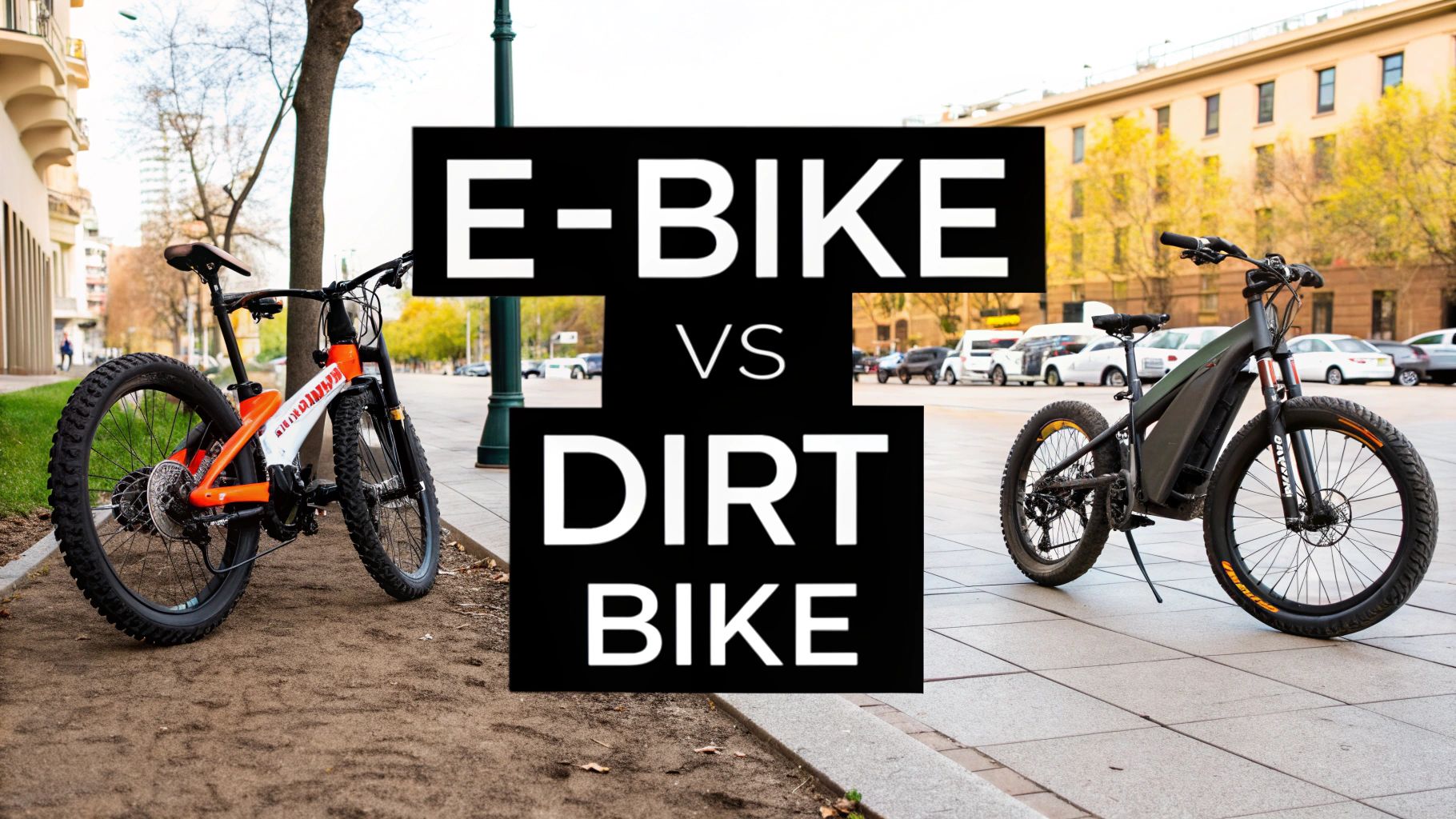
It’s a common mistake: see two wheels and an electric motor, and assume the same rules apply. But when it comes to the law, the gap between a standard e-bike and an electric dirt bike is massive. Getting this wrong isn't just a simple mix-up; it can lead to hefty fines and having your ride impounded.
At the heart of it, most states legally define e-bikes as bicycles, while electric dirt bikes are almost always classified as off-highway vehicles (OHVs) or even motorcycles. This one distinction changes absolutely everything about where and how you can ride. E-bikes generally get access to roads and bike paths, but OHVs are strictly limited to designated off-road areas.
What The Law Looks For
So, what’s the giveaway for law enforcement? It almost always comes down to one simple feature: functional pedals.
An e-bike, by legal definition, must have pedals that can propel the bike. Electric dirt bikes, on the other hand, have stationary footpegs. This single design choice is what keeps an e-bike in the bicycle category and pushes an electric dirt bike into a completely separate motorized vehicle class, with a whole different rulebook.
- Registration and Permits: Electric dirt bikes, as OHVs, nearly always require state registration and a special permit or tag to be ridden on public lands. E-bikes typically do not.
- Where You Can Ride: They are banned from public roads, bike lanes, and multi-use paths. Operation is usually restricted to private property or approved OHV parks.
- Required Equipment: The rules for lights, brakes, and other safety gear can be much stricter for OHVs than for vehicles classified as bicycles.
Here’s the simplest way to think about it: if you can't pedal it, the law doesn't see it as a bicycle.
Understanding these distinctions is also crucial if an accident occurs. An experienced Atlanta Bicycle Accident Lawyer can clarify how the specific vehicle type impacts liability and insurance claims. For those drawn to the high-powered off-road world, exploring more about the world of electric motorcycles is a great place to start.
Common Questions About E-Bike Laws
Even with a state-by-state breakdown, you’re bound to run into some real-world questions that the statutes don't always cover. Let's dig into some of the most frequent things riders ask about.
Getting these details right can make all the difference in staying legal and safe on the road. From insurance needs to the consequences of a little "aftermarket tuning," here's what you need to know.
Do I Need Insurance For My Electric Bike?
For the most part, no. The vast majority of states that follow the three-class system treat e-bikes just like regular bicycles, not motor vehicles. That means you typically don't need to carry liability insurance to ride on public roads.
That said, you should absolutely check your homeowner's or renter's insurance policy. While some policies might cover theft or damage to your e-bike, many have exclusions for motorized vehicles. You might need to add a special "rider" or get a separate policy to be fully covered, which is a smart move for a pricier model.
What Happens If I Modify My E-Bike For More Speed?
Tinkering with your e-bike to crank out more speed or power than its classification allows is a risky game. For example, if you tune a Class 2 e-bike to fly past 20 mph on throttle alone, you've just pushed it into a whole new legal world.
Suddenly, your e-bike could be reclassified as an unlicensed moped or motorcycle. This can lead to hefty fines, having your bike impounded, or even facing charges for operating an unregistered motor vehicle. On top of that, you can bet it will instantly void your manufacturer's warranty.
Can I Ride My E-Bike With A Suspended License?
This is a big one, and the answer is completely dependent on your state. In the 44 states that legally define e-bikes as bicycles and don’t require a driver's license, you can generally ride one even if your car license is suspended.
However, if you're in one of the few states that lumps e-bikes in with mopeds or requires a license, riding one would be illegal. This is a situation where you absolutely must confirm your local electric bike laws by state before you even think about hitting the road.
Are There Federal E-Bike Laws I Should Know?
Yes, but they play a very specific role. The main federal law that matters here is the Consumer Product Safety Act, which provides the legal definition for a "low-speed electric bicycle."
This law created the baseline standard that most states now use as a starting point:
- It must have fully operable pedals.
- The motor has to be less than 750 watts.
- The maximum motor-assisted speed is 20 mph.
Think of this federal definition as setting the rules for manufacturers and importers. It ensures that what's sold as an "e-bike" meets a certain safety and performance standard. But when it comes to the nitty-gritty of where and how you can actually ride, those rules almost always come from your state and local authorities.
Ready to ride with confidence? eBike Gang offers a premium selection of e-bikes and electric dirt bikes designed for performance and reliability. Explore our collection and find your perfect ride today at https://ebikegang.com.