

A 5000W electric bike motor isn't just a motor; it's a high-performance powerplant that completely transforms an e-bike into something closer to an electric motorcycle. This is the kind of power that delivers blistering acceleration and the raw torque to conquer ridiculously steep hills, blowing typical e-bike capabilities out of the water.
Let's be clear: this level of performance is built for off-road fanatics and serious DIY builders, not your average ride to the grocery store.
What a 5000W E-Bike Motor Actually Means for Riders
If a standard commuter e-bike motor is like a dependable sedan engine—perfect for getting you around town efficiently—then a 5000W e-bike motor is the roaring V8 in a muscle car. It’s not just a minor upgrade; it's a complete overhaul of the riding experience, one that puts raw, exhilarating power above all else.
That massive jump in wattage translates directly into a ride that will get your heart pounding. On an open trail, you're looking at speeds that can easily hit 45-50 mph or even more, giving you an adrenaline rush that feels a lot like riding a dirt bike. The acceleration is instant and brutal, launching you from a dead stop with enough force to pin you back in your seat.
More Than Just a Motor
Here’s the thing, though: you can't just slap a 5000W motor on any old bike and call it a day. It demands a specialized ecosystem of components designed to handle its immense power draw. Trying to pair it with standard e-bike parts is like dropping a race car engine into a go-kart frame—it's a recipe for disaster and a major safety hazard.
This kind of high-performance setup needs a trifecta of core components working in harmony:
- A High-Voltage Battery: You'll need a hefty battery, typically 72 volts or more, just to feed the massive energy appetite of a 5000W motor.
- A Robust Controller: This is the brain of the operation. It manages the flow of electricity to deliver smooth power while preventing the whole system from frying itself.
- A Reinforced Drivetrain: The chain, sprockets, and gears have to be tough enough to handle the incredible torque without snapping under the strain.
A 5000W e-bike blurs the line between a bicycle and a light motorcycle. Its power demands a whole new level of respect, skill, and safety awareness from the rider.
Understanding this distinction is crucial. The capabilities and legal status of these machines are worlds apart from what most people think of when they hear "e-bike." To see just how different they are, it helps to explore the various types of e-bikes available and see where they fit in. This gives you the groundwork for a deep dive into the performance, components, and responsibilities that come with wielding 5000 watts of power.
Real-World Performance: Speed, Torque, and Hill Climbing
Let's get one thing straight: spec sheets don't do a 5000W e-bike motor justice. The real story unfolds the moment you twist the throttle and feel that raw power kick in. This isn't just an upgrade; it's a completely different kind of ride that transforms what you thought an e-bike could do.
The first thing you'll notice is the speed. We're not talking about a little boost to help you pedal faster. A 5000W system can rocket you to 45-50 mph on a flat stretch. That’s serious velocity, turning empty dirt roads and private land into your personal playground.
Unleashing Raw Acceleration and Torque
But top speed is only half the story. The real thrill comes from the acceleration. It’s an instant, grin-inducing surge that takes you from a dead stop to cruising speed in just a few seconds. Forget the gentle push of a commuter e-bike; this is an aggressive launch that demands respect and your full attention.
That incredible get-up-and-go comes from massive torque. If you're into the technical side, there are some great primers on calculating motor torque that break down the physics. In the real world, a 5000W motor's typical 120-160 Nm rating means it has the brute force to chew through terrain that would swallow a lesser bike whole. Think deep mud, loose sand, or gnarly, rock-strewn climbs.
The difference is stark: a standard e-bike assists you up a hill. A 5000W e-bike lets you attack it, often without even needing to pedal.
This chart really puts the performance jump into perspective, comparing a 5000W machine to other vehicles you see every day.
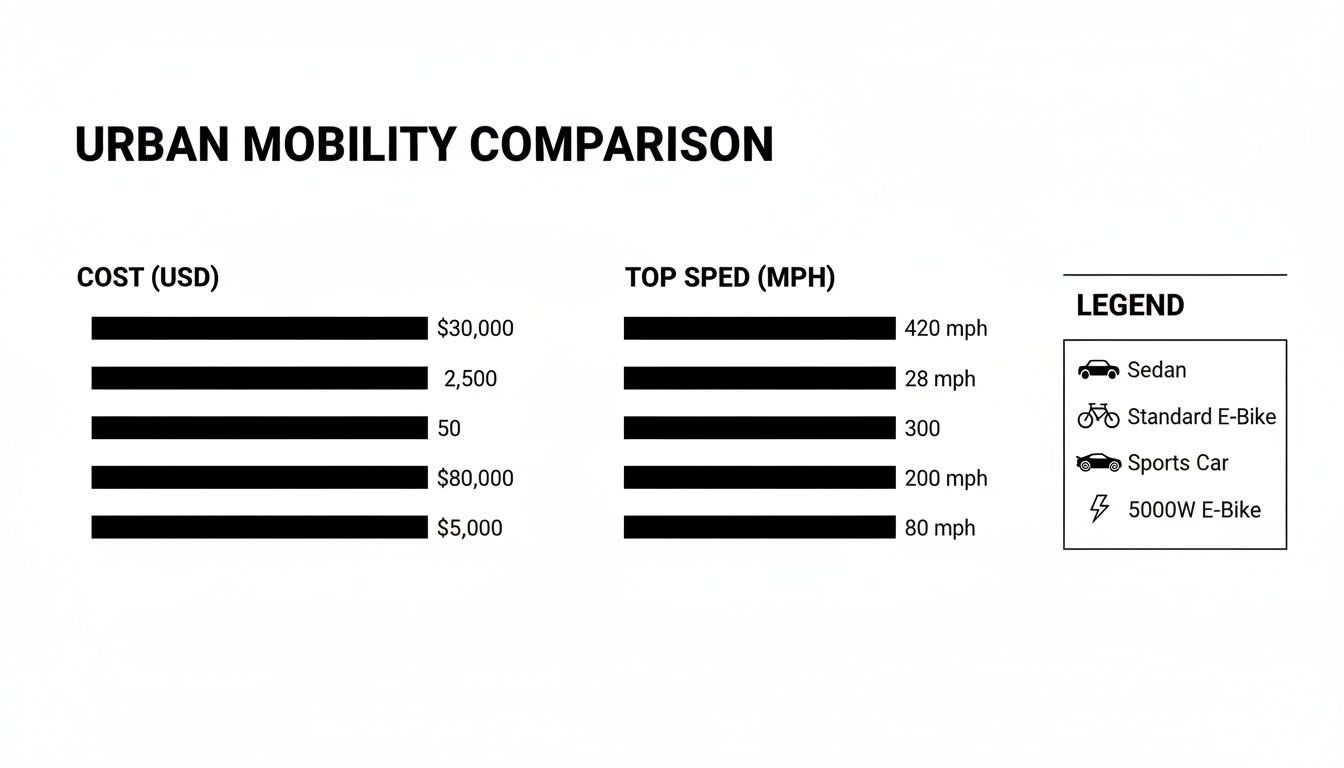
As you can see, the power on tap brings this kind of e-bike into a whole new category of performance.
Conquering Any Incline
When you combine that speed and torque, hills just stop being a problem. Seriously. A 5000W motor will laugh its way up incredibly steep gradients of 35-45% without breaking a sweat. If you live in a hilly area or love tackling mountain trails, this is a game-changer. No more planning routes to avoid climbs—you just point the front wheel up and go.
This insane capability is why these high-performance models have become so popular, grabbing a massive 28% market share among enthusiasts. For more on how e-bike speeds work in general, check out our guide on the topic here: https://ebikegang.com/blogs/news/how-fast-do-electric-bikes-go.
To really see what a leap we're talking about, here’s a quick comparison of how a 5000W motor stacks up against the more common e-bike motors out there.
E-Bike Motor Performance Comparison
This table illustrates the dramatic difference in what you can expect from these three popular motor classes.
| Performance Metric | 250W Motor (EU Standard) | 750W Motor (US Class 2/3) | 5000W Motor (High-Performance) |
|---|---|---|---|
| Typical Top Speed | 15-20 mph (25-32 km/h) | 20-28 mph (32-45 km/h) | 45-50+ mph (72-80+ km/h) |
| Typical Torque | 40-50 Nm | 80-90 Nm | 120-160 Nm |
| Hill Climbing | Struggles on steep inclines | Manages moderate hills | Conquers 35-45% gradients |
| Primary Use Case | Casual riding, flat commutes | Commuting, light trails | Off-road, performance riding |
It's clear that a 5000W motor isn't just a small step up. It's in a completely different performance universe, delivering a ride defined by sheer power, exhilarating speed, and the freedom to go just about anywhere.
The Power System Behind the Motor
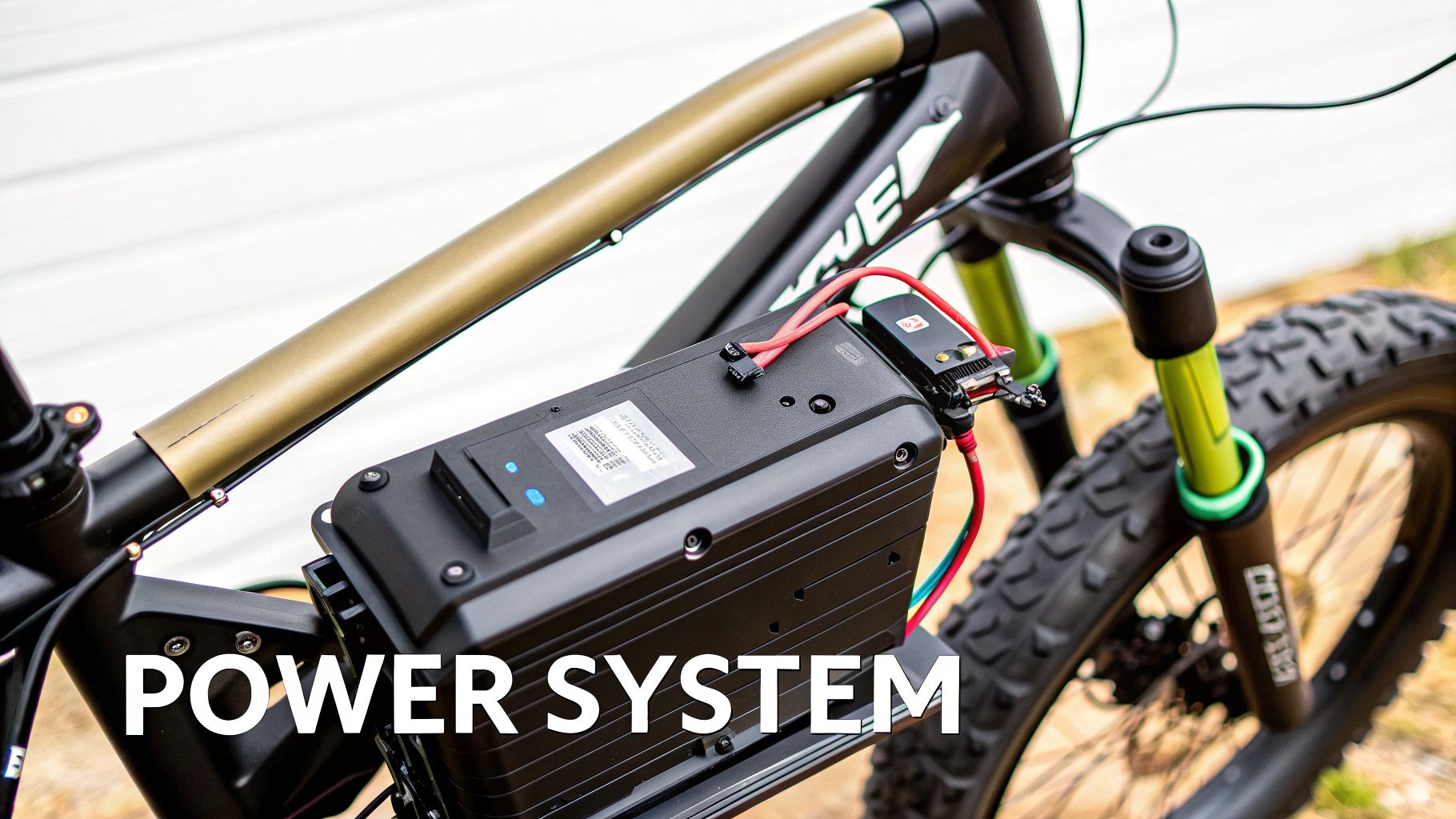
A 5000W e-bike motor is an absolute beast, but it’s only as good as the system that feeds it. Think of it like a high-performance race car engine—it's got raw potential, but without a high-octane fuel system (the battery) and a sophisticated computer managing everything (the controller), it’s just a hunk of metal.
This trio—the motor, battery, and controller—has to work in perfect harmony. If you cheap out or mismatch any one of these components, you're not just looking at poor performance. You're building a serious safety hazard. Each piece has to be specifically specced to handle the massive electrical demands of a 5000W setup.
The Battery: Your Fuel Tank
For a motor this powerful, you need a seriously big "fuel tank." The two numbers that matter most on a battery are voltage (V) and amp-hours (Ah). Voltage is like the electrical pressure, while amp-hours tell you how much juice is in the tank, which translates to your range.
A 5000W motor is thirsty for high voltage to run efficiently. You’ll find that most of these high-power builds are based on a 72V battery system, and some builders even push it to 84V. Running higher voltage means the motor can get the power it needs without drawing so many amps that it melts the wiring. Trying to run a 5000W motor on a standard 48V battery is a surefire way to kill your components.
It all comes down to a simple bit of math:
Volts (V) x Amps (A) = Watts (W)
To get 5000 watts from a 72V battery, your system needs to handle a continuous draw of nearly 70 amps. That is a huge amount of current, which is why both your battery and controller have to be up to the job. You can get a better feel for how this works with our detailed e-bike battery voltage chart.
The Controller: The Brains of the Operation
If the battery is the fuel, the controller is the brain. This little electronic box sits between the battery and motor, telling the power where to go and when. It reads the input from your throttle and translates it into a smooth, controlled flow of electricity to the motor.
A controller for a 5000W system is a whole different animal than the one on your average commuter e-bike. It’s built to handle those crazy high amps without frying and comes packed with critical safety features.
Here's what a good high-power controller does:
- Throttle Response: It keeps acceleration smooth and predictable, so you don't get thrown off the bike with a jerky start.
- Current Limiting: It acts as a gatekeeper, preventing the motor from pulling too much power and destroying the battery.
- Thermal Protection: It’s constantly monitoring temperatures. If things get too hot, it will dial back the power to protect the motor and itself.
Skimping on the controller is a terrible idea. Without a properly rated one, you risk a catastrophic failure of the entire electrical system. For any serious build, a quality controller matched to your motor and battery isn't just a suggestion—it's non-negotiable.
Why Quality Cells Matter
Listen, not all batteries are built the same. A high-wattage system like this puts an incredible amount of stress on the individual lithium-ion cells packed inside your battery. Using cheap, no-name cells is asking for trouble. They’re far more likely to overheat, lose their capacity quickly, or even worse, catch fire.
This is why you have to insist on premium cells from trusted brands like Samsung, LG, or Panasonic. These are engineered to handle high discharge rates safely and deliver consistent power. If you really want to understand the risks, it's worth reading up on understanding thermal runaway in lithium-ion batteries—it's a critical safety issue. At the end of the day, investing in a high-quality battery isn’t just about performance. It's about protecting yourself and your bike.
How to Use a 5000W E-Bike in the Real World
A 5000W e-bike motor gives your bike a serious split personality. In the wild, it's an unstoppable off-road beast, but on the pavement, it can be a surprisingly capable urban warrior. Figuring out which role fits your life is the key to getting your money's worth from this much power.
Each environment brings its own challenges and rewards, asking different things from you and your machine.
The Off-Road Beast
Get a 5000W e-bike on the dirt, and it just feels right. This is where that monstrous torque and beefy suspension really come alive, making the bike feel less like a bicycle and more like a lightweight electric dirt bike. It's built to dominate rugged trails, not just survive them.
Picture yourself staring up a steep, loose climb that would have you pushing a regular mountain bike. With a 5000W motor, you just twist the throttle, feel the tire dig in, and power your way to the top without a second thought. It opens up a whole new world of remote fire roads and gnarly single-track that used to be impossible, turning obstacles into pure fun.
- Conquering Steep Terrain: You'll fly up gradients that would bring lesser bikes to a dead stop.
- Exploring Remote Areas: With the right battery, that power lets you push deeper into the backcountry for real adventure.
- Pure Adrenaline: Nothing beats the thrill of instant acceleration on dirt, mud, and gravel.
For anyone who loves the trail, a 5000W e-bike isn't just a way to get around. It's a machine built for raw, unfiltered off-road excitement.
The Urban Warrior
While it’s most at home in the wild, a 5000W e-bike can be a beast in the city, too. In an urban jungle full of cars, that insane acceleration becomes your best friend for staying safe and getting where you need to go.
Think about pulling away from a stoplight. You’re not just trying to keep up with traffic—you're out in front of it. This ability to instantly get up to speed lets you claim your space on the road, making you far more visible and less likely to get squeezed. Those killer hills on your commute? They become non-existent, letting you get to work fast without breaking a sweat.
Of course, using this much power in the city comes with a few trade-offs. These bikes are heavy, often tipping the scales at 90-120 lbs. Good luck carrying one up a flight of stairs or lifting it onto a standard car rack. That immense power also demands a seriously overbuilt frame and top-shelf components to handle the stress of rough city streets safely.
The rise of these high-power machines is part of a bigger picture. The entire e-bike motor market is booming, and while smaller, regulation-friendly motors lead the way, the big guns are catching up. Motors over 500W are seeing an 8.66% CAGR, especially here in North America where we love our throttles. If you want to dive deeper, you can explore more data on these market trends and see how high-performance e-bikes are making their mark.
Understanding the Rules and Safety Requirements
Let’s be crystal clear: strapping a 5000W motor to a bike comes with some serious responsibility. This isn't your average pedal-assist ride anymore. The power you're dealing with pushes your bike into a whole new legal and safety category, and you absolutely have to know what you’re getting into.
First things first, forget about standard e-bike classifications. In most places, a 5000W bike is not legally considered an e-bike. The usual Class 1, 2, and 3 systems top out around 750W in the US. A 5000W beast flies right past that limit, landing it squarely in moped or even motorcycle territory in the eyes of the law.
What does that mean for you? It means you can't just hop on and ride down the street or on the local bike path. Doing so could get your bike impounded and land you a hefty fine. For the most part, these high-power machines are legally restricted to private land and designated off-road vehicle (ORV) parks.
Navigating Your Local Laws
Rules can change drastically depending on where you live—not just state by state, but often city by city. It’s on you to do the homework. You might find that your high-powered e-bike requires:
- Registration and Licensing: You may need to get a vehicle identification number (VIN), a license plate, and even a motorcycle license to ride it legally on any public roads.
- Insurance: Don't expect your homeowner's or renter's policy to cover this. You'll likely need to get a specific moped or motorcycle insurance policy.
Your best bet is to check directly with your local Department of Motor Vehicles (DMV). Playing dumb won't work if you get pulled over.
Gearing Up for High-Speed Safety
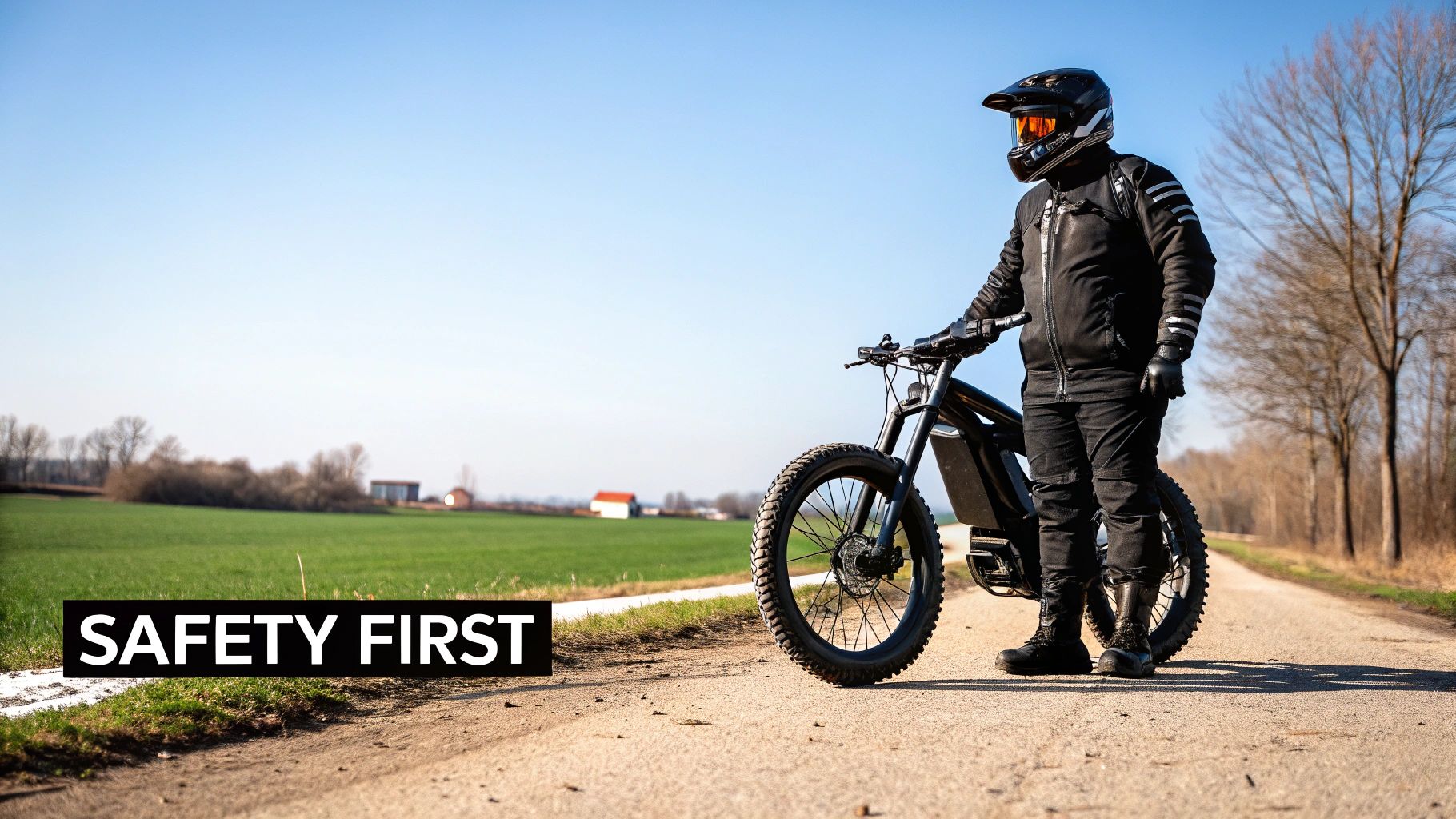
The legal stuff is just half the battle. The raw speed and torque from a 5000W motor mean standard bicycle gear just won't cut it. It’s flat-out dangerous to use bike-shop-grade components when you’re pushing motorcycle speeds.
Your bike needs to be built for this kind of abuse. This isn't a friendly suggestion—it’s a must-do for your own safety.
When you're hitting speeds over 45 mph, the difference between your e-bike and a motorcycle is basically zero. Your gear needs to reflect that reality. Your life could depend on it.
Here are the non-negotiable hardware upgrades:
- High-Performance Brakes: You need serious stopping power. We're talking powerful hydraulic disc brakes, preferably with massive 203mm or even 220mm rotors, to keep those speeds in check.
- A Robust Frame: The frame has to be tough enough to handle the motor's torque and high-speed vibrations without cracking. Look for reinforced frames built from chromoly steel or high-grade aluminum.
- Durable Tires: You'll want quality, motorcycle-rated or specific high-speed e-bike tires that can maintain grip when you're flying down the trail.
And finally, let’s talk about personal protective equipment (PPE). A simple bike helmet is not going to do the job. You need to dress like a motorcyclist. That means a full-face, DOT-certified helmet, an armored jacket, riding gloves, and durable pants. This isn't for looks; it's about walking away from a crash in one piece.
How to Choose the Right 5000W E-Bike
Jumping into the world of high-power e-bikes is a serious thrill, but picking the right one is about more than just finding the fastest-looking machine. Whether you’re buying a complete, turn-key bike or building your own beast with a conversion kit, a few key decisions will make or break your experience.
Think of it like building a race car. The 5000W electric bike motor is your engine—it’s the star of the show. But that engine is useless without a chassis, suspension, and fuel system that can keep up. Getting that whole package right is the only way to build a bike that’s not just powerful, but also safe and reliable.
Motor Type: Hub vs. Mid-Drive
The first big choice you'll face is where the motor lives. This decision completely changes how the bike feels, especially when you’re wrestling with the kind of torque a 5000W system puts out.
- Hub Motors: This is the most common setup for high-power builds, and for good reason. The motor sits right in the center of the rear wheel, giving you a direct, powerful push that feels like a rocket launch. They're simpler, incredibly durable, and don't put extra wear and tear on your chain and gears.
- Mid-Drive Motors: These motors are mounted where your pedals are, driving power through the bike's existing gears. This lets you use the gearing to your advantage for insane hill-climbing power and a more balanced, natural ride feel. The downside? They unleash hell on your drivetrain, so be prepared for frequent chain and sprocket replacements.
For pure, unadulterated power and simplicity, a rear hub motor is almost always the go-to for a 5000W build. But if you’re a technical rider who values nimble handling on tight trails, a mid-drive might be worth the extra maintenance headaches.
Frame and Suspension: Your Foundation
Let me be blunt: you can’t just slap a 5000W motor on any old bicycle. The raw torque would literally rip a standard frame apart. You need a frame specifically engineered to handle these extreme forces, usually built from reinforced steel or beefy, high-grade aluminum. Pay close attention to the welds and look for heavy-duty dropouts where the wheel attaches.
Suspension is just as critical. At these speeds, you need a quality front fork and a rear shock that can eat up major bumps without flinching. This isn't just for comfort—it’s about keeping your tires glued to the ground so you stay in control. A cheap suspension will bottom out in a heartbeat, making for a sketchy and dangerous ride.
A well-built 5000W e-bike is a complete system. Every component, from the frame to the brakes, must be matched to the motor's power. A weak link anywhere in the chain is a serious safety risk.
Battery and Controller: The Brains and Brawn
We’ve already touched on this, but it’s worth repeating: the battery and controller are the heart and brain of your bike. When you’re looking at a bike or a kit, you have to sweat the details here. For a 5000W motor, you shouldn't settle for anything less than a 72V battery with at least 30Ah of capacity if you want any decent range. Ask what kind of cells are inside—you want premium cells from brands like Samsung or Panasonic for safety and a long lifespan.
The controller needs to be a high-amperage, sine-wave model. These deliver power smoothly and quietly, which is a massive help for keeping traction when you twist the throttle. As the e-bike market grows—it was nearly USD 55 billion in 2025 and is expected to blow past USD 120 billion by 2035—so does the quality gap. Many bikes in the $699-$1,299 price range use 48V packs, so you have to verify you're getting a true 72V system built for this power. You can discover more insights on these e-bike market trends to see how the industry is shaping up.
Support, Warranty, and Parts
Finally, think about what happens after you swipe your card. A solid warranty shows that the company actually stands behind its product. Look for at least a 12-month warranty covering the big-ticket items: the motor, battery, and controller. Just as important is whether you can get spare parts. These bikes live a hard life, and things will break. Make sure the seller can get you the parts you need to keep your bike on the trail for years to come.
A Few More Things You're Probably Wondering About 5000W E-Bikes
Even after digging into the details, a few questions always seem to come up when you're talking about this much power. Let's tackle some of the most common ones so you can feel confident you know what you're getting into.
How Far Can I Actually Go on a 5000W E-Bike?
This is the big one, and the honest answer is: it depends. Your range is a direct result of how you ride, where you ride, and the battery you're running.
Let's say you have a common setup like a 72V 30Ah battery. If you're thrashing it off-road and constantly on the throttle, you might only get 25-35 miles. But if you're cruising on flatter terrain and being a bit more sensible, you could easily see that stretch to 40-50 miles, maybe even more.
Think of it like a muscle car versus a hybrid. Floor it everywhere, and you'll be looking for a charge pretty quickly.
Is a 5000W Motor a Maintenance Nightmare?
Surprisingly, the motor itself—especially if it's a hub motor—is pretty robust and doesn't ask for much. The real story is that all the other parts of the bike have to work a lot harder to keep up with that immense power. The motor puts a ton of stress on everything else.
Here’s what you’ll need to keep a close eye on:
- Brake Pads: You'll be chewing through them. With the speeds you're hitting, expect to replace hydraulic brake pads every 500-700 miles.
- Chain and Sprockets: If you're running a mid-drive, that insane torque is going to wear out your drivetrain fast. A new chain every 300-500 miles is pretty standard.
- Controller Connections: It's a good habit to periodically check that all your electrical connections are snug and not showing any signs of melting or heat damage.
Owning a 5000W e-bike means you have to be proactive with maintenance. It's not just about performance; it's about safety. Catching worn parts early prevents a small problem from turning into a massive failure when you're flying down a trail.
What's This "Nominal" vs. "Peak" Power I Keep Hearing About?
This is a really important concept that trips a lot of people up. Getting this straight helps you understand what an electric bike motor 5000w is truly capable of.
Nominal Power is the motor's cruising speed, so to speak. It’s the amount of power the motor can put out continuously without getting dangerously hot. Think of this as its true, sustainable strength for everyday riding.
Peak Power is the "oh wow" number. It’s the absolute maximum wattage the motor can pump out for a few seconds at a time—perfect for launching off the line or blasting up a ridiculously steep incline. A motor with a 5000W nominal rating might hit a peak of 8000W or more in a short burst.
Basically, nominal power is what you ride with day-to-day. Peak power is your secret weapon for short, intense moments. Both matter, but the nominal figure gives you a much better idea of the motor's real-world endurance.
Ready to feel the power for yourself? At eBike Gang, we specialize in high-performance electric bikes and dirt bikes that deliver an unmatched riding experience. Explore our collection and find your perfect off-road machine today at https://ebikegang.com.