

So, you're ready to trade the pavement for the dirt? Welcome. Learning to ride a dirt bike is one of the most rewarding skills you can pick up, opening up a world of trails, tracks, and off-road freedom. This guide is your roadmap, designed to get you from square one to confidently handling your bike. We're going to skip the fluff and focus on what actually works, making this an experience you'll be stoked about.
Your Off-Road Adventure Starts Here
This isn't your typical owner's manual. I'm going to give you a real-world breakdown of everything a new rider needs to know, without the confusing jargon. It all boils down to two things: safety and a solid foundation. Get those right, and you'll build the skills and confidence to have a blast on the trails.
We'll cover everything from getting the right gear to mastering the controls and building practical skills. You'll see why electric dirt bikes are such a fantastic starting point for new riders—they're just less intimidating and let you focus on technique. If you're wondering what to look for in a first e-moto, we've put together some great info on the best off-road electric bikes for adults.
What To Expect On Your Journey
Riding a dirt bike is about so much more than just twisting a throttle. It's about feeling the bike move beneath you and learning to read the terrain. I’ll walk you through that initial learning curve with advice you can put into practice on your very first day. You won't just learn what to do, but why it works.
Here’s a quick look at what we’ll tackle:
- Essential Safety Gear: We'll go beyond just telling you to wear a helmet and show you how to choose gear that fits right and offers real protection.
- Fundamental Controls: You'll get comfortable with the throttle, brakes, and your balance before the wheels even start turning.
- Core Riding Skills: This is the fun part—a clear process for starting, stopping, turning, and getting a feel for different surfaces.
- Building Confidence: I'll share some simple drills and a progression plan that will help you see real improvement every time you ride.
My goal here is to make your first time on a dirt bike empowering, not overwhelming. A structured approach helps you sidestep the common mistakes most beginners make and puts you on the fast track to becoming a capable rider.
You're getting into this sport at a great time. The global dirt bike market was valued at around USD 9.1 billion in 2021 and is on track to nearly double by 2031. For a new rider, that means more bikes to choose from, better gear, and a huge community to connect with.
Let's get you ready for the adventure.
Beginner's Quick-Start Checklist for Learning to Ride
To help you get started on the right foot, here's a quick checklist that summarizes the essential first steps. Think of this as your pre-ride briefing to ensure you're setting yourself up for a safe and successful first session.
| Phase | Key Action | Why It's Important |
|---|---|---|
| Gear Up | Get a properly fitted helmet, boots, gloves, and protective gear. | Your safety is non-negotiable. Ill-fitting gear can be as dangerous as no gear at all. |
| Bike Familiarization | Sit on the bike. Get a feel for the controls—throttle, brakes, pegs. | Building muscle memory starts before you're moving. Comfort with the controls reduces panic. |
| Mastering Balance | Practice balancing on the bike with the motor off, feet on the pegs. | This builds your core stability and teaches you how the bike feels underneath you without any other distractions. |
| Low-Speed Drills | Start with simple stop-and-go exercises in a flat, open area. | Mastering the basics at a slow, controlled pace builds the foundational skills needed for more complex maneuvers. |
Following this simple sequence will make your first few hours on the bike much smoother and more productive. It's all about building a solid base before you start pushing your limits.
Choosing Your Gear and First Electric Dirt Bike
Before you even think about twisting a throttle, let's get one thing straight: your gear is non-negotiable. This is the single most important investment you'll make in this sport. Think of it as your personal suit of armor, because when—not if—you take a spill, it's the only thing between you and the ground.
Skimping on protection is a classic rookie mistake, and it's one you don't want to learn the hard way.
Your Essential Protective Gear
Fit and quality are everything. Gear that's too loose can slide out of place during a crash, and gear that's too tight will restrict your movement and make you a timid, uncomfortable rider.
Here's the must-have lineup you need to assemble before your first ride:
- A Quality Helmet: This is the most critical piece of equipment you will own. Don't cheap out. Look for DOT and ECE certifications on the label; it means the helmet has passed serious safety tests. Your brain is worth it.
- Goggles: These are your windshield. They keep roost (the dirt and rocks kicked up by other bikes), branches, and bugs out of your eyes. They must seal comfortably against your face and fit snugly within your helmet's opening.
- Riding Boots: Motocross-specific boots are built like tanks for a reason. They're designed to prevent your ankles from twisting in directions they shouldn't and to protect your feet from impacts. They should feel stiff and supportive, not flimsy like a pair of hiking boots.
- Gloves: A good pair of gloves gives you a better grip on the controls, prevents blisters, and saves your palms from getting shredded in a fall. Look for a snug fit with some decent padding in the palm area.
- Body Armor: This usually means a chest protector, often with integrated shoulder and elbow pads. It's designed to absorb the force from falls and deflect painful roost, protecting your torso and major joints.
The best gear is the gear you'll actually wear every single time. Make comfort and fit a priority so you never have an excuse to leave a piece behind. You're building a safety habit from day one.
Once you’re kitted out, it’s time for the fun part: picking your first bike. While the sound of a gas engine is iconic, I’m a huge advocate for beginners starting on an electric dirt bike. The learning curve is just so much smoother and less intimidating.
Why Your First Bike Should Be Electric
Electric dirt bikes are a game-changer for new riders. They strip away a lot of the complexity that can feel overwhelming at first. You don't have to worry about a clutch, managing a finicky engine, or dealing with a jerky powerband.
Instead, you get to focus entirely on the fundamentals: balance, body position, and smooth throttle control.
The electric dirt bike market is blowing up, and for good reason. Riders love the reduced noise, the practically non-existent maintenance, and the instant, predictable torque. For a newcomer, all this translates into a much less stressful and way more enjoyable first experience.
Models like the VETRA BLAZER are an ideal starting point. Their power delivery is linear and easy to manage, which helps build confidence fast. There's no stalling the engine or fumbling for the right gear—you just twist the throttle and go.
This simplicity lets you drill down on what really matters when you're just learning. Of course, going electric means you'll want to get smart about battery care. For a good overview, check out these essential battery maintenance tips.
Matching the Bike to You
Getting the right size bike is just as important as the power source. A bike that's too tall or too powerful for you is a recipe for disaster and will absolutely kill your confidence.
As a rule of thumb, you should be able to sit on the bike and comfortably touch the ground with at least the balls of your feet.
Here’s a quick checklist for finding the right fit:
- Seat Height: Can you reach the ground? That stability is crucial for a beginner when starting and stopping.
- Power Level: Start small. Many electric bikes feature adjustable power modes, which are perfect for easing into the throttle response as your skills grow.
- Weight: A lighter bike is way easier to handle. You'll be able to maneuver it better at low speeds and, just as importantly, pick it up by yourself after you drop it.
By choosing a bike that fits both your body and your current skill level, you're setting yourself up for an awesome first ride, not an overwhelming one. For a deeper dive into specific models, take a look at our guide to the best electric dirt bikes on the market right now.
Getting a Feel for Your Bike and Finding Balance
Alright, let's talk about the single most important part of learning to ride a dirt bike. It doesn't happen with the engine screaming or roost flying. It happens when the bike is completely silent. This is where you build the foundation—the real muscle memory and confidence that will make or break your first real ride.
Think of it like this: you wouldn't try to learn a complex dance with a new partner by jumping straight into the most difficult moves. You’d get a feel for how they move and respond first. Your bike is no different. This first "handshake" is all about learning its weight and controls without the added pressure of motion.
Understanding the Essential Controls
First things first, let's break down the controls you'll be using constantly. If you're starting on an electric dirt bike, you've already got a massive head start—no clutch or gears to juggle. That means you can pour all your focus into the three main inputs for speed and direction.
- The Throttle: This is your "go" switch, located on the right handlebar. It’s not a light switch; it’s a dial. Practice twisting it slowly and deliberately. Get a sense of its full range of motion, from barely on to wide open. You want to feel that sweet spot where the power would just start to kick in.
- The Front Brake: The lever on your right handlebar controls the front brake. This is your primary stopper, providing about 70% of your total stopping power. It's incredibly effective, which also means you need to be smooth with it. Squeeze it gently to feel the bite point; never grab a handful out of panic.
- The Rear Brake: This is the lever on the left handlebar (or a foot pedal on some gas bikes). It's perfect for scrubbing a little speed on downhills or making small adjustments, but it's also more prone to locking up the rear wheel if you get too aggressive.
From day one, get into the habit of keeping one or two fingers resting lightly on each brake lever. It’s a simple trick, but it shaves critical milliseconds off your reaction time and helps build the instinct to squeeze, not grab.
This whole process starts with a few simple, foundational steps before you even get on the bike.
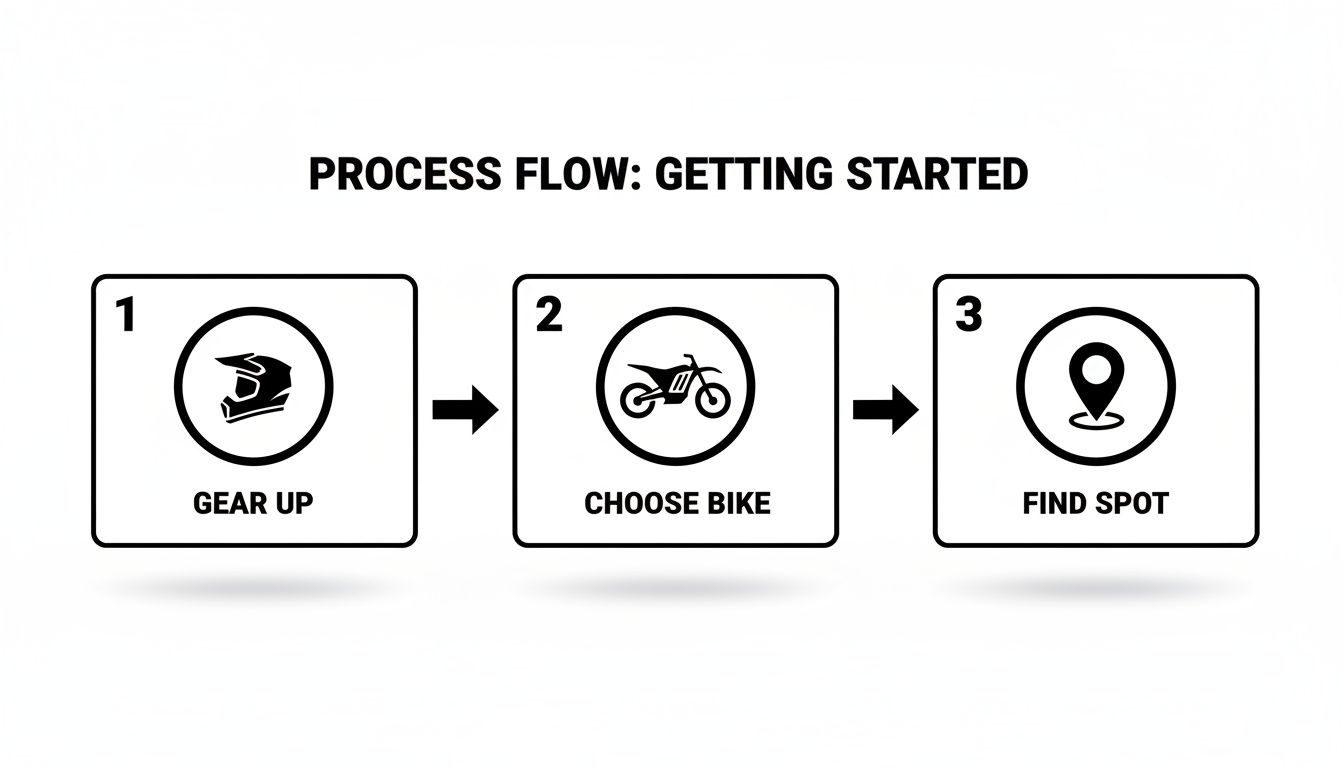
As you can see, making sure you have the right gear, the right bike, and a safe place to ride is the non-negotiable starting line.
Mastering Body Position and Balance
Balance is the name of the game. A classic rookie mistake is planting yourself on the seat and death-gripping the handlebars. The truth is, your real control comes from your core and legs, not your arms. Standing up on the pegs is your secret weapon.
This brings us to the attack position. It's the neutral, ready-for-anything stance that should become your home base whenever the trail gets anything but perfectly smooth.
Here’s how to find it:
- Stand on the Pegs: Center the balls of your feet on the pegs. This gives you a stable platform.
- Bend Your Knees and Elbows: Think of your limbs as extra suspension. Keep them loose and bent to soak up the bumps.
- Hinge at the Hips: Keep your back fairly straight, but lean your torso forward so your head is over the handlebars.
- Grip with Your Legs: This is the key. Squeeze the bike's frame with your knees and inner thighs. This locks the bike to your lower body, which frees up your hands and arms to steer with a light touch.
Your goal is to let the bike dance around underneath you while your torso remains stable and centered. Picture your head floating in a straight line as the bike bucks and weaves below.
Engine-Off Drills for Building Confidence
Now, let's put it all together without any risk. Find a flat patch of grass or an empty driveway for these engine-off drills. Trust me, these exercises are pure gold for building that physical connection to your machine.
- The Rocking Drill: Get into your attack position and, without using your arms, rock the bike side-to-side with your hips and legs. Feel the suspension compress and rebound. You're learning to steer with your body weight, which is a massive skill.
- The Balance Drill: Standing on the pegs, see how long you can balance without dabbing a foot down. Make tiny adjustments with your body to keep your center of gravity over the bike. You’ll feel your balance improving in minutes.
Spending just 15-20 minutes on these simple static drills will pay off big time. You're programming your brain and body for what's to come, making that first ride with power far less intimidating and way more fun.
Your First Ride: Starting, Stopping, and Turning
Alright, this is the moment. You've got the gear, you've memorized the controls, and you've gotten a feel for the bike's balance. Now it’s time to put it all together in a wide-open space—think an empty field or a big, vacant parking lot—and experience that first powered ride.
Forget about speed or style for now. The only goal here is to be smooth. We're going to build your confidence by focusing on the three most critical skills: getting moving, coming to a controlled stop, and making a basic turn. Master these, and you'll have the foundation for everything else that comes with learning to ride a dirt bike.
The First Smooth Start
Getting going for the very first time can be a little nerve-wracking. The secret is to be incredibly gentle with the throttle. Your bike, especially if it's electric, has instant torque, and a heavy hand will lead to a jerky, unnerving start. Let's make it smooth.
Sit on the bike with both feet planted firmly on the ground. Get into the habit of always keeping one or two fingers on both brake levers. Now, slowly and deliberately, twist the throttle just a hair—barely enough to feel the bike want to pull forward.
As you feel that gentle tug, lift your feet and place them on the pegs. Keep your body loose. That's it—you're rolling!
Pro Tip: Whatever you do, don't look down at your front wheel. Force yourself to keep your eyes up and look far ahead in the direction you want to go. Your bike naturally follows your gaze, and this one simple habit is the key to maintaining balance.
Mastering the Controlled Stop
Going is only half the battle; stopping safely and predictably is just as important. Your first instinct might be to stomp on the rear brake, but that’s an unstable and inefficient way to do it. Real control comes from using both brakes together.
As you're rolling at a slow walking pace, start to gently squeeze both the front and rear brake levers at the same time. You're aiming for a smooth, progressive pressure, not a sudden grab. You'll feel the bike slow down steadily.
Just before you come to a complete halt, get ready to put your left foot on the ground. Keeping your right foot on or near the rear brake gives you a bit more control in that final moment.
Drill this over and over.
- Roll forward for about 20-30 feet.
- Smoothly apply both brakes.
- Come to a complete stop and plant your left foot.
- Rinse and repeat until it feels completely natural.
This simple drill builds a massive amount of coordination and takes the panic out of braking. You're training your brain to see stopping as a deliberate, controlled action, not an emergency reaction.
Introducing Your First Turns
Once you're comfortable starting and stopping in a straight line, it’s time to add turning to the mix. We're not talking about sharp, aggressive corners yet. The goal is simply to get a feel for how the bike leans and responds by making large, gentle circles.
Start by riding in a wide circle, first one way and then the other. Keep your speed low and your eyes locked on where you want to go. Look through the turn, not at the ground right in front of you.
Here’s what you need to focus on:
- Look Ahead: Turn your head and eyes, looking far into the circle.
- Gentle Lean: Let the bike lean into the turn. Don't fight it—let physics do the work.
- Steady Throttle: Maintain a slight, consistent throttle to keep the bike stable.
After you've nailed circles, it's time for a "figure-eight" drill. Set up two markers (cones or water bottles work great) about 40-50 feet apart and practice riding around them in a figure-eight. This is a fantastic exercise because it forces you to transition from a left turn to a right turn, building coordination and drilling that "look ahead" habit into your muscle memory.
Building Real Skills with Practical Riding Drills
Alright, you've got the basics down—starting, stopping, and turning. Now it's time to move beyond just riding the bike and start truly controlling it. This is where the real fun begins. The drills we're about to cover are designed to build your active riding skills, teaching you how to react to terrain, manage traction, and use your body to influence the bike with precision.
Think of these drills as your personal playbook. They're what transform you from a passenger into a rider, turning it into an active conversation between you, your bike, and the trail. We’ll focus on building the muscle memory you need before hitting more challenging singletrack.
Mastering Braking on Loose Surfaces
One of the first reality checks for any new rider is braking hard on anything but perfect pavement. Dirt, gravel, and grass can be incredibly unpredictable, and learning to stop with confidence on these surfaces is a massive step forward. The key is to find the absolute limit of your traction without going past it.
Find a safe, open area with a loose surface—a gravel lot or a dirt patch works perfectly. Set up a cone or even just a rock to mark your braking point.
- Approach at a Steady Pace: Ride toward your marker at a consistent, moderate speed. Let’s say around 10-15 mph.
- Apply Brakes Progressively: When you hit the cone, smoothly apply both brakes. Pay close attention to what the tires are telling you. Can you feel the rear tire starting to slide? Is the front digging in or trying to wash out?
- Experiment with Body Position: Try the drill while sitting, and then again in the attack position. You'll immediately feel how standing up and shifting your weight back gives you a huge boost in stability and control.
Your goal here isn't just to stop. It's to stop smoothly, in the shortest distance you can, without locking up the wheels. This practice builds an instinctive feel for traction that will save you on every single ride.
Navigating Bumps and Uneven Terrain
Trails are rarely smooth. Getting comfortable with small bumps, roots, and rocks without being thrown off balance is non-negotiable. This is where the "attack position" you practiced earlier becomes your most valuable tool. Your legs and arms are your bike's secondary suspension, and this drill teaches you how to use them.
The core idea is simple: let the bike move beneath you while your head and torso stay relatively level. Don't fight the terrain; absorb it. By gripping the bike with your legs, you free up your arms to guide it with a much lighter touch.
Find a section of trail with some small, rolling bumps, or for a more controlled practice, just lay a 2x4 board flat on the ground.
- Get into the Attack Position: Stand on the pegs, knees and elbows bent, and look far ahead down the trail.
- Maintain a Neutral Throttle: Ride over the obstacle at a slow, steady speed. Don't grab a fistful of throttle or brake right on top of it.
- Absorb with Your Body: As the front wheel hits the bump, let your arms bend and soak up the impact. As the rear wheel comes over, let your knees do the same. Your body should feel like a spring, compressing and rebounding to keep you stable.
After a few passes, you'll start to find a rhythm. You're no longer just a passenger getting bounced around; you're actively managing the bike's movement and staying in complete control.
It’s a huge advantage that North America holds approximately 44.8% of the global dirt bike market. This means we have an incredible number of dedicated riding parks and trail systems perfect for practicing these fundamental skills. You can find more dirt bike market insights on market.us.
Common Beginner Mistakes and How to Fix Them
Look, everyone makes mistakes when they're starting out—it's practically a rite of passage. I've got my own highlight reel of blunders from when I was learning. The goal isn't to be perfect on day one. It's about spotting these common slip-ups early on, so you can correct them before they become bad habits that are tough to break.
One of the first gremlins every new rider battles is target fixation. This is that magnetic pull where your eyes lock onto the one thing you absolutely don't want to hit, like a big rock or a deep rut. And guess what? Where you look is where you go. Every time.
Breaking Bad Habits
It's a powerful, pesky instinct, but you can train yourself out of it. The mantra is simple: look where you want to go. You have to consciously lift your chin and aim your gaze far down the trail, looking through the turn, not at it. Trust your peripheral vision to keep track of the hazard. Your focus has to be on your escape route.
Another classic beginner move is riding way too stiff. I'm talking about a white-knuckle death grip on the handlebars and being glued to the seat like your life depends on it. When you ride like this, you're not a pilot; you're just cargo. You can't absorb bumps, and the bike's every little twitch knocks you off balance.
The bike is designed to move around underneath you. Your job is to stay balanced over it, using your core and legs for stability—not by clamping down on the handlebars.
To loosen up, start by actively gripping the bike with your knees and inner thighs. This one small change takes the pressure off your arms, letting you have a much lighter, more responsive touch on the controls.
Here are a few other common trip-ups I see all the time:
-
Mistake: Staring down at your front tire.
- Fix: Keep those eyes up! You should be scanning at least 20-30 feet ahead to see what's coming.
-
Mistake: Jerky, aggressive throttle or brake use.
- Fix: Smoothness is speed. Practice rolling the throttle on gently and squeezing the brakes with progressive pressure.
-
Mistake: Staying seated when the trail gets rough.
- Fix: Get up into that attack position. Let your arms and legs become the bike's secondary suspension.
Fixing these on-bike habits is crucial, but don't forget the bigger picture. Understanding general principles of how to prevent sports injuries will keep you riding longer and safer.
For even more specific on-trail advice, check out our guide on electric bike safety tips. Think of this section as your personal troubleshooting manual to build a solid foundation and get past the awkward beginner phase faster.
Your Top Questions Answered
When you're just starting out, you're bound to have questions. Everyone does. Let's tackle some of the most common ones I hear from new riders to clear the air and get you on the dirt with confidence.
How Old Do You Have to Be to Start?
Legally, it's a mixed bag and really depends on your state and where you're riding. Public trails and official tracks will have their own rules about age and engine size, so always check first.
From a practical standpoint, though? If a kid can confidently ride a bicycle without training wheels, they're usually ready. This typically happens around 4 to 6 years old. Starting them on a lightweight electric dirt bike is a fantastic move—it takes the clutch and gears out of the equation so they can nail the fundamentals of balance and throttle control first.
Am I Too Old to Learn?
Not a chance. I've seen people from all walks of life and all ages fall in love with this sport. Honestly, learning as an adult comes with some real advantages—better judgment, mature coordination, and a quicker grasp of how the bike actually works.
The real trick is to check your ego at the door and start on a bike that fits your current skill level, not the one you think you should be riding. A smaller, more manageable bike makes learning safer and way more fun, whether you're 16 or 60.
How Long Does It Take to Get Good?
This is the classic "how long is a piece of string?" question. It all comes down to how often you practice and, more importantly, how you practice.
You can get the absolute basics—starting, stopping, and gentle turns—dialed in during your first afternoon. Give it a few solid weekends of practice, running through the drills we talked about, and you'll feel like a confident beginner who can handle a simple trail.
Getting to that next level, where you can instinctively tackle tricky terrain and ride at speed without overthinking every move? That can take a full season or more. Just focus on making steady progress and building a rock-solid foundation. This isn't a race to the finish line; it's about building skills you'll have for life.
Ready to find the right electric dirt bike to kickstart your journey? eBike Gang, LLC has a handpicked selection of bikes perfect for beginners, like the VETRA BLAZER. They come with a 12-month warranty and top-notch support right here in the US.
Check out the collection and start your off-road adventure at https://ebikegang.com.