

Imagine this: you're miles from civilization, soaking up a perfect day on the trail, when you hear that sickening psssssssst of a flat tire. Just like that, a great ride turns into a long, frustrating walk home. This is where a portable air pump for bikes becomes your best friend—a small tool that gives you total self-sufficiency and keeps your adventure from grinding to a halt.
Why a Portable Pump Is Your Most Important Cycling Tool
We've all been there. That sinking feeling in your gut when you realize you have a flat is something every rider knows. It’s a ride-ender, plain and simple, and can leave you completely stranded. While most of us are good about planning routes and packing snacks, we often forget the one tool that offers true freedom from a mechanical breakdown. This is where the humble portable pump steps up to save the day.
A portable pump is so much more than a gadget for forcing air into a tire; it’s your declaration of independence on two wheels. It means you can fix one of the most common bike problems yourself, no matter where you are. Whether you’re a daily commuter, an e-bike explorer hitting backcountry trails, or a dirt biker deep in the woods, a reliable pump means you’re always in control.
The Modern Rider's Non-Negotiable Gear
Riders everywhere are catching on. The demand for portable bike pumps has exploded, thanks to a global cycling boom and a growing desire for on-the-go solutions. The market for these little lifesavers is valued at a whopping $143 million in 2025, driven by cyclists who want gear that’s compact, light, and actually works when they need it most.
This trend makes one thing crystal clear: a portable pump is now a fundamental part of cycling. It belongs right next to your helmet and water bottle as an absolute must-have. Think of it as a core piece of any smart cycle maintenance kit that prepares you for whatever the road or trail throws your way.
A portable pump isn't just for flats—it's for performance. Keeping your tires at the perfect pressure gives you better grip, makes pedaling more efficient, and delivers a smoother, safer ride every single time.
From Frustration to Freedom
At the end of the day, carrying a portable pump is about shifting your mindset. You stop hoping a flat won't happen and start being prepared for when it does. It erases the anxiety of getting stranded far from home and replaces it with the confidence of knowing you can handle it. This small, lightweight tool is your ticket to freedom, letting you ride farther and explore more without a second thought.
When you're packing for a ride, your gear list is crucial. For a great rundown of what to bring, guides on essential gear for your cycling adventures are a fantastic resource. Making sure a pump is on that list is one of the smartest moves you can make.
What Are the Different Types of Portable Bike Pumps?
Picking the right portable air pump for bikes doesn't have to be complicated. When you're out on a ride, you really only have three main ways to get air back into a flat tire. Each one is a tool designed for a specific job, and knowing the difference is the first step to making sure a flat tire never ruins your day.
Think of it this way: a classic mini-pump is like a trusty multi-tool—it’s always there and works every time if you put in the effort. A CO2 inflator is your emergency flare, delivering incredible speed when you need it most. And an electric pump? That’s your cordless power drill—automated, precise, and completely effortless.
Let's dig into each one so you can figure out which tool belongs in your pack.
Mini-Pumps: The Reliable Manual Workhorse
The mini-pump is the original trailside hero. It's basically a shrunken-down, lightweight version of the big floor pump you have in your garage. You pump it by hand, using a plunger to force air into the tire. It's a simple, effective, and nearly indestructible design that has saved countless rides over the decades.
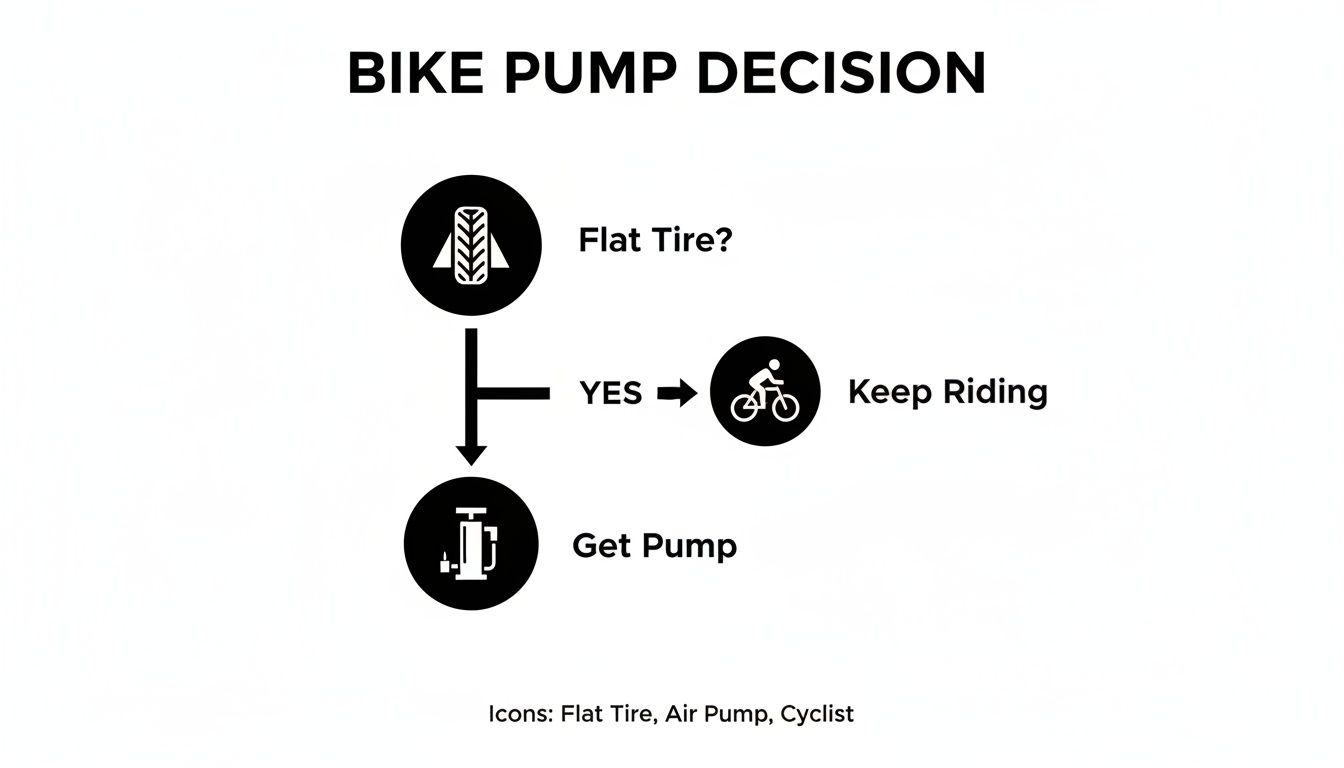
This simple flowchart pretty much sums up why a pump is non-negotiable.
While the idea of a portable pump has been around since the late 19th century, they really became popular after World War II. By 1980, brands like Topeak and Blackburn were making the first compact, frame-mounted pumps, and by the 1990s, they had grabbed 15% of the global bike accessory market during the mountain biking boom. If you're curious, you can explore the history of bicycle pumps to see just how far they've come.
Mini-pumps are the ultimate backup plan. They don't need batteries or cartridges. As long as you've got the arm strength, you can get air in your tire and make it home.
Their biggest selling point is that they just work. The downside? They require a good bit of elbow grease, especially for high-pressure road bike tires, and can take a while to fill up a tire completely.
- Best For: Long-distance tourers, bikepackers, and anyone who puts absolute reliability above all else.
- Pros: Super lightweight, affordable, and never runs out of "power."
- Cons: It's a workout! Slow to inflate and tough to reach high pressures.
CO2 Inflators: The Need for Speed
A CO2 inflator is engineered for one purpose: raw, blistering speed. Instead of a manual pump, this little gadget uses small, pressurized cartridges of carbon dioxide. You just screw the inflator head onto your tire's valve, pop the cartridge, and whoosh—your tire is inflated in seconds.
This makes it the hands-down winner for competitive racers or anyone who just wants to get moving again with zero fuss. The speed is genuinely impressive and can often seat a tubeless tire bead on the rim, something a mini-pump could never do on the trail.
But that speed comes at a price. Each cartridge is a one-shot deal, so you have to carry spares. Also, CO2 molecules are smaller than air and will slowly leak out of a rubber tube over about 24 hours, so you'll need to deflate and re-inflate with regular air when you get home.
- Best For: Racers, group riders, and anyone trying to fix a flat in the pouring rain.
- Pros: Insanely fast inflation (we're talking 1-3 seconds), tiny and light, and zero effort required.
- Cons: Cartridges are single-use, there's an ongoing cost, and you have to re-inflate with air later.
Electric Pumps: The Modern, Effortless Solution
The electric portable air pump for bikes is the new kid on the block, mixing modern tech with pure convenience. Think of it as a miniature air compressor you can hold in your hand. You set your target PSI on a digital display, attach the hose to the valve, and hit a button. The pump does all the work and shuts off automatically when it hits the right pressure.
This push-button operation is a total game-changer, especially for riders with high-volume e-bike or fat bike tires that would leave you exhausted trying to pump them up by hand. You get the precision of a shop pump in a package you can take with you.
The main catch, of course, is the battery. You have to remember to keep it charged. They're also a bit bulkier and heavier than the other two options. For many riders, though, the sheer convenience and dead-on accuracy are worth it.
- Best For: E-bike owners, commuters, and any rider who values convenience and precision.
- Pros: Totally effortless, precise pressure control, and pretty quick.
- Cons: Needs a charged battery, is heavier and bulkier, and costs more upfront.
Portable Bike Pump Type Comparison
Still on the fence? Here’s a quick-glance comparison to help you see how the three types stack up against each other.
| Pump Type | Best For | Pros | Cons |
|---|---|---|---|
| Mini-Pump | The "always prepared" rider, bikepackers, tourers. | Lightweight, affordable, ultra-reliable, never needs a charge. | Requires a lot of manual effort, slow, hard to reach high PSI. |
| CO2 Inflator | Racers, group riders, anyone who values speed. | Incredibly fast, compact, effortless to use. | Single-use cartridges, ongoing cost, needs re-inflation later. |
| Electric Pump | E-bike riders, commuters, tech-savvy cyclists. | Effortless, precise PSI, automatic shutoff, fast. | Requires a charged battery, heavier, more expensive. |
Ultimately, the best pump is the one that fits your riding style and priorities. Whether you value old-school reliability, lightning-fast repairs, or modern convenience, there's a perfect option out there to keep you rolling.
What Specs Actually Matter When Choosing a Pump?
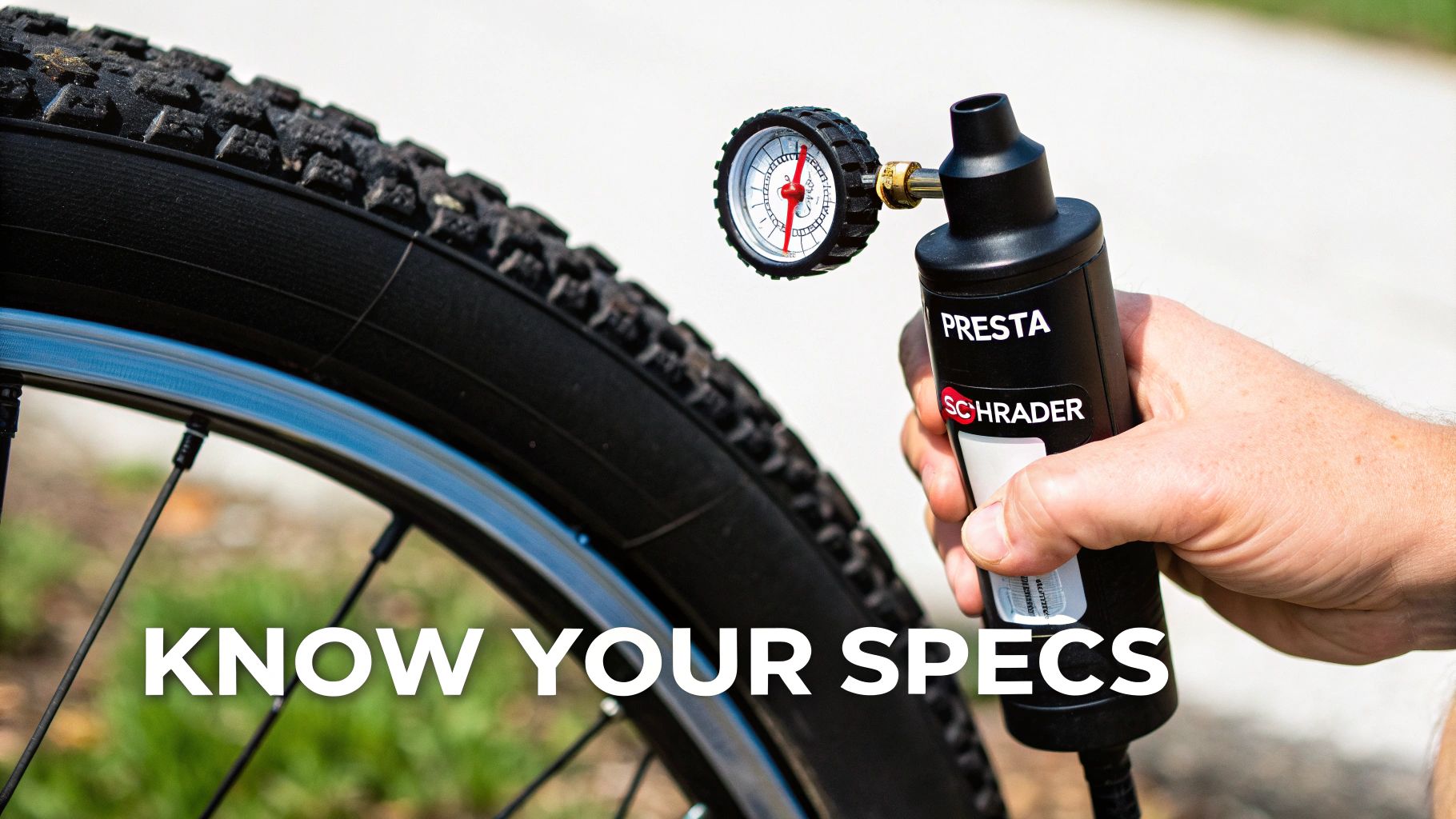
Shopping for a portable air pump for bikes can feel like you’re drowning in a sea of technical jargon. But honestly, once you cut through the noise, there are only a handful of specs that really determine how a pump will perform when you're stuck on the side of the road.
Getting these right is the difference between buying a reliable ride-saver and a useless gadget that just takes up space. Let's break down what to look for and what it actually means for you and your bike.
PSI and Air Volume: The Two Sides of Inflation
Think of getting air into your tire like using a garden hose. PSI (Pounds per Square Inch) is the force of the water, while air volume is how wide the stream is. You need the right combination of both for your specific tire.
A skinny road bike tire is like a narrow pipe; you need a high-pressure jet to fill it up. It requires high PSI (think 80-120 PSI) but doesn't actually hold a lot of air. On the other hand, a wide mountain bike or e-bike tire is like a big bucket. You need a wide, high-volume stream to fill it quickly, and the pressure doesn't need to be nearly as intense (usually 20-40 PSI).
- High-Pressure (HP) Pumps: These are built with narrow barrels, making it physically easier to cram air in at high pressures. They're a must-have for road bikes but will feel like they take forever to fill a fatter mountain bike tire.
- High-Volume (HV) Pumps: These have wider barrels that shove a ton of air with each stroke, making quick work of fat tires. They’re perfect for MTBs and e-bikes, but most can't generate enough force to get a road tire properly inflated.
Choosing the wrong type is a classic rookie mistake. An HP pump on a fat tire will leave you pumping for what feels like an eternity. An HV pump on a road tire might not even get it firm enough to ride home safely. Always match the pump type to your main ride.
Valve Compatibility: Presta vs. Schrader
Your bike’s tires have one of two main valve types, and your pump has to fit. Luckily, most modern pumps are designed to work with both, but it's essential to know which is which.
- Schrader Valve: This is the one you’ve seen a million times—it's the same valve found on car tires. It’s wider, more rugged, and common on cruisers, hybrids, and many mountain bikes.
- Presta Valve: Thinner and a bit more delicate, this is the standard for road bikes and higher-end mountain or gravel bikes. It has a small locknut on the tip that you have to unscrew before you can inflate it.
Modern pumps solve this problem with clever head designs. Some have a little piece inside you can flip around, while many nicer models have a "smart head" that automatically clamps onto either valve type without any fiddling. If you want to dive deeper, you can explore the general principles of valves and inflation to understand the mechanics behind it all.
Materials and Build Quality
The stuff a pump is made of directly impacts how long it'll last and how much it weighs—two things that matter a lot when you’re carrying it on every single ride.
Aluminum vs. Plastic
Most pumps are made from either aluminum or a tough composite plastic.
- Aluminum: An aluminum body is usually more durable and does a better job of handling the heat that builds up during pumping. It just feels more solid and can take a beating, which is great for rugged off-road adventures.
- Plastic: Don't knock it! High-quality plastic or composite pumps can be surprisingly strong, and their biggest advantage is being lighter. For road cyclists or bikepackers counting every gram, a well-made plastic pump is often the smarter choice.
Size, Weight, and Portability
Finally, think about the simple reality of carrying the thing. The most powerful pump in the world is totally useless if you leave it at home because it's a pain to bring along.
Check the pump’s dimensions and weight. Is it small enough to tuck into a jersey pocket or a small saddlebag? Or does it need its own mount on your bike frame? A compact pump weighing under 150g can be a game-changer for a minimalist rider. A slightly larger, more powerful electric pump might be the perfect fit for an e-bike rider who already has panniers for storage. The best pump is always a balance between performance and the practicalities of how you ride.
Finding the Right Mounting and Storage Solution
Let's be honest, a powerful, high-tech portable air pump for bikes is completely useless if it’s sitting in your garage when you get a flat tire miles from home. The final piece of the puzzle is figuring out how to carry it with you on every ride, turning it from an accessory you might remember to an essential tool you never forget.
The best storage solution is one you don't even have to think about. It should be secure, quiet, and feel like a natural part of your bike setup. What works for you will really depend on your bike, your riding style, and, of course, the size of the pump you've chosen.
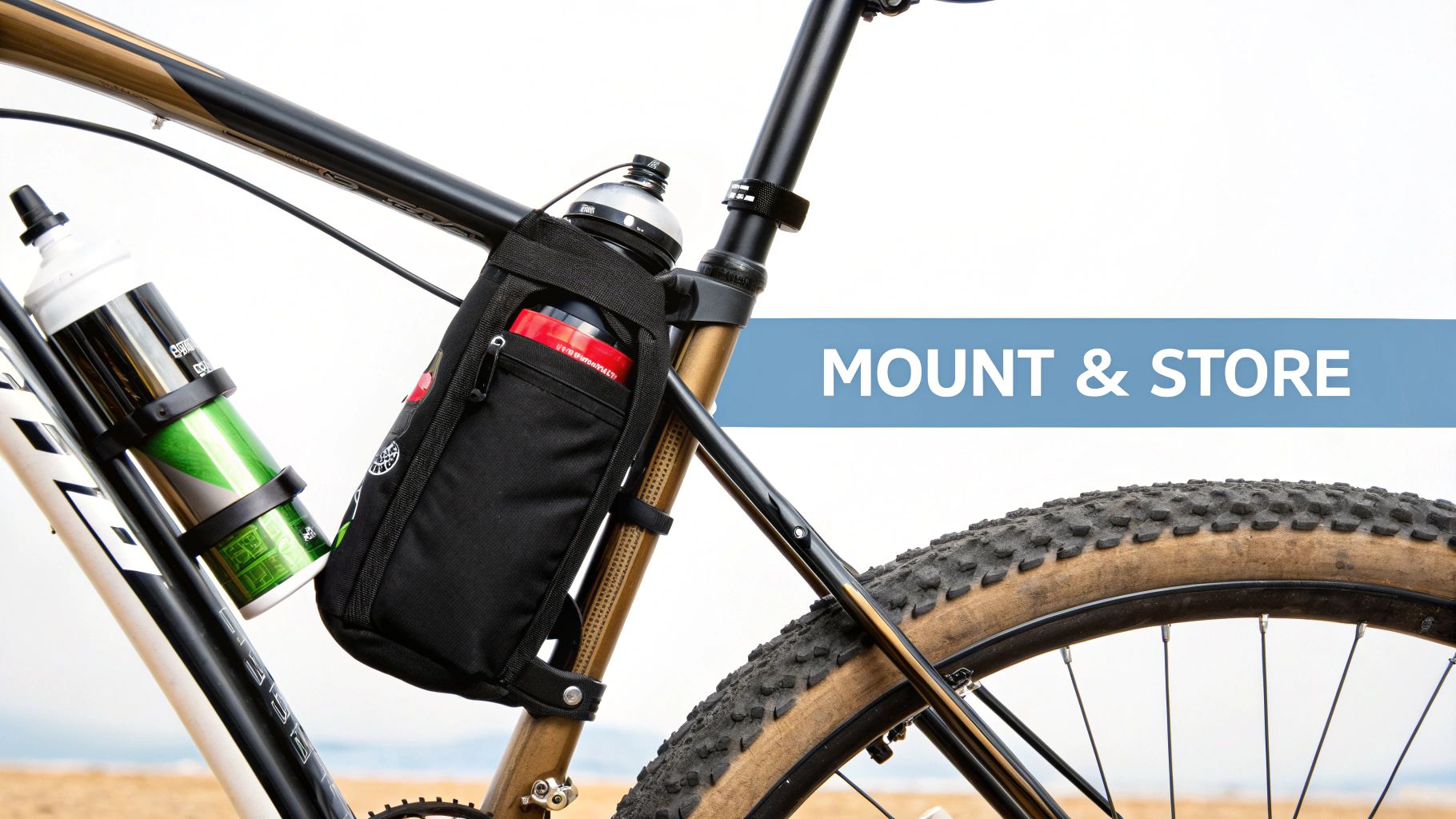
Common Mounting and Carrying Methods
Most pumps are designed with portability in mind, so you've got a few solid options for attaching them to your bike or yourself.
- Frame Mounts: This is a classic for a reason. Many mini-pumps and some compact electric models come with a simple plastic bracket that bolts right onto your bike's frame, usually alongside a water bottle cage. It's a fantastic "set it and forget it" solution.
- Saddle Bags: That small bag tucked under your bike's seat is the perfect home for a full repair kit. It’s ideal for stashing a compact pump, a spare tube, and tire levers, keeping everything you need for a flat fix in one dedicated spot.
- Jersey Pockets: If you're a road cyclist or a minimalist at heart, a super-lightweight pump can easily slip into a rear jersey pocket. For example, something like the FlexiPump Nano, which weighs just 130g, is barely noticeable back there. It's the simplest method, but it really only works for the smallest, lightest pumps.
Tailoring Storage to Your Bike Type
The right solution isn't one-size-fits-all. Different bikes come with their own unique challenges and opportunities for carrying gear.
E-Bikes and Commuter Bikes
Electric bikes often have frames packed with batteries and wiring, which can make finding space for a traditional frame mount a bit tricky. The good news? They're practically built for carrying gear in other ways.
For e-bike riders, thinking beyond the frame is key. The goal is to integrate the pump into your existing cargo setup so it becomes an invisible but essential part of your everyday kit.
Think about using pannier bags on a rear rack or adding a handlebar bag. These options give you plenty of room for a more powerful electric pump, plus all your other essentials like locks, snacks, and rain gear. Since your e-bike handles the extra weight effortlessly, you don’t have to sacrifice pump performance for portability. If you're looking to gear up, check out our guide to the best electric bike accessories for more great storage ideas.
Mountain Bikes and Dirt Bikes
When you're tearing down a rocky trail, your biggest enemy is rattling. A pump that's constantly vibrating or, even worse, falls off mid-ride is a serious no-go. For mountain bikers, a secure, rattle-free mounting system is absolutely non-negotiable.
Look for frame mounts that include a sturdy velcro strap to cinch the pump down tight. Another really popular option for off-road riders is a hydration pack or a hip pack. Stowing the pump in a dedicated compartment ensures it stays quiet, protected from mud and impacts, and is always with you—even if you and your bike part ways unexpectedly on the trail.
How to Use and Maintain Your Portable Pump
Having the right portable air pump for bikes is a great start, but knowing how to use it when you're stuck on the side of the trail is what really counts. This is where theory hits the road. Getting comfortable with the process can turn a ride-ending disaster into a quick, five-minute pitstop.
Let's walk through exactly what to do in a real-world flat tire scenario. Then, we’ll cover the simple maintenance that keeps your pump ready for action when you need it most.
Step-by-Step Inflation Guide
Picture this: you've just patched a tube or swapped it out, and now it's time to get that tire back up to pressure. Whether you're working with a manual or an electric pump, the basic steps are the same.
- Prep the Valve: First, spin the wheel so the valve is at the top. It's just easier to work with that way. If you have a Presta valve, unscrew the little locknut at the tip all the way. Give it a quick tap with your finger—you should hear a "psst" of air. This just confirms the valve isn't stuck closed. For a Schrader valve, all you need to do is remove the plastic cap.
- Get a Solid Connection: Push the pump head (the chuck) firmly and squarely onto the valve stem. If there's a locking lever, flip it to secure the connection. You want it to feel snug and solid. A wobbly connection is the number one reason for leaking air and, even worse, a bent or broken valve stem.
- Pump It Up: Time to get to work. With a manual pump, use smooth, full strokes from the shoulder, not just your arms. If you have an electric pump, just hit the start button. Watch the built-in gauge if you have one. If not, you'll have to rely on the good old "thumb test." Press firmly on the tire's surface—it should feel rock-hard for a road bike or have just a little bit of give for a mountain or e-bike tire.
Pro tip for manual pumps: Don't be shy about putting your body weight into it, especially for those last few pumps to get to high pressure. Bracing the wheel against a tree or even your own leg gives you the stability to finish the job without a struggle.
Keeping Your Pump Ready for Anything
A portable pump is a simple mechanical tool, and like any tool, it works best when it's clean and cared for. A quick maintenance routine doesn't take much time but makes a world of difference in your pump's reliability. Think of it this way: you check your tire pressure before a ride, so why not check your pump once in a while?
If you want a deeper dive into the basics, our guide on inflating bike tires is a great place to start. A little preventative care goes a long way, especially after a muddy or dusty ride when grit and grime can work their way into the moving parts.
Essential Bike Pump Maintenance Checklist
A few simple checks can keep your portable pump in top working condition for years. Follow this straightforward checklist to make sure it’s always ready to save your ride.
| Maintenance Task | Frequency | Why It's Important |
|---|---|---|
| Clean the Chuck | After every muddy ride or every few months. | Dirt crammed inside the chuck is a surefire way to get a poor seal on the valve, leading to leaky, frustrating pumping. A quick wipe with a clean rag is all it takes. |
| Check Seals and O-Rings | Once a year or if you feel air leaking. | The rubber O-rings are what create the pressure seal. Over time, they can dry out and crack, causing your pump to lose efficiency. A quick visual inspection is key. |
| Lubricate Moving Parts | Once a year for manual pumps. | A single drop of silicone-based lubricant on the main plunger shaft keeps the action smooth. Important: Never use petroleum-based lubes like WD-40, as they can damage the rubber seals. |
| Inspect the Hose | Every six months. | For pumps with a flexible hose, check for any cracks or brittleness, paying close attention to where the hose meets the pump body and the chuck. |
By making these simple steps part of your routine, your portable pump will be a trusty companion on every ride. You'll have the confidence to explore farther, knowing you're fully prepared for whatever the trail throws your way.
Got Questions About Portable Bike Pumps? We've Got Answers.
When you're gearing up, a few questions always pop up about portable pumps. Getting them sorted out is the difference between buying with confidence and just guessing. We'll walk through the most common things riders ask us, giving you straight, practical answers so you can pick the right tool and ride without worry.
Think of this as your final check-in before hitting the trail. We’ll cover everything from whether these little pumps can handle modern tubeless tires to if splurging on an electric model actually makes sense.
Can I Use a Portable Pump for My Tubeless Tires?
You absolutely can, but it’s crucial to know what it’s good for. For topping off your air before a ride or re-inflating after your sealant has plugged a small puncture, a portable pump is perfect. Both manual and electric models have no problem adding air to a tubeless tire that’s already seated on the rim.
The real test comes when you need to set up a new tubeless tire or, worse, reseat a bead that’s popped off the rim mid-ride. That job requires a massive, instant blast of air to force the tire bead up against the rim hooks and create a seal.
A standard portable pump, especially a little hand pump, just can't move air fast enough to seat a stubborn tubeless tire. When you're stuck on the trail in that situation, a CO2 inflator is your best friend.
That’s why a lot of seasoned riders carry both. They'll have a trusty mini-pump or a compact electric pump for everyday inflation, but they'll also pack a CO2 cartridge and inflator head as a "get out of jail free" card for reseating a tubeless tire in a pinch.
What Is the Difference Between High-Pressure and High-Volume Pumps?
Getting this right is one of the most important parts of choosing a pump, because it's all about matching the tool to your tires. Pick the wrong one, and you’re in for a world of frustration. It's like trying to fill a swimming pool with a pressure washer—it just isn't the right tool for the job.
- High-Pressure (HP) Pumps: These are your go-to for skinny tires that need a ton of pressure, like on a road bike (80-120 PSI). They have a narrow barrel, which makes it much easier to push the handle down when the pressure gets high, but it also means you're moving less air with each stroke.
- High-Volume (HV) Pumps: These are built for beefy mountain bike, e-bike, or fat bike tires that run at lower pressures (20-40 PSI). Their barrels are much wider, pushing a huge amount of air with every pump to fill big tires fast. The trade-off? They become almost impossible to use once you get into higher pressure ranges.
If you try to fill a mountain bike tire with an HP pump, you'll feel like you're pumping for an eternity. On the flip side, trying to get a road tire up to pressure with an HV pump will have you sweating long before the tire is firm enough to ride safely. Always match the pump to the bike you ride most.
How Accurate Are the Gauges on Portable Pumps?
Honestly, the accuracy can be all over the place. As a general rule, the digital gauges you find on good-quality electric portable pumps are pretty spot-on, usually accurate to within 1-2 PSI. That precision is one of their biggest advantages.
On the other hand, those tiny little analog dial gauges on most manual mini-pumps? It's best to think of them as a rough estimate. They’re great for getting you into the right ballpark so you can get home, but they’re rarely perfectly accurate. Their small size and the bumps of the trail can easily throw them off.
That’s why it’s always a smart move to double-check your pressure with a reliable standalone digital or dial gauge when you get back to your garage. That way, you know you’re set up for the best performance and safety on your next ride.
Is an Electric Portable Pump Worth the Extra Cost?
For more and more riders, the answer is a big "yes." An electric portable air pump for bikes can be a total game-changer, but it really depends on what you value most. The upfront cost is higher, but the payoff in convenience is often well worth it.
An electric pump is probably a great fit for you if:
- You're all about convenience and precision. Being able to set your target PSI, hit a button, and let the pump do all the work is a luxury you’ll quickly love. It stops automatically at the perfect pressure every time.
- You ride big tires. Pumping up an e-bike, fat bike, or even a plus-sized mountain bike tire by hand can feel like a full-on workout. An electric pump saves a ton of time and energy.
- You find manual pumping difficult. For riders who might not have the upper body strength to hit high pressures, an electric pump makes flats a non-issue.
But if you're a minimalist who counts every gram, or if you just want something that has zero chance of failing because of a dead battery, then a top-notch manual mini-pump or a simple CO2 inflator is still the most practical choice.
Ready to stop worrying about flat tires for good? At eBike Gang, we offer powerful and reliable electric bikes and dirt bikes designed to keep you riding longer and farther. Pair your ride with the right gear to ensure you're prepared for anything the trail throws your way. Explore our collection today and experience the freedom of being fully self-sufficient on every adventure. Check out our lineup at https://ebikegang.com.