

Finding the right electric mountain bike isn't about picking the one with the highest specs; it's about finding the one that feels like an extension of you on the trail. Your ideal e-MTB is a perfect match for your riding style, the terrain you love to conquer, and your budget. For someone tackling chunky, root-filled climbs, a high-torque mid-drive model like the eBike Gang MB750 delivers the balanced power needed to clean technical sections. On the other hand, if you're a cross-country rider covering long distances, you might care more about a lighter frame and battery efficiency.
The goal is simple: align the bike’s features with your adventure.
How to Find Your Perfect Electric Mountain Bike
The world of e-MTBs can feel overwhelming, but this guide is here to help you sort through the noise. We'll skip the overly technical jargon and focus on what really matters—comparing the core components like motors, batteries, and suspension to see how they perform for different riders on different trails.
The electric mountain bike scene is exploding, with the market projected to hit USD 15.21 billion by 2032. That's great news for us riders, as it means more innovation, better technology, and more choices than ever before. You can dive deeper into these market growth trends at fortunebusinessinsights.com.
Your Quick Reference Guide
To kick things off, let's simplify the decision-making process. This table breaks down the most critical factors to consider, giving you a solid foundation for your search.
Key Takeaway: Stop looking for a single "best" bike. The real secret is finding the best combination of motor, battery, and suspension for the specific trails you ride most often. That’s how you get a bike that doesn't just work, but actually makes every ride better.
Understanding these fundamentals is the first step. Each one plays a huge role in how the bike handles, feels, and ultimately, how much fun you have out there.
Quick Guide to Key E-MTB Decision Factors
| Key Feature | What to Look For | Why It Matters |
|---|---|---|
| Motor System | Mid-drive motor, high torque rating (Nm) | A mid-drive motor provides a natural-feeling pedal assist and keeps the bike's weight centered, which is huge for balance and climbing tough terrain. |
| Battery Capacity | Watt-hours (Wh), look for 500Wh or more | This is your fuel tank. A bigger battery means more range, giving you the confidence to tackle longer loops without worrying about the bike dying. |
| Suspension Type | Hardtail vs. Full-Suspension | A hardtail is lighter and more efficient on climbs. A full-suspension bike soaks up bumps and drops, giving you way more comfort and control on rough trails. |
| Brake System | Hydraulic disc brakes, large rotors (180mm+) | E-bikes are heavier and faster, so you need serious stopping power. Hydraulic brakes offer better modulation and power, especially on steep descents. |
Think of these four elements as the heart, lungs, and legs of your future bike. Getting them right for your needs is what separates a good purchase from a great one.
E-MTB Motors and Batteries: The Heart of the Machine
When you're looking at an electric mountain bike, the motor and battery are everything. They’re the engine and the fuel tank, and they determine how much power you have on tap for steep climbs and how long you can stay out on the trail before heading home. Getting this choice right isn't just about picking the biggest numbers; it's about matching the bike's power system to how and where you ride.
The first big decision is the motor type. While you'll see hub-drive motors on a lot of budget and commuter e-bikes, they just don't cut it for serious trail riding. Placing the motor's weight in the rear wheel throws off the bike's balance and makes the power delivery feel clunky and unnatural on technical terrain. For true off-road performance, a mid-drive motor is the only way to go.
Why Mid-Drive Motors Rule the Trail
A mid-drive motor sits right at the bottom bracket, the same place your pedals attach to the frame. This central location is a game-changer for handling and control on singletrack.
- Better Balance: Keeping all that weight low and centered helps the bike feel nimble and predictable, which is exactly what you need when you're navigating tight switchbacks or picking your way through a rock garden.
- A More Natural Feel: These motors use smart torque sensors that read how hard you're pedaling. The power they deliver feels like an amplified version of your own effort, not a sudden, jerky push from behind.
- Smarter Gearing: Because the motor drives the crank, it can take advantage of the bike’s gears. This keeps the motor running in its sweet spot, giving you incredible efficiency for scaling brutally steep climbs without overheating.
When you start comparing mid-drives, it's easy to get fixated on wattage. But the number you really need to care about is torque, measured in Newton-meters (Nm). Torque is the raw twisting force that gets you up and over trail obstacles. A motor with 85Nm of torque will feel worlds more capable on a tough climb than one with 60Nm, even if their peak wattage is the same. For a deeper dive into these core components, our comprehensive electric bike buying guide has all the details you need to make a smart choice.
Matching Motor Power to Your Ride
The "right" amount of power really comes down to your personal riding style and the trails you frequent. If your typical rides involve rolling cross-country trails, a 50Nm motor focused on efficiency might be perfect. But if you’re an aggressive all-mountain rider who lives for punishing climbs, you’ll want 85Nm or more to power through the gnarliest sections.
Expert Insight: Think of wattage as the motor's horsepower and torque as its low-end grunt. On the trail, that grunt is what pulls you up the hill, making torque the most critical spec for off-road performance.
Market trends show that most riders are finding a happy medium. In 2024, motors in the 250-500W range made up a whopping 59.11% of the e-MTB market. This power level offers plenty of torque for most riders on climbs up to 15%, without completely draining the battery. Still, with a compound annual growth rate of 9.86%, more powerful motors over 500W are on the rise as people look to tackle even more extreme terrain. You can dig into these e-MTB market trends over at mordorintelligence.com.
What to Look for in a Battery
Your e-MTB's battery is its lifeline, and its capacity—measured in watt-hours (Wh)—dictates your range. A bigger Wh number simply means you can ride farther or use more assistance for longer. For most trail riding, look for a battery with at least 500Wh. For riders planning all-day epics, 625Wh to 750Wh is quickly becoming the new standard.
But it’s not just about capacity; how the battery is integrated into the frame is just as important.
- Integrated Batteries: Housed neatly inside the bike’s downtube, these provide a sleek look and protect the battery from rocks, mud, and water. Almost all modern premium e-MTBs use this design.
- External Batteries: These are mounted onto the downtube. They're often easier to pop off for charging, but they can slightly raise the bike's center of gravity and disrupt the clean lines.
A well-integrated battery that sits low in the frame makes a huge difference in how the bike feels, making it feel more planted and stable when you're ripping through high-speed corners. Finally, never overlook the Battery Management System (BMS). This little electronic brain is non-negotiable—it protects the battery from overcharging, overheating, or discharging too far, which is crucial for both your safety and the long-term health of your investment.
Suspension, Frames, and Brakes: The Heart of Your Ride's Performance
Sure, the motor on an e-MTB gets all the attention, but it's the chassis—the frame, suspension, and brakes—that truly dictates how the bike feels and performs out on the trail. This is the stuff that turns raw power into confidence, control, and comfort when you're picking your way through a root-strewn singletrack or bombing down a rocky descent. Nailing these components is absolutely crucial to finding a bike that works for you.
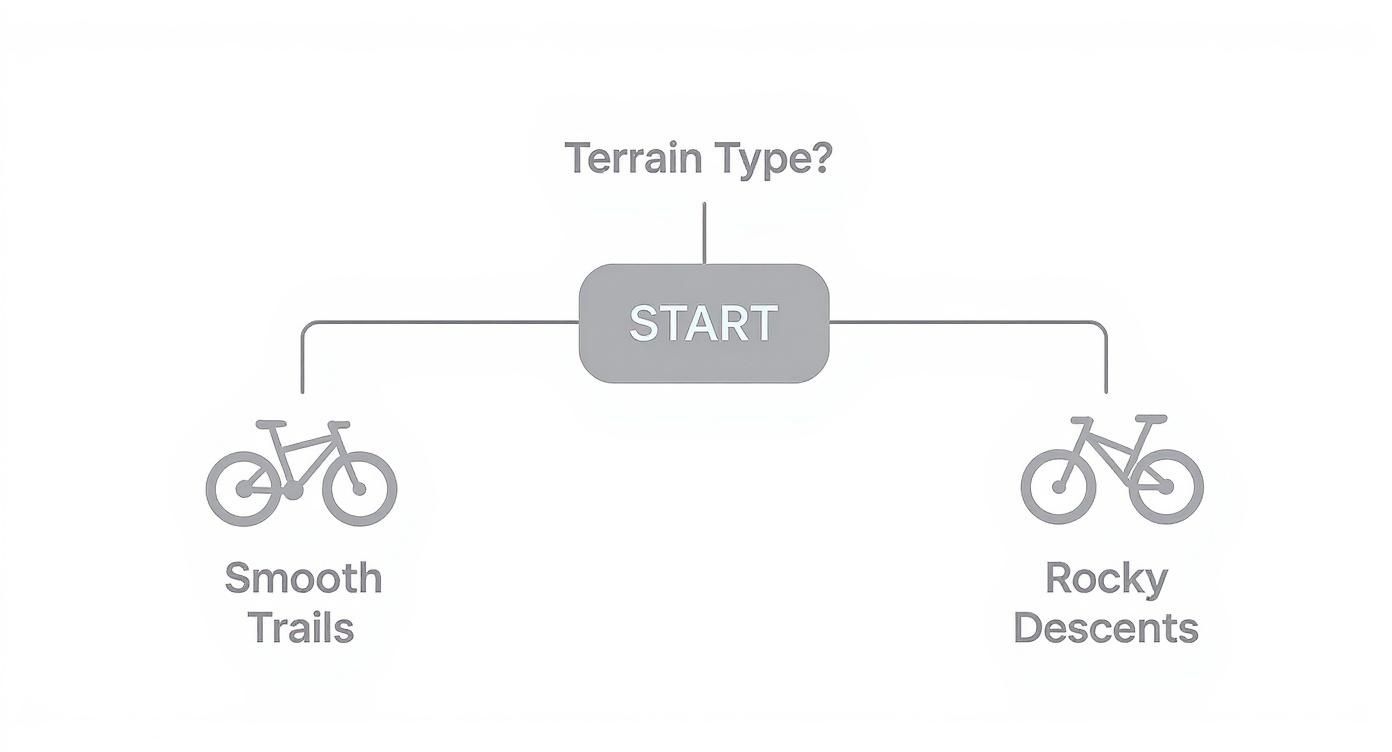
Your first big decision comes down to the suspension platform. Choosing between a hardtail and a full-suspension bike will have the biggest single impact on your wallet, your maintenance schedule, and how the bike handles different terrain. It's the classic trade-off between pure efficiency and all-out capability.
A hardtail e-MTB, with its suspension fork up front and a rigid rear triangle, is all about efficiency. It's lighter, simpler to maintain, and gives you a very direct, connected feeling with the trail. This makes it a killer choice for smoother flow trails, fire roads, or for riders who really value climbing speed.
Hardtail vs. Full-Suspension: Matching the Bike to the Trail
This isn't just a budget decision. It's about being honest about the kind of ground you'll be riding on most of the time.
| Suspension Type | Best For | The Big Advantage | The Catch |
|---|---|---|---|
| Hardtail | Smoother trails, big climbs, and cross-country style riding. | More bike for your buck (better components), less maintenance, and more efficient pedaling. | Can feel chattery and unforgiving on really rocky or rooty trails. |
| Full-Suspension | Technical climbs, rocky descents, and all-mountain adventures. | Unbelievable traction, comfort, and control on rough terrain. You'll ride faster and with more confidence. | Heavier, pricier, and requires more upkeep on pivots and the rear shock. |
On the other hand, a full-suspension e-MTB, with both a fork and a rear shock, is built to do one thing: keep your tires glued to the dirt. That translates to incredible traction on tricky climbs and a magic carpet-like feel on fast, bumpy descents. If you plan on tackling genuinely rough trails, the added capability isn't a luxury—it's a necessity.
How Much Suspension Travel Do You Need?
Beyond the basic type, the amount of suspension travel—how far the wheels can move to soak up bumps—is the next critical detail. It’s measured in millimeters (mm) and really defines what the bike is built for.
- Short-Travel (100-130mm): This is cross-country and light trail territory. These bikes are efficient, snappy, and feel incredibly nimble on less demanding terrain.
- Mid-Travel (140-160mm): Welcome to the all-mountain sweet spot. This range offers a fantastic balance of climbing ability and descending confidence, making it the most versatile choice for riders who want to do a little bit of everything.
- Long-Travel (170mm+): Reserved for hardcore enduro and downhill riding. This much travel is designed to erase huge hits and provide rock-solid stability at speed on the gnarliest trails you can find.
Expert Insight: If your local riding is a mixed bag of smooth climbs and moderately chunky descents, a mid-travel full-suspension bike in the 140-160mm range is the money setup. It’s capable enough to save you when things get hairy without feeling like a pig on the flatter sections.
Frame Materials: Does It Really Matter?
The frame is the skeleton of your e-MTB, and its material affects the bike's weight, stiffness, ride quality, and price. For electric mountain bikes, the decision almost always comes down to aluminum versus carbon fiber.
Aluminum is the trusted workhorse. It’s strong, durable, and relatively inexpensive, delivering a stiff and responsive ride that can handle years of abuse. For most people, it's the smart choice. Carbon fiber is the high-performance option—it’s lighter and can be shaped to be incredibly stiff in some areas while absorbing vibrations in others for a smoother feel. Of course, that performance comes with a serious price tag. For the vast majority of riders, a well-designed aluminum frame delivers 90% of the performance at a fraction of the cost.
Why Your Brakes Are a Non-Negotiable Safety Feature
Let's be blunt: e-MTBs are heavier and faster than their analog cousins. Because of this, powerful and reliable brakes aren't just a feature, they're an absolute must-have. Hydraulic disc brakes are the only real option here. They provide far superior stopping power, finer control (what we call modulation), and consistent performance in any weather.
Look for brakes from well-known brands like Shimano, SRAM, or Magura. Two things you need to pay close attention to are the rotor size and the number of pistons in the caliper. Bigger rotors (measured in mm) get rid of heat better and give you more braking leverage. You should be looking for a minimum of 180mm rotors, but 200mm or even 203mm rotors are even better, especially for the front wheel where most of your stopping power comes from.
Finally, four-piston calipers provide more clamping force and better feel than two-piston models. This gives you the precise control needed to slow down on steep, loose sections without locking up your wheels and losing traction.
Matching Your Bike to Your Riding Style
The spec sheet is one thing, but how a bike feels on the dirt is what truly matters. The best electric mountain bikes aren't just a collection of parts; they're a cohesive system where the motor, battery, and suspension work in harmony to match your ambitions on the trail. Getting honest about how you ride is the first real step to finding the perfect bike.
Are you the kind of rider who loves to log miles on flowy singletrack on a Saturday morning? Or are you hunting for adrenaline on steep, rock-strewn descents? Maybe you're an explorer at heart, using your bike to push deep into the backcountry for all-day adventures. Each of these missions calls for a different machine.
Let’s look at three common rider profiles to see where you fit in. This will help you figure out which features you absolutely need and where you can save a little.
The Trail Explorer
This is the rider who lives for long, rolling cross-country rides. They enjoy a mix of smooth climbs and fast, fun descents. For them, it’s all about covering ground, soaking in the views, and getting a good workout with a little electric assist. A Trail Explorer wants a bike that feels nimble and balanced, prioritizing efficiency and range over brute force.
Here’s what their ideal setup looks like:
- Motor: A mid-drive motor with 60-75Nm of torque is the sweet spot. It offers plenty of punch for most climbs without killing the battery, and the power delivery feels smooth and natural on undulating terrain.
- Battery: A 500Wh to 625Wh battery provides enough juice for a few hours of fun without weighing the bike down. It’s the Goldilocks zone for range and weight.
- Suspension: Look for 120-140mm of travel. This is more than enough to smooth out roots and rocks for a comfortable ride, but it won't feel mushy or inefficient when you're pedaling uphill.
A Trail Explorer’s bike should feel lively and responsive. The geometry is typically more neutral, striking a great balance between climbing efficiency and descending confidence, making it a fantastic all-rounder for most trail networks.
The All-Mountain Rider
This rider actively seeks out the hard stuff. They'll happily grind up a tough, technical climb because they know a steep, rowdy descent is waiting for them at the top. They need a burly, confidence-inspiring bike that can handle mistakes and plow through rough sections without flinching.
An All-Mountain Rider's bike is built for pure capability:
- Motor: A high-torque mid-drive motor pushing 85Nm or more is a must. You need that raw power to muscle your way up incredibly steep, loose, and technical climbs that would be impossible otherwise.
- Battery: A bigger battery—think 625Wh to 750Wh+—is non-negotiable. High-torque motors chew through power, especially in boost modes, so you need a big tank to make sure you get to the bottom of that last descent.
- Suspension: 150-170mm of travel is the name of the game. This long-travel suspension is designed to absorb big hits, gobble up rock gardens, and smooth out drops, keeping you stable and in control when things get wild.
For the All-Mountain rider, a full-suspension bike isn't a luxury; it's a necessity for maintaining traction and control when the trail gets ugly.
The Backcountry Adventurer
This rider sees their e-MTB as a tool for exploration. They're planning huge, all-day rides on remote fire roads and singletrack, often carrying extra gear. The goal is to get way out there, to places that would be out of reach on a traditional bike. For them, maximum range and bulletproof reliability trump everything else.
A bike for the Backcountry Adventurer is all about endurance:
- Motor: An efficiency-focused mid-drive with 60-85Nm is ideal. You need enough power for long, sustained climbs, but the motor's tuning should prioritize battery conservation for the long haul.
- Battery: Go for the biggest battery you can find, usually 750Wh or more. Many of these riders also look for systems that can accommodate a piggyback range-extender for ultimate peace of mind.
- Frame & Features: A sturdy frame with mounting points for racks and gear is a huge bonus. Here, component durability is far more important than saving a few grams. To dig deeper into what makes a bike truly trail-ready, check out our guide on choosing an off-road electric bike for adults.
This growing appetite for adventure has helped mountain e-bikes capture over a quarter of all e-bike sales. The dominant 250W to 750W motor category, which accounted for over 62% of U.S. sales in 2024, perfectly caters to these different riding styles.
To make it even clearer, here’s a quick breakdown of how these features line up with each rider profile.
E-MTB Feature Recommendations by Rider Profile
| Rider Profile | Recommended Motor | Ideal Suspension | Key Features |
|---|---|---|---|
| Trail Explorer | 60-75Nm (Balanced) | 120-140mm Travel | Efficiency, nimble handling, all-around performance |
| All-Mountain Rider | 85Nm+ (High Torque) | 150-170mm Travel | Burly frame, aggressive geometry, downhill stability |
| Backcountry Adventurer | 60-85Nm (Efficient) | 130-150mm Travel | Max battery capacity, gear mounts, component durability |
This table should help you quickly pinpoint the specs that will best serve the kind of riding you plan to do.
The Bottom Line: Don't just buy a bike with impressive stats; invest in a machine that complements your riding DNA. An All-Mountain rider on a Trail bike will feel under-gunned and nervous, while a Trail Explorer on a big All-Mountain rig will just be lugging around extra weight. Be honest with yourself about where and how you ride—it's the single most important step in finding the right e-MTB.
What Your Money Gets You: Breaking Down E-MTB Price Tiers
Let's talk money. E-mountain bike prices are all over the map, from a couple of thousand dollars to more than a new car. It's easy to get sticker shock, but the price tag isn't just about a fancy brand name. It’s a direct reflection of what’s bolted to the frame—the motor’s kick, the suspension’s smoothness, and how well the whole package will hold up after a season of being slammed through rock gardens.
Think of the market in three general tiers. As you climb the ladder, you're paying for real, noticeable improvements in how the bike rides and how long it lasts.
Entry-Level: Your Ticket to the Trails
For $2,500 to $4,500, you’re looking at the real starting line for a trail-capable e-MTB. Forget the cheap, dangerous junk you might see in a big-box store; these bikes are built for actual dirt. They have the essentials you need to be safe and have fun on singletrack.
At this price, you should expect a solid mid-drive motor from a known brand, a certified battery pushing at least 500Wh, and proper hydraulic disc brakes. Most bikes you’ll find here are aluminum hardtails, and that’s a good thing. Skipping the complexity of rear suspension lets manufacturers put the money where it counts: a better fork up front, a reliable drivetrain, and wheels that won't fold on you.
I'll take a great hardtail over a cheap full-suspension bike any day of the week. You get better components, less maintenance headaches, and a bike that actually helps you become a better rider.
This is the perfect zone for anyone new to mountain biking or for riders sticking to flowy trails who want a dependable machine that won't empty their wallet.
Mid-Range: The Sweet Spot for Most Riders
When you step up to the $4,500 to $7,000 range, you hit the sweet spot where performance and value really shake hands. For most serious riders, this is the place to be. The biggest leap forward is usually the suspension—you'll get higher-end air forks and rear shocks with more adjustments, letting you dial in the ride perfectly for the terrain.
This is also where well-designed full-suspension aluminum frames and even some entry-level carbon frames show up. The component upgrades here make a tangible difference when you're pushing it on the trail:
- Serious Stopping Power: Four-piston hydraulic brakes with bigger rotors become the norm. They give you the confidence to brake later and harder on steep, long descents without fading.
- Climb-Friendly Gearing: You'll see wide-range, 12-speed drivetrains that give you an easier gear for spinning up the steepest climbs.
- More Miles, More Fun: Batteries get a boost, often to 625Wh or 750Wh. That extra juice is what you need for those all-day epic rides.
Premium and High-End: The Best of the Best
Once you cross the $7,000 threshold, you're in the top tier. Here, you're paying for peak performance and shaving off every possible gram. These are the dream builds, where no expense is spared. Lightweight carbon fiber frames are standard, engineered for the perfect mix of razor-sharp stiffness and trail-smoothing compliance.
Everything gets an upgrade. You’ll find feather-light carbon wheels, top-shelf suspension that feels impossibly smooth, and often electronic shifting that delivers flawless gear changes. While these bikes are incredible, the performance gap between this tier and the mid-range is much smaller than the jump from entry-level. This is the realm of racers and die-hard enthusiasts who need every last ounce of performance and are willing to pay for it.
Your E-MTB Pre-Purchase Checklist
You’ve done the research and narrowed it down. You’re ready to pull the trigger on a new electric mountain bike. Before you do, it pays to run through one final check. This isn't about re-reading spec sheets; it's about the real-world details that make the difference between a good bike and your bike.
The single most important thing you can do? Test ride multiple bikes. Seriously. No review or YouTube video can substitute for the actual feeling of the bike underneath you on a trail. Pay close attention to how the motor kicks in, how the bike feels flicking through tight corners, and whether the suspension smooths out the bumps or feels harsh.
Final Decision Tip: It's amazing how often the bike that looks perfect on paper just doesn't feel right on the trail. And sometimes, the one you almost overlooked is the perfect match. Trust your gut during the test ride—comfort and confidence are everything.
Confirming the Perfect Fit
Frame geometry is the secret sauce that dictates your comfort and control. First, make sure the standover height is right—you need to be able to put a foot down easily and safely. Your reach to the handlebars should feel natural, not like you're stretching or cramped, which is a recipe for back and shoulder pain on longer rides.
Talk to the shop about sizing or dig into the manufacturer's charts online. Getting the fit right is the foundation of a great ride, making you more efficient on the climbs and more in control on the descents. This is especially true for bikes with unconventional designs; for example, learning how a fat tire e-bike is sized can be a little different.
Know Before You Go
Before you hand over your credit card, you need to be sure you can actually ride your new e-bike where you want to. E-bike regulations vary wildly from one trail system to the next.
- Check Trail Access: Confirm that your local trails permit e-MTBs. Class 1 bikes are the most widely accepted, but it's always best to check first.
- Understand E-Bike Classes: Most true e-MTBs are Class 1 (pedal-assist only, up to 20 mph), which is the key to legal trail access in most places. You’ll want to avoid Class 2 bikes with throttles for most singletrack riding.
A quick search on the website of your local trail advocacy group or park service will tell you what you need to know and can save you a world of frustration.
Finally, get ready to do a little basic maintenance. A new bike is an investment that needs looking after. Learn how to properly clean and lube the drivetrain after every few rides—it will dramatically extend its life. You'll also want to understand the best practices for battery health, like storing it with a partial charge and keeping it out of extreme hot or cold. These simple habits will keep your bike running smoothly for years of adventure.
E-MTB FAQs: Your Final Questions Answered
Alright, so you're getting close to pulling the trigger on an electric mountain bike. It's totally normal to have a few last-minute questions pop up. Let's clear up some of the most common ones so you can feel 100% confident in your choice.
How Much Range Will I Actually Get?
Manufacturers love to throw big numbers around, but let's be real. For most trail riding, you can realistically expect between 20 and 40 miles on a single charge. Think of that as your baseline.
Now, that number can swing wildly. How much you weigh, how steep the climbs are, and which assist mode you’re using are the big three factors. If you’re mashing that Turbo button on every uphill, you’ll chew through your battery way faster than if you stick to Eco on the flats. A good habit is to plan your rides on the conservative side of your bike's estimated range.
What's the Deal with E-Bike Classes?
This is a big one, because it dictates where you're legally allowed to ride. Getting it right is key to keeping trail access open for everyone.
- Class 1: This is your standard pedal-assist e-MTB. The motor only kicks in when you pedal, and it cuts off at 20 mph. This is the gold standard for trail access and what most e-mountain bikes are.
- Class 2: These bikes have a throttle, meaning you can get power without pedaling, up to 20 mph. Because of the throttle, they're often not allowed on trails designated for non-motorized use.
- Class 3: Also pedal-assist only, but the motor keeps helping you up to 28 mph. These are built for speed and are almost always restricted to roads and bike paths, not singletrack.
For hitting the dirt, a Class 1 e-MTB is pretty much always the right call. It's the most versatile and widely accepted choice.
The Bottom Line: Stick with a Class 1 e-MTB. It gives you the best shot at being able to ride on the widest variety of trail networks. You should still always check local trail rules, but this class is your ticket to the most adventure.
How often Does an Electric Mountain Bike Need Maintenance?
Think of it this way: an e-MTB has all the same parts as a regular mountain bike, just with a motor and battery added to the mix. It needs the same love and attention, plus a little extra. I'd recommend a full professional service at least once a year.
In between those big tune-ups, you've got some homework. After every few rides, give your chain a good clean and lube, check your brake pads for wear, and make sure your tires are at the right pressure. As for the battery, treat it right—don't store it in a freezing garage or a hot car, and try to keep its charge between 20% and 80% if you're not riding for a while. A little bit of care goes a long way in protecting your investment.
Ready to hit the trails with some extra power? Check out the lineup of rugged, trail-ready electric mountain bikes from eBike Gang, LLC and find the perfect machine to kickstart your next adventure. Find your ride at https://ebikegang.com.