

So, you’ve made a great choice and invested in an electric bike. It's more than just a bike with a motor—it's a serious piece of gear that gets you where you need to go, whether that's the office or the top of a trail. But now comes the big question: where do you keep it?
Finding the right storage solution is about more than just getting it out of the way. It’s about protecting your investment. The best electric bike storage solutions are a smart mix of security, space-saving design, and protection from the elements. Whether you go for a wall mount in your apartment, a secure shed in the backyard, or a beefy floor stand, the goal is to keep your e-bike safe and ready for your next ride.
Protecting Your Investment with the Right E-Bike Storage
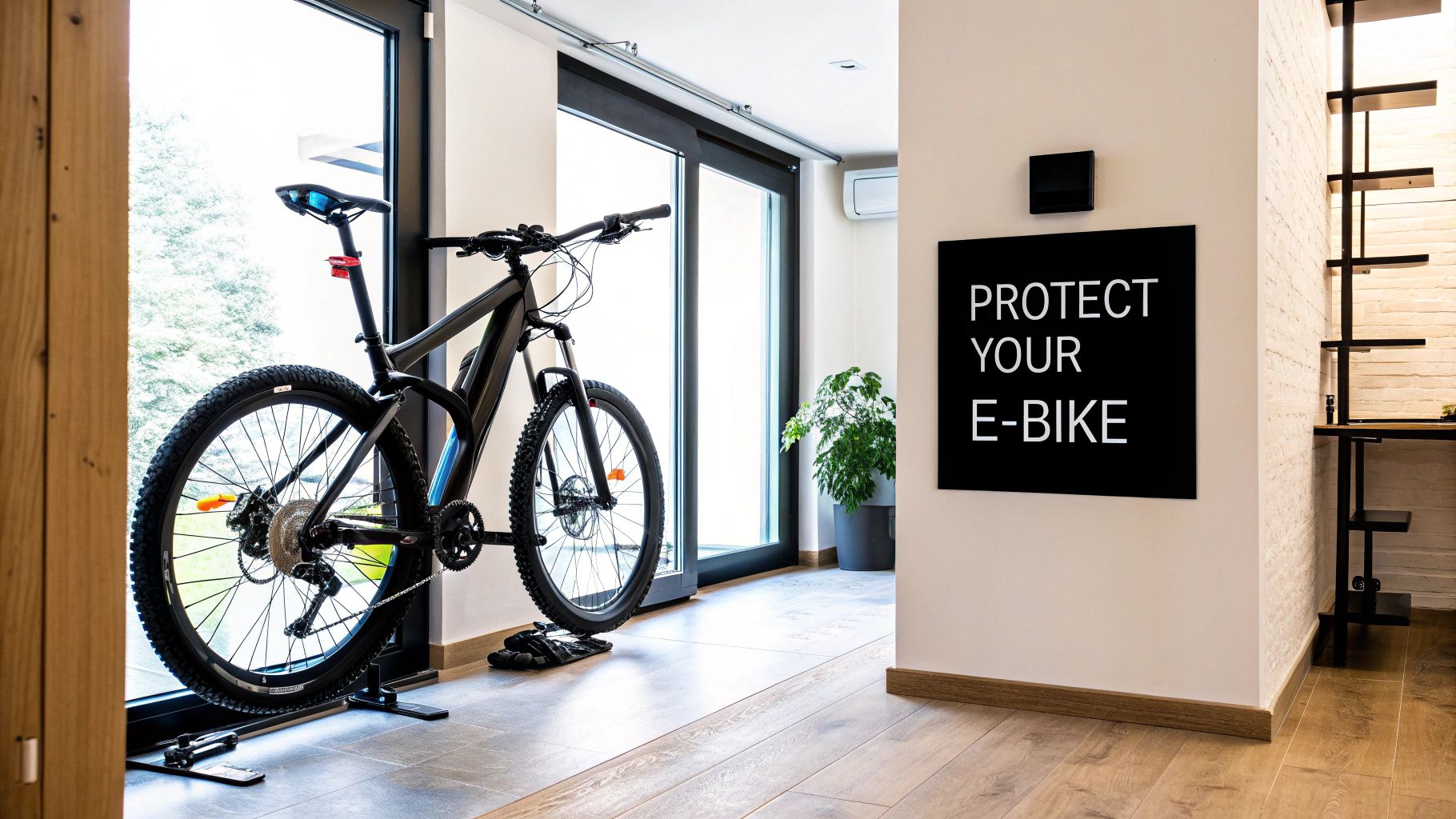
An e-bike isn't just a bike. It's a significant investment in how you commute, explore, and enjoy the outdoors. And with that investment comes a challenge that regular bike owners don't really have to worry about: finding a storage spot that can handle its extra weight, bulk, and value. That flimsy hook you used for your old ten-speed? It’s probably not going to cut it.
This is where a real storage strategy comes in. The average e-bike weighs between 50 and 80 pounds, which is more than enough to overwhelm most standard bike racks. Leaving an asset this valuable unlocked or exposed to rain, snow, and wild temperature swings is a surefire way to damage its sensitive electronics—especially the battery. Think of your storage plan as your first and best line of defense.
Why Your E-Bike Needs Special Attention
At the heart of your e-bike is a sophisticated system of electronics and a very expensive battery. Protecting these components is the name of the game. It’s helpful to think of it less like parking a bicycle and more like parking a small vehicle. You wouldn’t leave your car parked in a hailstorm on purpose, and that same mindset should apply to your e-bike.
To help you figure it all out, this guide will walk you through the essentials of keeping your ride safe. We'll get into:
- Indoor vs. Outdoor Options: Weighing the top-tier security of indoor storage against the sheer convenience of keeping it outside.
- Security and Theft Prevention: How to layer your defenses with the right locks, ground anchors, and smart placement.
- Battery Preservation: Simple, practical tips for short-term and long-term battery care that will extend its life.
- Space-Saving Solutions: Clever ways to store your e-bike in apartments, garages, and sheds without taking over your living space.
Getting your storage sorted means your bike will be secure, charged up, and ready to roll whenever you are.
Indoor vs. Outdoor: Where Should You Park Your E-Bike?
Figuring out where to keep your e-bike is the very first puzzle you need to solve. This decision impacts everything from your bike's lifespan and security to how often you actually feel like riding it. It's not just about getting it out of the way; it's a real trade-off between total protection and everyday convenience.
Think of it like this: would you leave a brand-new laptop out on the patio overnight? Probably not. Your e-bike, with its valuable battery and electronics, deserves the same consideration. The choice between parking it inside or out really boils down to your living space, the local weather, and how much risk you're comfortable with. Let's dig into the pros and cons to find the right spot for your ride.
The Case for Keeping It Indoors
Let's be blunt: storing your e-bike inside is the best thing you can do for it. The biggest win here is climate control. Extreme heat, freezing cold, and damp, humid air are the mortal enemies of your battery and electronic components. Over time, they can sap your battery's health and invite rust to settle in on your frame and chain. Keeping it inside a temperature-controlled space completely sidesteps these problems.
Then there's the security aspect. An e-bike tucked away in your house, apartment, or garage is simply a much tougher target for thieves. Given how much these bikes cost, theft is a genuine risk. Your front door is the best lock you have.
Plus, it just makes life easier. Charging is a breeze when you're right next to an outlet—no more messing with extension cords in the rain. And when it’s time for a little maintenance, you can work on it in a warm, well-lit space instead of shivering in the driveway.
When Outdoor Storage Makes Sense
Of course, not everyone has a spare room or a spacious garage. For apartment dwellers or anyone tight on square footage, a dedicated outdoor storage solution is a lifesaver. The obvious benefit is getting your bike out of the hallway and reclaiming your living space.
Modern outdoor options are much better than they used to be. We're not just talking about a flimsy tarp. You can get everything from heavy-duty, form-fitting waterproof covers to mini bike "tents" and even lockable sheds. They're built to fend off rain, snow, and the harsh UV rays that can fade your bike's paint and make plastic parts brittle.
The secret to making outdoor storage work is to not cheap out on weatherproofing and security. A basic cover offers minimal protection. You need something specifically designed to handle the elements and deter a thief with a pair of bolt cutters.
Before you buy, take a hard look at your environment. If you get hammered with snow every winter, a simple cover won't do the trick—you'll want a fully enclosed shed. And if you live in an area where bike theft is common, you absolutely need to anchor that shed to the ground and use multiple, high-quality locks.
Comparing Your Options Head-to-Head
So, how do you choose? It all comes down to balancing protection, convenience, and the reality of your living situation. This chart lays out the key differences pretty clearly.
| Feature | Indoor Storage | Outdoor Storage |
|---|---|---|
| Security | Excellent. It's behind your home's main locks. | Good to Fair. Depends entirely on the quality of your locks, anchors, and shed. |
| Weather Protection | Excellent. Full protection from heat, cold, and humidity. | Good. Only if you invest in a high-quality, fully waterproof cover or shed. |
| Convenience | High. Super easy to grab, charge, and work on. | Moderate. You have to go outside, and charging can be a hassle. |
| Space Impact | Takes up valuable living space. | Frees up all your indoor space. |
At the end of the day, the right answer is the one that fits your life. If you’ve got a secure garage, you're golden. If you're in a tiny apartment, a sleek vertical wall mount could be your best friend. And if it has to live outside, a top-notch, weatherproof bike shed will give you the peace of mind you need to sleep at night.
Smart Indoor Storage Racks for Any Space
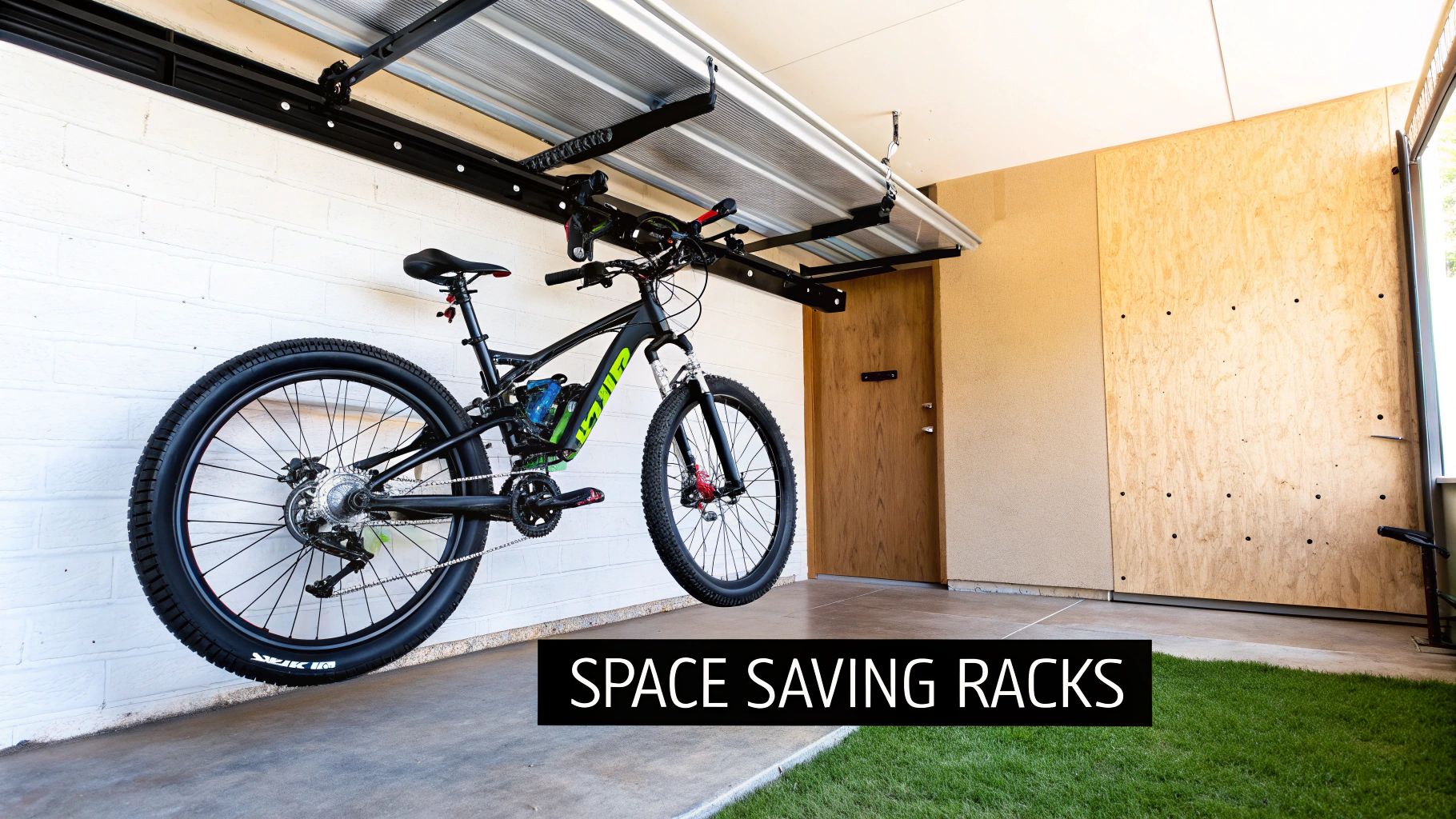
Bringing your e-bike inside is a great move for security and keeping it out of the weather, but it creates a new puzzle: where do you put a heavy, awkward machine without it completely taking over your home? Just using the kickstand or leaning it against a wall is a recipe for scuffed paint and a frustrating trip hazard. The real solution is to start thinking vertically.
Smart indoor racks are all about reclaiming your floor space. Don't think of your walls and ceiling as boundaries—think of them as prime, unused real estate. By getting your bike up and off the ground, you can integrate it into your living space cleanly and efficiently, turning a bulky item into a non-issue.
Going Vertical: Wall-Mounted Racks
If you're tight on floor space in an apartment or garage, a wall-mounted rack is your best friend. We're not talking about a simple hardware store hook here; these are heavy-duty racks engineered to handle an e-bike's significant weight, which often tips the scales at 50-70 pounds. For that reason, they absolutely must be screwed directly into wall studs to create an anchor that won't budge.
You'll generally find two main styles:
- Vertical Mounts: These racks hold your bike upright by one of the wheels. A good one will also have a small tray for the other wheel to rest on, which keeps your wall clean from tire marks. Many even have a pivoting feature, letting you swing the bike flat against the wall to really maximize your space.
- Horizontal Mounts: Sometimes called "docks" or "cradles," these hold the bike parallel to the floor, almost like it's on display. They look fantastic and can turn your e-bike into a piece of wall art, but you'll need a good amount of horizontal wall space to pull it off.
Before you buy anything, triple-check the rack’s weight capacity and make sure it’s a good fit for your e-bike’s frame style and tire width.
One critical piece of advice: measure everything before you drill. You need to account for the bike's full length and the width of the handlebars once it's on the rack. The last thing you want is an obstacle course in your hallway that keeps you from opening a door.
The Ultimate Space-Saver: Ceiling Hoist Systems
Got high ceilings in your garage, basement, or loft? A ceiling hoist is a total game-changer. This system uses pulleys and ropes to lift your e-bike straight up to the ceiling, getting it completely out of the way. It’s hands-down the best way to keep your floor space 100% clear.
The magic of the pulley system means lifting a heavy e-bike is surprisingly easy. Thanks to the mechanical advantage, an 80-pound bike can feel like you’re only lifting 20 pounds, making it a practical option for just about anyone. You’ll need to locate and secure the mount into the ceiling joists, but the reward is a beautifully uncluttered space, perfect for long-term winter storage.
For those in truly compact homes, it’s worth exploring some ingenious bike storage solutions for small apartments to transform your living area.
Drill-Free Solutions: Freestanding Gravity Stands
What if you're renting and can't drill holes, or you just don't want to? A freestanding gravity stand is the perfect workaround. This clever piece of engineering uses the weight of the bike (or two bikes) to lean securely against the wall, creating a stable storage spot without a single screw.
These stands usually have adjustable arms to fit different frame shapes and sizes, making them super versatile. They’re also a breeze to set up and can be moved at a moment's notice. While they do take up a bit more floor space than a wall mount, their non-permanent, flexible nature is a huge win for renters. And while you're upgrading your setup, you can check out some of the best electric bike accessories to complement your ride.
https://ebikegang.com/blogs/news/best-electric-bike-accessories
This push for better e-bike storage isn't just anecdotal—it's showing up in the market numbers. The global bike rack market was valued at USD 595.87 million in 2024 and is on track to hit USD 873.69 million by 2031, a surge driven by the need for stronger, more robust solutions for today's heavier bikes.
Securing Your E-Bike Outdoors Against Thieves and Weather
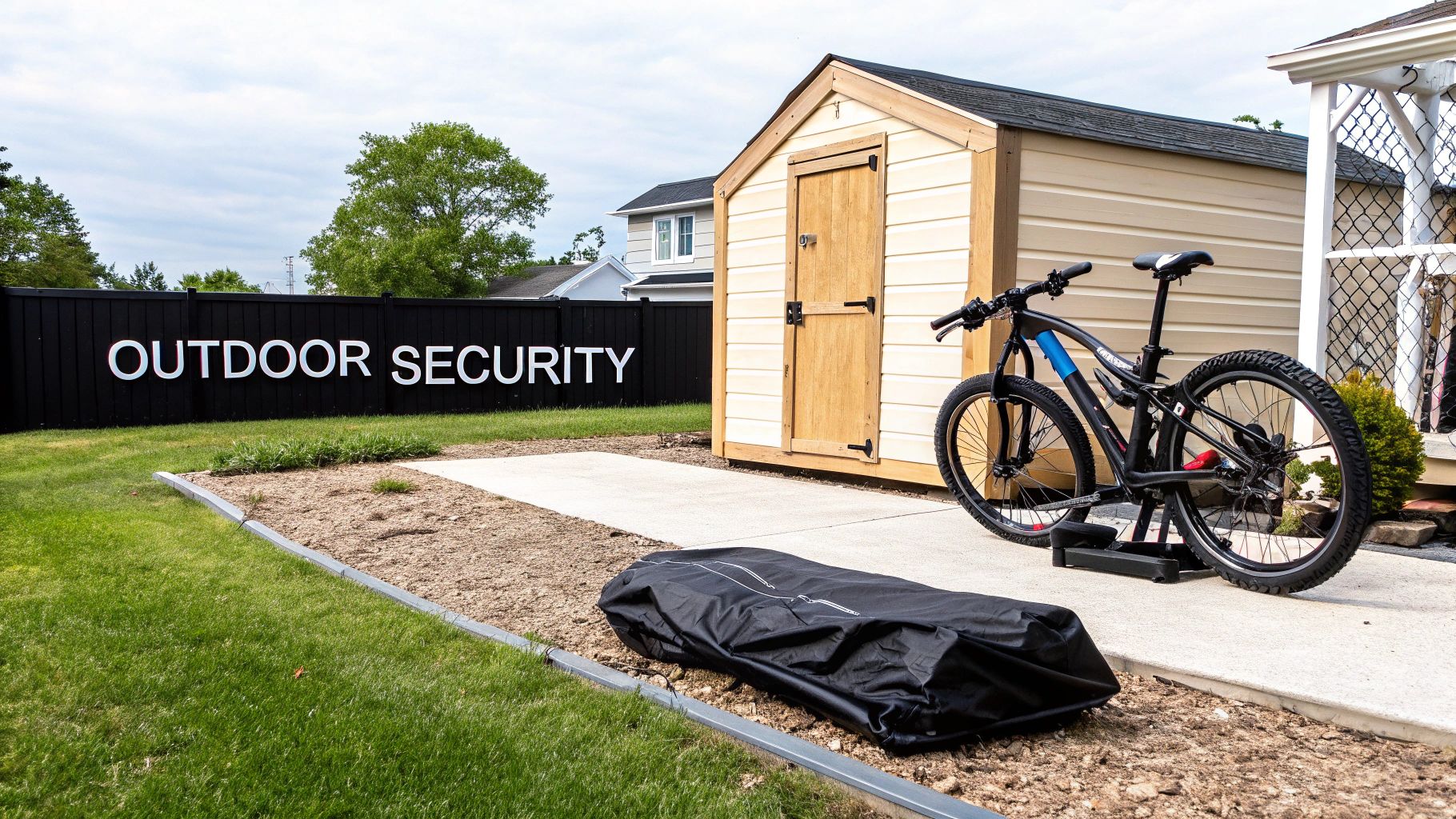
Let's be real—sometimes, keeping your e-bike inside just isn't in the cards. When your bike has to live outside, you’re suddenly fighting a war on two fronts: opportunistic thieves and the never-ending assault of the weather. Just leaving your pride and joy exposed is asking for trouble, but with the right game plan, you can turn your outdoor space into a pretty solid fortress for your ride.
Think of it this way: your mission is twofold. First, you have to protect your bike's delicate electronics and moving parts from the sun, rain, and humidity. Second, you need to make stealing it such a massive headache that any potential thief gives up and moves on. A flimsy tarp and a cheap cable lock won’t get you very far against a determined criminal or a nasty storm.
Weatherproofing Your Outdoor Setup
The elements are a silent killer for bikes. Rain and humidity will wage a constant war on your chain and gears, inviting rust. At the same time, direct sunlight can bleach your paint job and make plastic components brittle over time. Your first line of defense is a seriously good, weatherproof cover.
You'll want a cover made from a heavy-duty, UV-resistant material that is genuinely waterproof, not just "water-resistant." A quality cover should be large enough to drape over the entire bike and touch the ground, which stops moisture from sneaking in from below. The best ones even have little vents to prevent condensation from building up underneath—a lifesaver in humid climates.
If you’re looking for a more permanent solution, a dedicated bike shed or a storage tent offers a complete shield. While the goal is to keep your bike as dry as possible, it doesn't hurt to know its limits. You can get the full rundown on how water and e-bikes mix in our guide on whether e-bikes are waterproof.
Building a Layered Security System
Here’s a hard truth: any single lock can be broken by a motivated thief. Your goal isn’t to make your bike impossible to steal, but to make it so inconvenient and time-consuming that they’ll look for an easier target. This is where a "layered" approach comes in, combining strong physical locks with immovable anchors and maybe even some tech.
Your main defense is a top-tier lock. Forget those skinny cable locks; they can be snipped in seconds. You need something that laughs in the face of bolt cutters.
- Heavy-Duty U-Lock: These are the undisputed champions for a reason. Their solid, rigid shape is a nightmare for thieves to pry open or cut through.
- Hardened Steel Chain: A thick, beefy chain gives you more flexibility than a U-lock. This is great for securing your bike to bigger things, like a thick porch post or a tree.
The lock itself is only half the battle—how you use it is what really matters. Always, always lock the frame of your e-bike to something that can’t be cut, lifted, or unbolted. If your lock is long enough, weave it through the frame and the rear wheel.
Anchoring and Secondary Defenses
That "immovable object" is the absolute cornerstone of your outdoor security. If you don’t have a sturdy fence post or a solid railing handy, you might need to create one yourself. A ground anchor is a beast—it's a heavy-duty steel loop that you bolt directly into concrete. It creates an incredibly strong, permanent locking point that isn't going anywhere. This is a must-have if you use a bike shed, as it stops a thief from just picking the whole shed up.
Once your physical security is solid, think about adding some electronic backup. A motion-activated alarm is a small, cheap device that attaches to your bike and shrieks if it gets bumped, drawing instant attention. For the ultimate backup plan, a hidden GPS tracker lets you see your bike's location on your phone, giving you a fighting chance to get it back if the worst happens.
By combining a great lock, a solid anchor, and an alarm, you create a security trifecta that will send all but the most professional thieves looking elsewhere.
Essential Battery Care During Storage
Let’s be honest: your e-bike’s battery is its powerhouse. It's also the single most expensive and important part of your ride. Taking care of it properly during storage isn’t just a good idea—it’s the secret to keeping it healthy and making it last as long as possible. Think of it like a muscle; you can't just let it sit idle for months or push it to its limit and expect it to perform well.
The number one rule? Always remove the battery from the bike if you're not planning to ride for more than a few days. Just pop it out and bring it inside. Keeping it at a stable room temperature, out of direct sunlight or a frigid garage, is the single best thing you can do to protect its delicate lithium-ion cells from breaking down. This simple habit is one of the easiest and most effective electric bike storage solutions you can adopt.
The Goldilocks Zone for Battery Charge
When you're stashing your battery away for a while, its charge level is everything. Leaving it at 100% or letting it drop to zero are two of the fastest ways to permanently wreck its capacity. Both of those extremes put a ton of stress on the battery's internal chemistry, which ultimately shortens its lifespan and reduces how many charge cycles you'll get out of it.
The sweet spot—the battery's happy place—is somewhere between 40% and 60% charge. This half-full state minimizes stress and dramatically slows down the natural aging process.
- Fully Charged (100%): Storing a battery at full charge is like holding a rubber band stretched out for months on end. Over time, it loses its snap. The same thing happens to your battery’s ability to hold a charge.
- Fully Depleted (0%): A totally dead battery is even worse. It risks falling into a "deep discharge" state, a point of no return from which it might never wake up.
A battery stored the right way can stay in great shape for years. One that’s neglected can lose a huge chunk of its capacity in just one off-season. That's why minding the charge level is so critical to protecting your investment.
Long-Term Storage and Safety Protocols
If you're storing your bike for a longer stretch, like over the winter, you can't just set the battery aside and forget about it. Even when it’s not being used, it will slowly lose its charge. To keep it from dropping into the danger zone, make a point to check the charge level every 4-6 weeks. If you see it’s dipped below 40%, just plug it in for a little bit to get it back into that ideal storage range.
Our guide on how long e-bike batteries last goes into even more detail on getting the most out of your battery's lifespan.
Safety during charging is just as crucial. Always, always use the original charger that came with your e-bike. Third-party chargers might not have the right voltage or safety cutoffs, which is a recipe for disaster. And try to avoid using extension cords, as they can cause voltage drops that lead to overheating. For those who want a truly dedicated and secure setup, it's worth looking into specialized lithium-ion battery charging safety cabinets.
This focus on proper care is more important than ever. E-bikes are a huge part of how we get around now—the market was valued at USD 61.89 billion in 2024 and is expected to climb to USD 113.64 billion by 2030. As more people start riding, the need for smart, safe storage and charging solutions becomes critical for everyone. You can explore more e-bike market insights at Grand View Research.
How to Choose the Right Storage for Your Lifestyle
With so many e-bike storage options out there, it’s easy to get overwhelmed. The trick is to stop focusing on the rack itself and start thinking about your actual life—your home, your bike, and your daily routine. What works for a suburban homeowner with a spacious garage is going to be totally wrong for an urban commuter in a tiny studio apartment.
Think of it like a puzzle. Your specific needs are one piece, and the storage options are the other. When you connect them correctly, you’ll find a solution that doesn’t just work but actually makes your life as a rider easier.
For the Urban Commuter in a Small Apartment
When you’re living in an apartment or any home where space is tight, your floor is prime real estate. The best strategy here is to go vertical. A vertical wall-mounted rack is a game-changer, hoisting your e-bike up and out of the way and turning an unused patch of wall into a smart storage spot.
Some of the best models even have a pivoting feature, letting you swing the bike flat against the wall to maximize every last inch. If drilling holes isn't an option, a freestanding gravity stand is a fantastic alternative for renters. It just leans against the wall, using your bike's own weight to stay stable, all without leaving a single mark.
For the Suburban Homeowner with a Garage
A garage gives you plenty of options, but it can also become a black hole of clutter if you’re not careful. For the ultimate space-saving hack, look into a ceiling hoist system. These use a simple pulley setup to lift your e-bike right up to the rafters, keeping your floor completely clear for your car, workbench, or other gear.
The best part? The pulleys give you a mechanical advantage, making it surprisingly easy to lift a heavy, 70-pound e-bike. If you’d rather have quicker access, a heavy-duty wall rack bolted securely into the studs is always a reliable choice. To really level up your security, consider installing a ground anchor into the concrete floor. It gives you an immovable object to lock your bike to, which is a major deterrent for thieves.
For the Off-Road Enthusiast with a Heavy Bike
Let's be honest, those beefy off-road and fat-tire e-bikes are in a different weight class. They’re heavier and bulkier, and they demand a storage solution that's just as tough. Often, the simplest and most effective choice is a sturdy floor stand designed specifically for wider tires—no lifting required, you just roll the bike right into place.
If you’re set on a wall or ceiling mount, you absolutely have to check the weight capacity. Your bike could easily top 80 pounds, so always pick a rack that’s rated for well more than your bike’s actual weight. You need that extra safety margin.
This flowchart breaks down the essentials for proper battery care, whether you’re storing it overnight or for the whole winter.
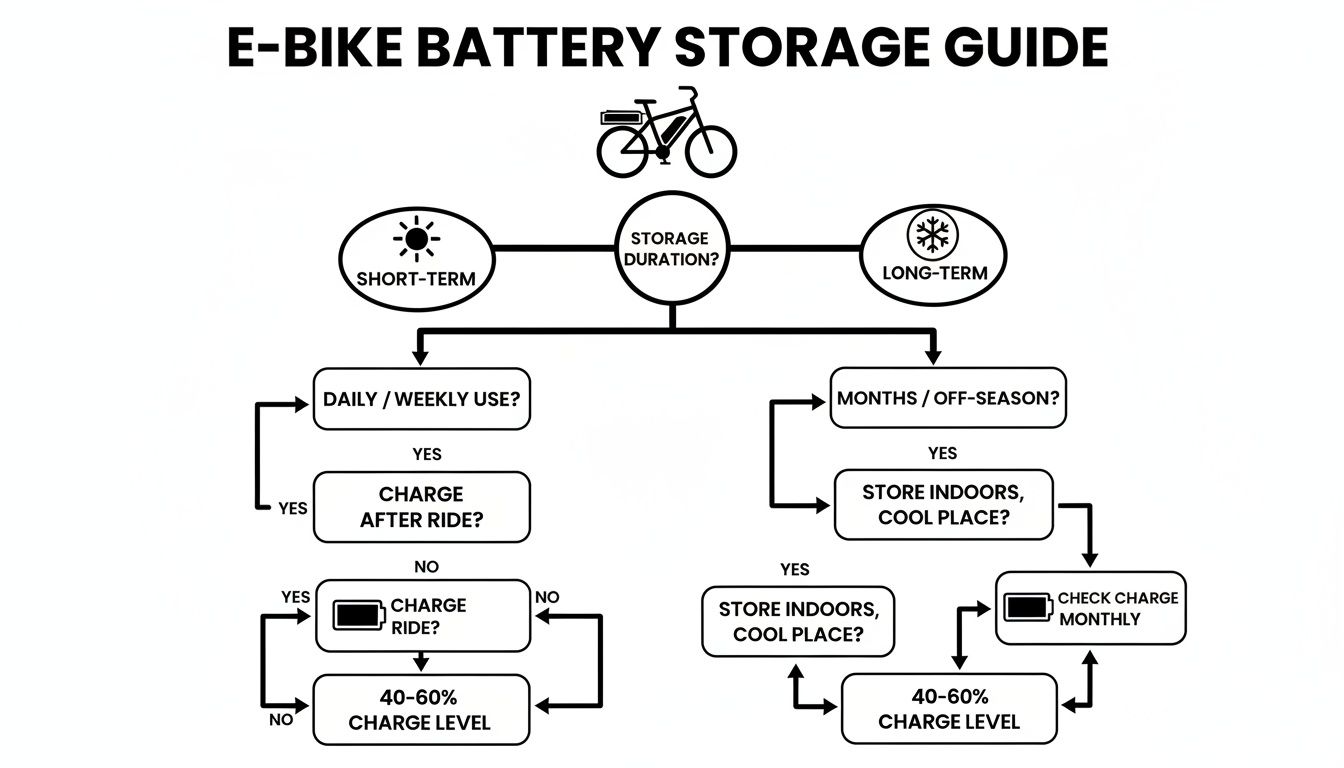
As you can see, keeping your battery’s charge between 40-60% is the sweet spot for preserving its long-term health, no matter how long you store it. This is especially important for bigger bikes like cargo models, which are becoming more and more popular.
The global electric cargo bike market was valued at USD 2.41 billion in 2024 and is on track to hit USD 4.62 billion by 2030. However, this growth is being held back by a real-world problem: a lack of specialized parking and charging infrastructure. You can discover more insights about the electric cargo bike market from TechSci Research.
Your Top E-Bike Storage Questions, Answered
Once you've got your e-bike, a whole new set of questions pop up. It's not just about riding; it's about protecting your investment. How do you store it? What's the deal with the battery? Getting these things right is key to keeping your bike safe and ready to roll for years.
Let's cut through the noise and get straight to the answers every new e-bike owner asks.
Can I Just Use a Regular Bike Rack for My E-Bike?
This is a big one, and the short answer is a hard no. Your standard bike rack is built for a regular bike that weighs maybe 20-30 pounds. Your e-bike, with its motor and battery, is a different beast entirely, often tipping the scales at 50 to 80 pounds.
Putting that much weight on a rack not designed for it is asking for trouble. It's a huge safety hazard that could lead to the rack failing, sending your bike crashing down. Always, always check that any rack—whether for your car or your garage—is specifically rated for the heavy-duty weight of an e-bike.
How Do I Store My E-Bike Battery Over the Winter?
Cold weather and e-bike batteries do not mix. First things first: take the battery off the bike and bring it inside. Find a spot that's dry, out of the sun, and stays at a comfortable room temperature. Freezing temperatures can permanently zap the life out of the battery's cells.
Second, don't store it at 100% charge, but don't let it die completely either. The sweet spot for long-term storage is a charge level between 40% and 60%. It’s a good idea to check on it every month. If it dips below that 40% mark, just give it a little boost to get it back in that happy zone.
Think of it this way: Proper battery care is the single most important thing you can do for your e-bike's health. A little attention goes a long way and ensures you get consistent power season after season. Neglect it, and you could see a major drop in performance after just one winter.
Is Anchoring My Outdoor Bike Shed Really Necessary?
Yes, 100%. A shed is great for keeping rain and sun off your bike, but if it isn't bolted down, it’s not much of a security feature. A determined thief can often just lift or tip over a lightweight shed to get to what's inside, completely bypassing the lock on the door.
To make it secure, you have to anchor the shed to a solid base, like a concrete slab. For an extra layer of security, install a ground anchor inside. This gives you an unbreakable point to lock your bike's frame to, making it incredibly difficult for anyone to walk away with it. Combining an anchored shed with a solid lock is the foundation of smart outdoor electric bike storage solutions.
Ready to ride with confidence? eBike Gang, LLC offers a powerful lineup of electric bikes and dirt bikes built for performance and backed by exceptional support. Explore our models and find your perfect ride today at https://ebikegang.com.